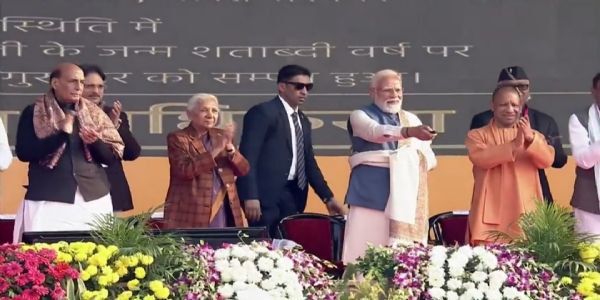
New Delhi/Lucknow, 25 December (H.S.): Prime Minister Narendra Modi on Thursday inaugurated the Rashtra Prerna Sthal in Lucknow, Uttar Pradesh, a grand national memorial built in honour of former Prime Minister and Bharat Ratna Atal Bihari Vajpayee.
Speaking at the ceremony on the occasion of Vajpayee’s 101st birth anniversary, the Prime Minister described the new complex as a symbol of inspiration embodying India’s vision of self-respect, unity, and public service.
Extending Christmas greetings to the nation and the world, PM Modi remarked that festivals like Christmas celebrate the values of joy, compassion, and shared humanity—principles that align with India’s inclusive traditions. The Prime Minister noted that December 25 holds deep significance for India, marking the birth anniversaries of Atal Bihari Vajpayee, Bharat Ratna Pandit Madan Mohan Malaviya, and Maharaja Bijli Pasi, each of whom contributed immensely to the country’s unity and identity.
PM Modi recalled how Atal ji, as Prime Minister in 2000, had issued a postage stamp in honour of Maharaja Bijli Pasi, whose legacy of valour and social inclusiveness continues to inspire generations. He paid tributes to Mahamana Malaviya ji, Atal ji, and Bijli Pasi ji, acknowledging their enduring influence on India’s national spirit.
Monument of Modern Inspiration
The Prime Minister described the Rashtra Prerna Sthal as a national memorial of leadership, unity, and vision, featuring towering 65-foot bronze statues of Dr. Syama Prasad Mookerjee, Pandit Deendayal Upadhyaya, and Atal Bihari Vajpayee, symbolizing their monumental contributions to nation-building.
Built on a reclaimed site that once housed mounds of waste spread across more than 30 acres, the project has transformed the area into a landmark of civic renewal and collective effort.PM Modi praised the artisans, architects, and planners of the project and congratulated Chief Minister Yogi Adityanath and his team for executing the development over three years.
Quoting Vajpayee’s words, he underlined that the memorial conveys a clear message — that every effort must be dedicated to nation-building, and that “Sabka Prayas” (everyone’s effort) will lead India to the goal of “Viksit Bharat” (Developed India).
Legacy of Visionary Leaders
Highlighting the life and ideals of Dr. Syama Prasad Mookerjee, the Prime Minister recalled his decisive role in preserving India’s unity. “It was Dr. Mookerjee who rejected the idea of two constitutions, two symbols, and two prime ministers in one nation,” PM Modi said. He reaffirmed that by abrogating Article 370, his government ensured that the Constitution of India now applies fully in Jammu and Kashmir.
As India’s first Industry Minister, PM Modi noted, Dr. Mookerjee laid the foundations of industrial policy and economic self-reliance, giving rise to India’s modern manufacturing landscape. “Today, Make in India has taken that very vision to new heights,” the Prime Minister said, citing the ‘One District, One Product’ campaign and the ongoing creation of a Defense Industrial Corridor in Uttar Pradesh.
He shared that the BrahMos missile, whose capabilities were showcased during Operation Sindoor, is now being manufactured in Lucknow, stressing that the day is not far when Uttar Pradesh will gain global recognition for defense production.
From Antyodaya to Saturation Governance
PM Modi then paid homage to Pandit Deendayal Upadhyaya, the proponent of the philosophy of Antyodaya and Integral Humanism, who believed that India’s progress must be measured by “the smile on the face of the person standing last in the queue.”
“We have expanded Antyodaya into a new dimension of saturation — a guarantee that every deserving citizen, without discrimination, receives every government benefit,” the Prime Minister stated. He emphasized that true good governance, social justice, and secularism exist when development reaches every home and citizen equitably.
Achievements in Inclusive Welfare
Underlining the scale of welfare reforms,PM Modi said that millions of poor families are now receiving housing, toilets, electricity, tap water, gas connections, free ration, and free healthcare—many for the first time. “When we reach the last person, we fulfill the dream of Pandit Deendayal ji,” he remarked.
Elaborating on India’s social transformation, he said: “Within a decade, crores of Indians have emerged from poverty because this government prioritized the last person.” Before 2014, around 25 crore citizens were covered under social security; today, that number has crossed 95 crore, including a vast majority in Uttar Pradesh.
He highlighted the success of schemes like the Pradhan Mantri Jeevan Jyoti Bima Yojana, providing ₹2 lakh life insurance at a minimal premium, now covering over 25 crore beneficiaries, and the Pradhan Mantri Suraksha Bima Yojana, which has insured nearly 55 crore citizens. Combined, these schemes have already provided payouts of nearly ₹25,000 crore, giving timely relief to families across India.
Continuing Atal Ji’s Legacy of Good Governance
Calling Atal Bihari Vajpayee the architect of modern governance,PM Modi said that his predecessor turned slogans into action. “While others spoke of eradicating poverty, Atal ji brought real governance to the ground,” he said.PM Modi cited infrastructure and digital revolutions that trace their roots to Vajpayee’s leadership — from Aadhaar’s conceptual origins to telecom liberalization and the Golden Quadrilateral project. “Atal ji’s telecom policy democratized connectivity; today India is among the world’s top users of mobile and internet,” said PM Modi.
He added with pride that India is now the world’s second-largest mobile phone manufacturer, with Uttar Pradesh leading the country in production. He further noted that it was Atal ji who launched the Delhi Metro and the Pradhan Mantri Gram Sadak Yojana, which has built nearly 8 lakh km of rural roads, including 4 lakh km in the past eleven years under the current government.
“Today, Uttar Pradesh is known as the expressway state of India,” he added.
Honouring Every Architect of India’s Nationhood
The Prime Minister reflected on India’s long-standing tendency after independence to attribute all national progress to a single family. “Our party has freed the nation from this mindset,” he asserted, explaining that the BJP governments now honour every leader who served India selflessly.He cited examples — the statue of Netaji Subhas Chandra Bose at Kartavya Path, the renaming of an Andaman island after him, the memorials of Babasaheb Ambedkar (Panch Teerth) rebuilt from Delhi to London, and the world’s tallest statue of Sardar Vallabhbhai Patel in Gujarat’s Ekta Nagar, now the venue for National Unity Day.
He also mentioned the government’s efforts to honour tribal leaders and lesser-known freedom fighters, including Bhagwan Birsa Munda’s memorial, the Shaheed Veer Narayan Singh Museum, and the recently built Maharaja Suheldev memorial in Uttar Pradesh. “From Raja Mahendra Pratap Singh to the martyrs of Chauri Chaura, their contributions are now remembered with full dignity,”PM Modi said.
Ending Political Untouchability and Promoting Respect
PM Modi criticized dynastic politics, saying it breeds insecurity and exclusivity, forcing political families to eclipse others. “Political untouchability became their weapon — and they even excluded non-family Prime Ministers from our collective memory,” he said.He reminded the audience that it was his government that created the Prime Ministers’ Museum in Delhi, giving due recognition to every Prime Minister of independent India, no matter how short their tenure.
“In the last 11 years, our government has bestowed national honours like the Bharat Ratna on leaders such as P.V. Narasimha Rao ji and Pranab Mukherjee ji — respect once denied by previous regimes. We’ve even honoured leaders like Mulayam Singh Yadav ji and Tarun Gogoi ji with national awards,” PM Modi said.
“The values of our party teach respect for all, not exclusion.”
Uttar Pradesh: From Challenges to Aspirations
As a Member of Parliament from Uttar Pradesh, the Prime Minister expressed pride in the state’s transformation. “Once discussed for its law-and-order problems, Uttar Pradesh is now recognized for development,” he said.He cited the Ram Mandir in Ayodhya, the Kashi Vishwanath Dham in Varanasi, and now the Rashtra Prerna Sthal in Lucknow as projects that reflect the state’s spiritual revival and modern progress.
“These developments have placed Uttar Pradesh on India’s tourism and industrial map,” he said, adding that the state’s hardworking people are scripting a new model of growth, good governance, and social justice.
Monument of National Inspiration
Developed under the Prime Minister’s vision to celebrate India’s iconic leaders, the Rashtra Prerna Sthal is a 65-acre national inspiration complex built at a cost of approximately ₹230 crore. It features a state-of-the-art museum spread over nearly 98,000 square feet, designed in the shape of a lotus, symbolizing purity and enlightenment.
Through interactive exhibits and advanced digital displays, the museum chronicles India’s democratic journey, showcasing the contributions of nation-builders such as Dr. Mookerjee, Pandit Upadhyaya, and Atal Bihari Vajpayee. The memorial is envisioned as a permanent national asset, promoting values of leadership, unity, service, and civic responsibility.
A New Chapter for a Developed India
Concluding his address, PM Modi said that Rashtra Prerna Sthal will continue to inspire generations, reminding citizens that selfless service and collective effort are the cornerstones of a developed and united India. “Let this site of inspiration keep motivating us to realize the dream of a prosperous, inclusive, and self-reliant nation,” he said.
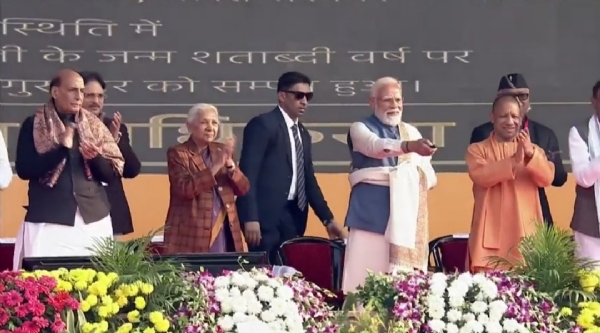
The event was attended by Uttar Pradesh Governor Anandiben Patel, Chief Minister Yogi Adityanath, and senior Union Ministers including Rajnath Singh and Pankaj Chaudhary, along with several dignitaries and citizens.
---------------
Hindusthan Samachar / Jun Sarkar