New Delhi, 22 June (H.S.):
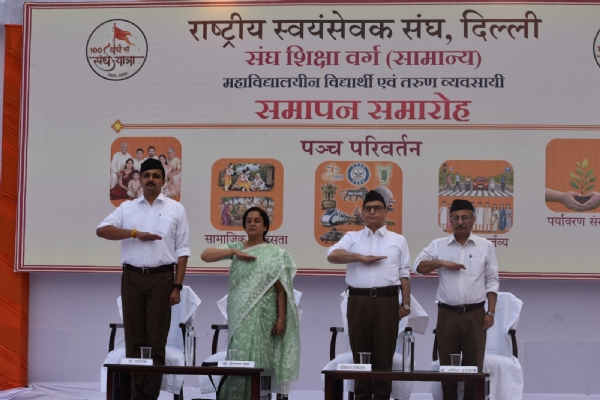
Harishchandra, Intellectual Training Head of the North Zone of the Rashtriya Swayamsevak Sangh (RSS), called upon volunteers and people from all sections of society to embrace the principles of 'Panch Parivartan' (Five Transformations) in their daily lives. He said that a strong, cultured, and self-reliant society can be built only by putting into practice values such as social harmony, family awareness, an environmentally sustainable lifestyle, the fulfilment of civic responsibilities, and commitment to Swadeshi (self-reliance in indigenous products and practices).
Harishchandra was addressing the valedictory ceremony of the Sangh Shiksha Varg (General) for college students and young professionals, organised by the Delhi Prant unit of the RSS. The event was held at Lalit Mahajan Saraswati Vidya Mandir in Vasant Vihar, South-West Delhi, with Dr. Shailaja Gupta, Chief Project Director of INDSEPI, attending as the chief guest.
According to information released by the Indraprastha Vishwa Samvad Kendra, 159 trainees from different parts of Delhi Prant participated in the 15-day training camp. During the programme, participants received practical and ideological training focused on physical fitness, mental resilience, ideological clarity, discipline, leadership skills, and social responsibility.
In his address, Harishchandra elaborated on the life, national vision, and organisational philosophy of RSS founder Dr. Keshav Baliram Hedgewar. He said Dr. Hedgewar's national outlook was enriched by diverse experiences. While pursuing his MBBS degree in Calcutta (now Kolkata), he came into contact with revolutionary organisations such as the Anushilan Samiti and gained a close understanding of various streams of India's freedom movement. He also remained associated with the activities of the Indian National Congress. These experiences, he said, broadened Dr. Hedgewar's nationalist vision and led him to conclude that nation-building begins with character-building.
He said that ever since its establishment, the RSS has considered personality development and social organisation as the foundation of its work. According to the Sangh, when individuals develop character, discipline, self-confidence, and dedication to the nation, society becomes organised and the nation grows stronger. He emphasised that the creation of individuals endowed with strong character, high moral values, and unwavering patriotism is the true foundation of national progress and development.
Highlighting the organisation's current expansion, Harishchandra said that more than 83,000 RSS shakhas are now conducted regularly across the country. In addition, over 177,000 service projects are being carried out in areas such as education, healthcare, rural development, social harmony, and public welfare. He added that more than 21,000 trainees have undergone training in various RSS camps this year, reflecting the organisation's expanding reach and growing social acceptance.
Speaking about the RSS's organisational culture and working style, Harishchandra said that the Sangh has never raised slogans glorifying its own organisation. Instead, it has always accorded the highest place to the slogan Bharat Mata Ki Jai. He said this reflects the Sangh's belief that it does not consider itself above the nation or society, but merely a medium for serving the national interest.
Harishchandra further said that the RSS does not believe in claiming credit for its work. Positive social transformation, he noted, becomes possible only through the collective efforts of responsible, aware, and patriotic sections of society. Therefore, the true credit for any achievement belongs to society itself. He added that if any organisation begins placing itself at the centre of recognition, it risks deviating from its core ideology and organisational culture. According to him, the awakened and organised strength of society is the RSS's greatest achievement and source of credibility.
Calling upon volunteers to play an active role in society, Harishchandra said that any task undertaken with complete dedication, focus, and commitment is bound to succeed. He urged volunteers to become agents of positive social transformation and actively contribute to the process of nation-building.
Chief guest Dr. Shailaja Gupta praised the disciplined functioning and training methodology of the Sangh Shiksha Varg. She said the real strength of any organisation lies in the character, discipline, punctuality, and dedication of its workers towards the national interest. If individuals learn to make effective use of time and discharge their responsibilities sincerely, they can achieve remarkable success both personally and socially.
She said that organisational unity, collective spirit, and a sense of oneness are essential for building a strong nation and society. Dr. Gupta also highly appreciated the RSS Ghosh (band), describing it as not merely a musical ensemble but a symbol of discipline, collective coordination, cultural consciousness, and national pride. She said the Ghosh helps instil uniformity, teamwork, and a strong sense of duty among volunteers.
Among those present at the programme were Delhi Prant Sanghchalak Dr. Anil Agrawal, Camp Director Dr. Shashank, along with several senior RSS office-bearers, volunteers, and trainees.
Notably, the tradition of the Sangh Shiksha Varg began in 1927. Initially known as the Adhikari Shiksha Varg (Officers' Training Camp), it was renamed Sangh Shiksha Varg in 1950. From 2024 onwards, the format was revised, reducing the training duration to 15 days. During the camp, trainees receive practical instruction in community living, discipline, leadership, social harmony, and organisational functioning to prepare them to play a constructive and positive role in society.
---------------
Hindusthan Samachar / Jun Sarkar