New Delhi, 10 June (H.S.): The rejection of Congress candidate Meenakshi Natarajan’s nomination for the June 18 Rajya Sabha election in Madhya Pradesh has triggered a political and legal controversy, with the Congress party describing the decision as unlawful and contrary to democratic principles. The party has urged the Election Commission of India to intervene immediately and review the matter.
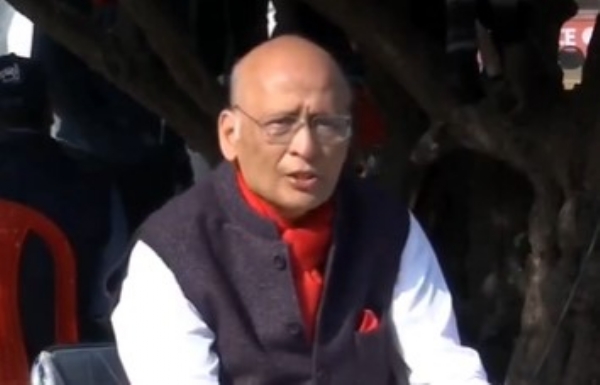
Congress leader and head of the party’s Legal Affairs, Right to Information (RTI), and Human Resources departments, Abhishek Manu Singhvi, stated that no criminal case is legally pending against Meenakshi Natarajan and, therefore, there was no valid legal basis for rejecting her nomination. He questioned the Returning Officer’s decision and described it as a misinterpretation of the law.
In a video message shared on social media platform X by Congress National Secretary and Communication, Campaign and Media Department head Ruchira Chaturvedi, Singhvi said that although he is currently abroad, he had spoken in detail with Natarajan and senior Congress leaders regarding the issue. He expressed surprise that the Returning Officer had rejected her nomination despite the absence of any criminal case that legally required disclosure in the nomination papers.
Singhvi explained that a private complaint filed by an individual cannot be treated as a criminal case unless the concerned magistrate or court formally takes cognisance of the matter. He said that in Natarajan’s case, only a notice had been issued and the court had not yet taken cognisance. Therefore, treating the matter as a pending criminal case was contrary to established judicial principles and legal procedures.
He further noted that Indian jurisprudence and various High Court rulings clearly establish that the issuance of a notice alone does not constitute proof of a pending criminal prosecution. According to Singhvi, Congress had presented this legal position before the Returning Officer, yet the nomination was rejected.
Alleging a lack of independent and impartial consideration, Singhvi said the Returning Officer failed to adopt an objective approach. He argued that a fair assessment of the facts and applicable law would not have justified rejection of the nomination. He appealed to the Election Commission to exercise its constitutional and administrative powers to review and overturn the decision.
On Tuesday, Returning Officer Arvind Sharma accepted an objection filed by the Bharatiya Janata Party (BJP) and rejected Natarajan’s nomination. The BJP alleged that she had failed to disclose details of a pending case in Telangana, information that it claimed was required under election rules.
Congress, however, maintains that no First Information Report (FIR) had been registered in the matter and that no court had taken cognisance of the complaint. The party stated that only a legal notice had been issued, to which Natarajan had responded appropriately, making disclosure in the nomination form legally unnecessary.
Following the rejection, Meenakshi Natarajan accused the BJP of exerting political pressure. She said the BJP had fielded a third candidate despite lacking adequate numerical strength and claimed Congress had anticipated attempts to disrupt the electoral process. According to her, once the BJP realised Congress legislators remained united, her nomination was challenged on the basis of a legal notice.
Congress MP Vivek Tankha also criticised the decision, stating that the issue involved only a civil notice concerning an alleged compensation claim of ₹10 crore, to which a response had already been submitted. He described the rejection as legally weak.
Congress General Secretary K.C. Venugopal called the development an attack on democracy and alleged that the Election Commission did not even permit a Congress delegation to present its case. He said the episode raised serious concerns about democratic values and the fairness of the electoral process.
Politically, the decision could significantly affect the Rajya Sabha election. If Congress fails to secure relief from either the Election Commission or the Supreme Court, all three vacant Rajya Sabha seats from Madhya Pradesh could be won unopposed by BJP candidates. While the victories of BJP nominees Tarun Chugh and Rajneesh Agrawal are already considered likely, the candidature of Mahesh Kewat has added a new political dimension to the contest.
Notably, anticipating the possibility of cross-voting or political defections, Congress had already moved its legislators to Bengaluru. The party is now preparing to challenge the decision through both legal and political channels.
---------------
Hindusthan Samachar / Jun Sarkar

10 Jun 2026