Jammu, 30 April (H.S.):
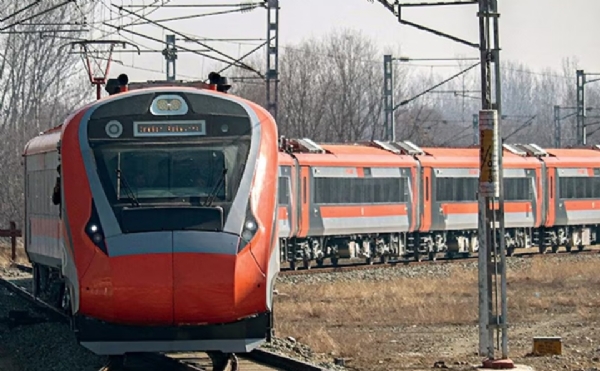
Jammu and Srinagar, the winter and summer capitals of Jammu and Kashmir, have today been directly linked by rail for the first time. With this milestone, the carrying capacity of the Vande Bharat Express trains serving Srinagar has been increased two‑and‑a‑half‑fold, making tickets more easily available for tourists, pilgrims and the local population. The Vande Bharat Express train to Srinagar was flagged off from Jammu Railway Station at a function attended by Jammu and Kashmir Chief Minister Omar Abdullah, Union Railway, Information and Broadcasting, Electronics and Information Technology Minister Ashwini Vaishnaw, Minister of State in the Prime Minister’s Office Dr. Jitendra Singh, and local representatives.
The Vande Bharat Express trains numbered 26401/26402 and 26403/26404, originally launched by Prime Minister Narendra Modi last year between Shri Mata Vaishno Devi Katra and Srinagar, have now been extended to terminate at Jammu Tawi. The corridor spans approximately 266 kilometres, with regular services set to begin on 2 May 2026. Earlier, these trains operated with eight‑coach rakes; they are now being run with 20‑coach rakes, raising their capacity by two‑and‑a‑half times.
Train 26401 will depart Jammu Tawi at 6:20 a.m., halt at Shri Mata Vaishno Devi Katra, Reasi and Banihal, and reach Srinagar at 11:10 a.m., covering the journey in four hours and fifty minutes. The return train, 26402, will leave Srinagar at 2:00 p.m. and arrive at Jammu Tawi at 6:50 p.m. This pair will run six days a week, with no service on Tuesdays.
The second service, train 26404, departs Srinagar at 8:00 a.m., stops at Banihal and Katra, and reaches Jammu Tawi at 12:40 p.m. Its return, 26403, will leave Jammu Tawi at 1:20 p.m. and arrive in Srinagar at 6:00 p.m. This pair will run six days a week except Wednesdays, ensuring that most days of the week offer morning and afternoon Vande Bharat options from both ends of the corridor for easier travel planning.
The Jammu–Srinagar Vande Bharat Express has been equipped with robust security arrangements. In addition to Railway Protection Force personnel on the 20‑coach rake, eight‑member commando squads specially trained to handle situations, particularly terrorist attacks, will also remain deployed.
Prime Minister Modi had earlier dedicated the Jammu–Kashmir rail link to the nation on 6 June of the previous year, marking a historic integration of the Union Territory with the rest of India’s rail network. In the same year he had also inaugurated India’s highest railway arch bridge, the Chenab Bridge, and the country’s first cable‑stayed rail bridge, the Anji Khad Bridge, near Shri Mata Vaishno Devi Katra, and flagged off the two Vande Bharat Express trains serving Srinagar. The fare for the Katra–Srinagar run is ₹715 for Chair Car and ₹1,320 for Executive Class; Jammu‑based fares have not yet been officially notified.
The new rail link between Jammu, Udhampur, Shri Mata Vaishno Devi Katra, Banihal, Srinagar and Baramulla—spanning some 324 kilometres—has cut travel time drastically. A seven‑hour road journey from Katra to Srinagar now takes about three hours by train, and all‑season connectivity between Jammu, Srinagar and Baramulla is achieved within a few hours. The regular operation of trains between Katra and Srinagar has also provided a cheaper and more convenient medium for faster movement of passengers and freight. For the Union Territories of Jammu and Kashmir and Ladakh, boxed in by adversaries on three sides, the rail link offers a secure, swift and continuous line for troop and defence‑logistics movement alongside civilian traffic.
Chenab and Anji Khad bridges—engineering feats
The 1,315‑metre‑long Chenab Arch Bridge, the world’s second‑highest railway arch bridge, stands at 359 metres above the riverbed—about 35 metres taller than the 324‑metre‑tall Eiffel Tower in Paris. The only higher railway span globally is the 275‑metre‑high Shuibai Railway Bridge over the Beipan River in China. The structure, located in a seismically active Zone‑4 area, has been built to withstand intensity‑8 quakes on the Richter scale and winds of up to 266 km/h, with wind‑speed sensors linked to a red‑signal mechanism that halts operations when winds exceed 90 km/h. The bridge is also designed to survive blasts of up to 40 kilograms of TNT, using 63‑millimetre‑thick blast‑proof steel in its piers, specially coated for durability of at least 15 years.
The 473.25‑metre‑long Anji Khad cable‑stayed bridge, India’s first of its kind, soars 331 metres above the riverbed and uses a single central pier with 96 cables to support the deck. Built in a difficult Himalayan terrain, it is engineered to withstand winds of 213 km/h and severe seismic shocks, underlining Indian Railways’ technical prowess.
The Udhampur–Srinagar–Baramulla Rail Link (USBRL) project, completed after more than four decades of work, includes 36 tunnels (stretching about 119 kilometres) and 943 bridges, with the 12.75‑kilometre‑long Tunnel T‑49 now India’s longest railway transportation tunnel. The project has cost around ₹43,780 crore and has paved the way for several new initiatives, including five additional proposed railway links—Baramulla–Uri, Sopore–Kupwara, Anantnag–Pahalgam, Awantipora–Shopian, and Banihal–Baramulla doubling—as well as a Jammu–Punch route via Akhnoor and Rajouri (223 km, estimated at ₹22,771 crore). The Shrinagar–Kargil–Leh and Jammu–Punch lines are currently stalled over viability concerns, while the strategically vital Bilaspur–Manali–Leh line, spanning some 489 km at an estimated cost of ₹1,31,000 crore, has completed its survey and DPR and is classified as a “strategic line” by the Defence Ministry.
Civil‑military and logistical benefits
The USBRL project is also of critical importance for national defence, as it creates a parallel communication and logistics line for the armed forces. Military traffic, which earlier relied heavily on time‑consuming and capacity‑limited roads, can now move faster, cheaper and more reliably by rail, even during winter or when landslides and snowfall block highways. The maintenance depot for troops and equipment can now move closer to the forward areas, shortening response times and enhancing combat readiness. Senior Army officers have noted that the rail link will ease the perennial strain of winter resupply to the high‑altitude sectors of Jammu and Kashmir and Ladakh, allowing more scope for training and operational flexibility.
---------------
Hindusthan Samachar / Jun Sarkar
30 Apr 2026