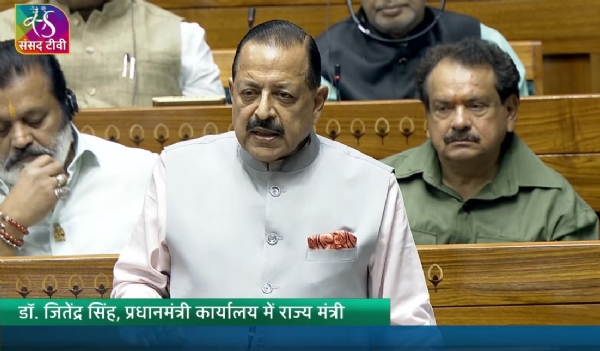
New Delhi, 29 July (H.S.): The Lok Sabha on Wednesday passed a bill seeking to make the existing law against paper leaks more stringent amid disruptions and protests in the House. The Public Examinations (Prevention of Unfair Means) Amendment Bill, 2026 was passed by voice vote.
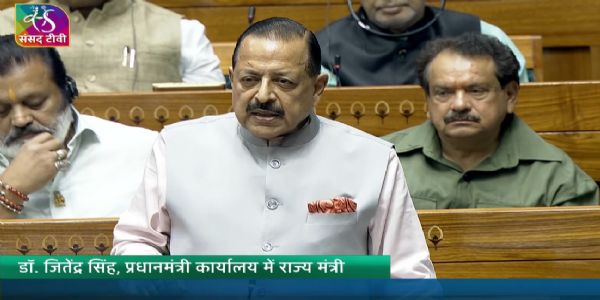
Replying to the debate on the bill, Minister of State in the Prime Minister’s Office Dr Jitendra Singh said that the government had expected constructive suggestions from members but attempts were made to politicise the issue.
Dr Singh responded to the discussion on the Public Examinations (Prevention of Unfair Means) Amendment Bill, 2026, which began in the Lok Sabha on Tuesday. After the passage of the bill, the proceedings of the House were adjourned until Thursday.
Dr Singh said that several members had presented their suggestions during the discussion on the legislation. Around 40 to 45 members participated in the debate and shared their views on various aspects of the bill. However, he expressed surprise over the conduct of the Leader of Opposition.
“We are surprised by the behaviour of the Leader of Opposition. The words used by him are not only against parliamentary decorum but also contrary to the dignity of the House and democratic traditions,” Singh said.
He stated that the Public Examinations (Prevention of Unfair Means) Act was implemented in January 2024. However, following recent incidents, the government decided to make the law more effective based on expert advice and practical experiences. He said that while the offence was already cognisable, non-bailable and non-compoundable, its provisions have now been made more stringent.
Under the amended provisions, the punishment for individuals involved in unfair practices has been increased from three to five years to five to ten years, while the maximum fine has been raised to Rs 50 lakh. The maximum penalty for service providers has been increased from Rs 1 crore to Rs 5 crore, and they can now be barred from conducting examinations for up to eight years. Penalties and punishments for directors and management personnel found guilty have also been enhanced. In cases of organised crime, the minimum punishment has been increased to seven years, with provisions for a fine of up to Rs 10 crore.
Dr Singh rejected the claim that no action had been taken after the law was enacted in 2024. He said that 52 FIRs have been registered under the Act in the last two years. Of these, 29 cases relate to prevention of unfair means, while 23 cases have been registered under various provisions of the Bharatiya Nyaya Sanhita.
Referring to the recent paper leak case, Singh said that information about the incident was received during the night of July 7 and 8. The investigation was handed over to the Central Bureau of Investigation (CBI) on July 12. The next day, 13 people were detained and raids were conducted at nearly 92 locations. According to the government, the CBI completed the investigation swiftly and filed a chargesheet, while trial proceedings under the new law have also begun, with a provision for a decision within around five months.
Highlighting achievements in the education sector under the present government, Singh said that there has been a 30 per cent increase in the sector. The number of universities has increased from 760 to 1,293, while the number of higher education institutions has risen from 51,534 to 64,896. During the same period, the government expanded Eklavya Model Residential Schools for tribal students and implemented the National Education Policy (NEP) 2020.
The Union Minister also highlighted significant expansion in medical education. He said the number of All India Institutes of Medical Sciences (AIIMS) has increased from seven to 22, while government medical colleges have risen from 387 to 844. MBBS seats have increased from around 51,300 to 1.39 lakh, while postgraduate medical seats have also witnessed substantial growth. The government said these measures would improve the availability of doctors in the country.
Singh said suicide is a sensitive issue and statistics related to such incidents should not be politicised. He claimed that suicide cases linked to paper leaks have declined in recent years. The government expressed confidence that the new and stricter law would enhance transparency in public examinations and strengthen students’ trust in the system.
On the issue of action against protesting students, Singh said security forces exercised maximum restraint throughout the operation. He said it was ensured that no loss of life occurred, and the administration’s objective was only to maintain law and order and not to harm anyone. He rejected allegations that the Home Minister had ordered firing during the student protests.
Singh said that he himself had served as an MLA and MP and was aware of administrative procedures. He stated that no minister has the authority to order firing, as such orders can only be issued by executive magistrates such as Sub-Divisional Magistrates (SDMs) or District Magistrates (DMs). He added that only tear gas was used to control the crowd.
Targeting the Congress, Singh referred to the Assam agitation and said that during the Congress government’s rule between 1969 and 1984, around 860 innocent people, mostly students, lost their lives during the All Assam Students’ Union movement.
He also criticised claims made during the debate that there had been 150 paper leaks affecting 750 crore students. Singh said such figures should not be presented without evidence and that discussions should be based on facts and verified information.
Dr Singh criticised the Leader of Opposition for staging a protest outside the Prime Minister’s residence at 7, Lok Kalyan Marg. Taking a dig at him, Singh said the move reflected frustration and disappointment, adding that since he could not become Prime Minister, he chose to sit in protest outside the Prime Minister’s residence.
---------------
Hindusthan Samachar / Jun Sarkar