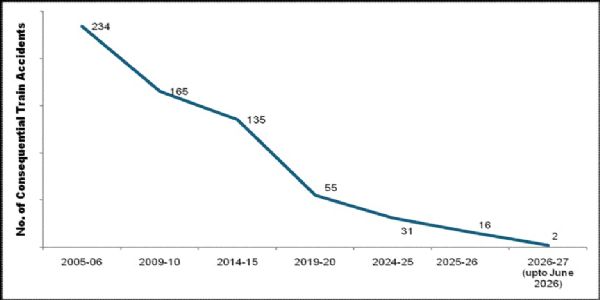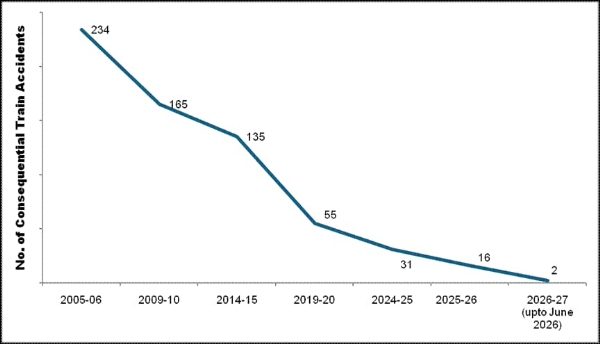
New Delhi, 29 July (H.S.): Indian Railways has said that significant improvements have been achieved in rail safety due to enhanced safety measures, modern technology, improved infrastructure, and advanced maintenance systems. Only two consequential rail accidents have been reported until June in the financial year 2026-27, compared to 135 such incidents in 2014-15. During the same period, the accident index has declined to 0.01. The Railways has successfully deployed the indigenous automatic train protection system Kavach 4.0 on 2,569 route kilometres of high-density railway corridors, including the Delhi-Mumbai and Delhi-Howrah routes.
Railway Minister Ashwini Vaishnaw, in a written reply to a question in the Lok Sabha on Wednesday, stated that the number of consequential train accidents declined to 16 in 2025-26, an 88 per cent reduction compared to 2014-15. In the ongoing financial year 2026-27, only two such accidents have occurred until June. The accident index has also declined from 0.11 in 2014-15 to 0.01 in 2025-26, reflecting a 91 per cent reduction.
He said that expenditure on railway safety has been increased continuously. The allocation, which stood at Rs 39,200 crore in 2013-14, has risen to more than Rs 1.20 lakh crore in the Budget for 2026-27. The Railways has strengthened safety systems through the installation of electronic interlocking and complete track circuiting at 6,671 stations, interlocking at 10,395 level crossings, modern railway tracks, long rail panels, ultrasonic flaw detection systems, track recording systems, and other advanced technologies.
The Railway Minister said that all unmanned railway level crossings on the broad gauge network were eliminated by January 2019. Besides, measures such as manufacturing of LHB coaches, regular inspection of railway bridges, fire safety systems, modern signalling, use of advanced track machines, and regular training of employees have also contributed to improving railway safety.
Vaishnaw explained that Kavach is an indigenous automatic train protection system developed in India. It automatically applies brakes if the locomotive pilot fails to adhere to the prescribed speed limits, thereby reducing the possibility of accidents. The Kavach version 4.0, approved in July 2024, includes enhanced features such as improved location accuracy, more precise signalling information in large railway yards, and direct coordination with electronic interlocking systems.
The Railway Minister said that as of July 20 this year, Kavach 4.0 has been successfully operationalised across 2,569 route kilometres on the country’s busiest railway corridors — Delhi-Mumbai and Delhi-Howrah. Additionally, trackside Kavach work is underway on 21,858 route kilometres. So far, 11,253 kilometres of optical fibre cable has been laid, 1,668 telecommunication towers have been installed, 988 station data centres have been developed, and 6,153 locomotives have been equipped with the Kavach system.
He added that work is also underway to install Kavach systems in 7,327 more locomotives and 1,200 EMU/MEMU train sets.
The Railway Minister further stated that more than 94,000 technicians, engineers, and operational staff have been trained in the Kavach system so far, including nearly 57,000 locomotive pilots and assistant locomotive pilots. By June this year, Rs 3,874 crore had been spent on the Kavach project, while Rs 2,066 crore has been allocated for the financial year 2026-27. The Railways said that the expansion of the Kavach project across the country is being carried out at a rapid pace.
---------------
Hindusthan Samachar / Jun Sarkar