




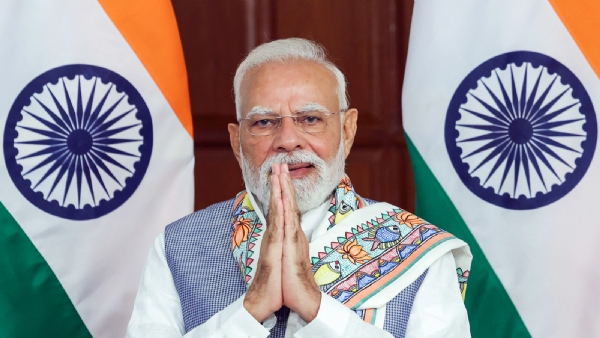
New Delhi, 17 July (H.S.): Prime Minister Narendra Modi will visit Haryana, Chandigarh and Punjab on Friday to inaugurate and lay the foundation stone for a series of major infrastructure, transport, healthcare and education projects worth over Rs 24,800 crore. During his visit, he will also flag off India's first hydrogen-powered train between Jind and Sonipat.
According to an official spokesperson, the Prime Minister will flag off the country's first hydrogen-powered train from Jind Railway Station in Haryana at around 11 a.m. At approximately 11:30 a.m., he will dedicate and lay the foundation stone for development projects worth nearly Rs 14,700 crore at Eklavya Stadium in Jind. Later in the day, he will travel to Chandigarh, where he will inaugurate and lay the foundation stone for projects worth more than Rs 4,700 crore at around 1:45 p.m. He will conclude his visit in Jalandhar, Punjab, by launching development projects valued at over Rs 5,470 crore.
Haryana Programme
The Prime Minister will flag off India's first hydrogen-powered train operating between Jind and Sonipat, marking a significant step towards clean and sustainable transportation in the railway sector. Designed, engineered and integrated entirely in India, the train has been developed using indigenous technology, reflecting the country's growing capabilities in advanced railway engineering. With its launch, India will join a select group of nations operating hydrogen-powered trains.
The train uses hydrogen fuel cell technology, which converts hydrogen into electricity to power the locomotive. The only by-product of this process is water vapour, resulting in zero carbon emissions during rail operations. Compared to diesel-powered trains, it eliminates tailpipe emissions, reduces dependence on fossil fuels and fuel imports, and significantly lowers noise levels. Unlike conventional electric trains, it does not require continuous overhead electrification because electricity is generated onboard through hydrogen fuel cells. The use of green hydrogen also reduces reliance on electricity generated from fossil fuel-based thermal power plants, supporting India's transition towards sustainable transportation.
The train consists of ten coaches, making it one of the longest hydrogen-powered passenger trains developed anywhere in the world. It is powered by a 3,200-horsepower propulsion system, making it among the most powerful hydrogen-powered passenger trains currently in operation.
The Prime Minister will also dedicate and lay the foundation stone for National Highway projects in Haryana worth over Rs 12,470 crore.
He will dedicate to the nation the 157.92-kilometre, four-lane, fully access-controlled Delhi-Amritsar-Katra Expressway (Packages 1 to 5), developed at a cost of about Rs 9,680 crore. The Greenfield corridor forms part of the 667-kilometre Delhi-Amritsar-Katra Expressway. Once fully operational, it is expected to reduce travel time between Delhi and Katra from around 14 hours to nearly six hours, while the journey between Delhi and Amritsar will be shortened from about eight hours to four hours. The project is also expected to ease congestion on NH-44 (GT Road), boost pilgrimage and tourism to Shri Mata Vaishno Devi, and accelerate industrial and logistics development along the corridor.
The Prime Minister will inaugurate the 33.81-kilometre, four-lane, partially access-controlled Ambala-Kala Amb Highway on National Highways 7 and 344. The project will strengthen connectivity between Ambala city and the Kala Amb industrial area, improve road connectivity between Haryana and Himachal Pradesh, facilitate tourism to hill destinations, and reduce logistics costs for industries in the Kala Amb region.
He will also inaugurate the 40.60-kilometre Jind-Gohana Greenfield Highway on National Highway 352A. The highway will reduce travel time between Jind and Gohana from nearly two hours to just 40 minutes, benefiting commuters, freight transport and the agriculturally significant Jind-Gohana region while improving connectivity with Rohtak, Panipat and the Delhi-NCR region.
The Prime Minister will lay the foundation stone for the 24.27-kilometre Hansi-Barwala Brownfield Highway project, under which the existing road will be upgraded into a two/four-lane highway with paved shoulders.
He will dedicate the elevated railway track at Kurukshetra to the nation. The major urban infrastructure project is expected to eliminate longstanding traffic congestion at railway crossings, improve road safety, facilitate smoother vehicular movement, and enhance the operational efficiency of both rail and road transport.
The Prime Minister will also dedicate major medical institutions to the nation, including Pandit Nekiram Sharma Government Medical College in Bhiwani, Maharshi Chyawan Medical College, and Rao Tula Ram Hospital at Koriawas in Narnaul. These institutions are expected to strengthen medical education, increase MBBS seats, improve the availability of specialist healthcare professionals, provide better healthcare closer to people's homes, and reinforce Haryana's healthcare system.
He will also lay the foundation stone for the Sikh Museum at Kurukshetra. The museum will showcase the history of Sikhism, the teachings of the Sikh Gurus, their courage and sacrifices, and the invaluable contribution of the Sikh community to India's civilisation and culture through the use of modern technology.
Chandigarh Programme
Prime Minister Modi will inaugurate and lay the foundation stone for projects worth over Rs 4,700 crore related to healthcare, education and road infrastructure.
He will inaugurate the Advanced Mother and Child Centre and the Advanced Neurosciences Centre at the Post Graduate Institute of Medical Education and Research (PGIMER), Chandigarh. The Advanced Mother and Child Centre has been designed to provide comprehensive tertiary healthcare services for high-risk pregnancies, critically ill newborns and children requiring specialised treatment. Equipped with 300 beds and state-of-the-art medical facilities, it will significantly strengthen maternal and child healthcare services and benefit thousands of families across the region.
The Advanced Neurosciences Centre will integrate neurology, neurosurgery, neuro-critical care and advanced diagnostic facilities under one roof, ensuring timely and world-class treatment for patients suffering from complex neurological disorders while strengthening medical research, education and training in neuroscience.
The Prime Minister will also lay the foundation stone for a 150-bed state-of-the-art Critical Care Block at PGIMER under the Pradhan Mantri Ayushman Bharat Health Infrastructure Mission (PM-ABHIM). The facility will significantly enhance emergency preparedness, intensive care services and disaster response capabilities while strengthening the region's healthcare infrastructure.
He will inaugurate and lay the foundation stone for several educational infrastructure projects, including the Kurukshetra Boys' Hostel and Mess at Punjab Engineering College, a hostel block at Government College, Sector 46, and a Research Scholars' Hostel at Punjab Engineering College. These facilities will strengthen academic infrastructure, improve residential accommodation for students and researchers, and create a better environment for higher education.
To improve regional mobility, the Prime Minister will inaugurate the six-lane Greenfield Highway connecting IT City in Mohali district with Kurali. The highway will reduce travel time between Mohali, Kharar and Kurali while improving connectivity between Punjab, Haryana, Himachal Pradesh and Jammu & Kashmir.
He will also lay the foundation stone for the PR-7 Spur of the Ambala-Chandigarh Greenfield Highway (NH-205A). The 10.3-kilometre Greenfield corridor will allow long-distance traffic to bypass Zirakpur's urban areas and provide direct connectivity between the Zirakpur Bypass and Chandigarh Aerocity.
Jalandhar Programme
Prime Minister Modi will inaugurate and lay the foundation stone for railway and road infrastructure projects worth over Rs 5,470 crore aimed at strengthening connectivity, improving passenger convenience and accelerating economic growth.
He will inaugurate 75 redeveloped railway stations, including Jalandhar Cantonment, under the Amrit Bharat Station Scheme. Spread across 20 states, these stations represent another major milestone under one of the world's largest railway station redevelopment programmes. Developed at a cost of around Rs 1,570 crore, the stations have been transformed into modern, passenger-friendly facilities while incorporating elements reflecting local culture, heritage and architecture under the theme of Heritage as well as Development.
The Prime Minister will also inaugurate the Daulatpur Chowk-Kartoli new railway line, built at a cost of around Rs 830 crore as part of the Nangal Dam-Talwara-Mukerian New Rail Line Project. The project will significantly strengthen rail connectivity between Punjab and Himachal Pradesh, benefiting Hoshiarpur and Una districts. It will also improve access to important religious destinations such as Shri Anandpur Sahib and Maa Chintpurni Temple by providing faster, safer and more reliable rail transport.
He will flag off the Kartoli-Ambala rail service, enhancing connectivity across Punjab, Haryana and Himachal Pradesh. The Prime Minister will also flag off the Amritsar (Chheharta)-Varanasi rail service, establishing direct rail connectivity between two of India's most significant spiritual and cultural centres.
To further strengthen Punjab's road infrastructure, the Prime Minister will inaugurate and lay the foundation stone for National Highway projects worth over Rs 3,070 crore.
He will inaugurate the 30.9-kilometre Package-6 of the four-lane New Delhi-Amritsar-Katra Expressway. This section will facilitate faster and smoother movement, particularly for heavy vehicles, while reducing fuel consumption and vehicle operating costs.
The Prime Minister will also lay the foundation stone for the 25.2-kilometre, six-lane Greenfield Southern Ludhiana Bypass. The project is expected to reduce travel distance and time between Ludhiana and Bathinda while improving connectivity with other major economic centres.
---------------
Hindusthan Samachar / Jun Sarkar
17 Jul 2026
PM Modi Launches India's First Hydrogen-Powered Train, Ushering in a New Chapter in Green Rail Mobility
17 Jul 2026