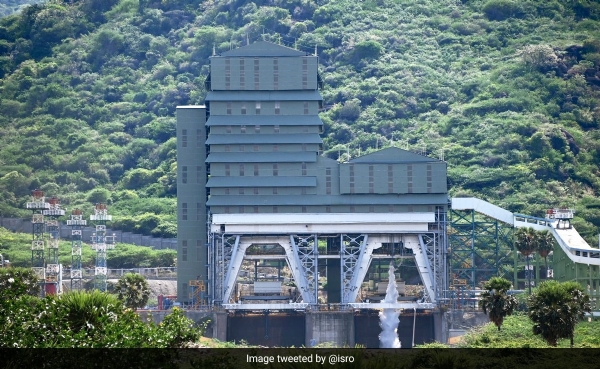
Chennai ,27 June (H.S.):The Indian Space Research Organisation (ISRO) has achieved a significant breakthrough in its next-generation launch vehicle programme by successfully conducting a hot test of its Semi-Cryogenic Engine Power Head Test Article (PHTA) at a thrust level of 175 tonnes, bringing the country closer to deploying a more powerful version of the Launch Vehicle Mark-3 (LVM3).
The test was carried out on June 24 at the ISRO Propulsion Complex (IPRC) in Mahendragiri, Tamil Nadu. It marks the eighth successful hot test in the ongoing development of the indigenous semi-cryogenic propulsion system, a key technology expected to enhance India's future space missions.
The Power Head Test Article comprises all critical engine systems except the thrust chamber and is used to validate the engine's integrated performance. During the latest trial, engineers evaluated the engine's build-up sequence following pre-burner ignition and demonstrated stable operation at 175 tonnes of thrust—equivalent to 88 per cent of its planned full capacity of 200 tonnes.
ISRO said the test progressed exactly as predicted, with all engine parameters remaining within expected limits. The engine's main turbopumps also performed successfully, generating outlet pressures of 400 and 500 bar during the firing.
The achievement follows earlier successful tests conducted at thrust levels of 94 tonnes and 120 tonnes, providing growing confidence for a full-scale 200-tonne engine test in the next phase of development.
The semi-cryogenic propulsion stage (SC120), powered by the 2,000-kilonewton-class SE2000 engine, is being developed to replace the existing L110 liquid core stage of the LVM3, India's heaviest operational launch vehicle. The upgraded stage is expected to significantly increase payload capacity while improving reliability and operational efficiency.
Powered by Liquid Oxygen (LOX) and ISRO's refined kerosene fuel, Isrosene, the engine uses cleaner, non-toxic propellants. Once integrated with an upgraded cryogenic upper stage, the new propulsion system is expected to strengthen India's capabilities in launching heavier satellites, undertaking deep-space exploration missions and supporting future human spaceflight programmes, including the country's long-term space ambitions.
---------------
Hindusthan Samachar / Arun Lakshman