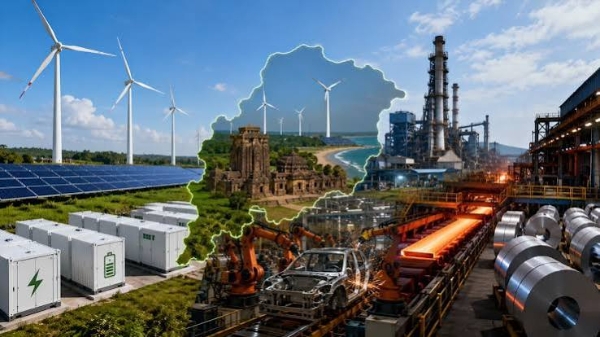
The transition comes as the global steel industry faces mounting pressure to cut emissions. Steel production remains one of the largest industrial sources of greenhouse gases worldwide, prompting governments and manufacturers to seek cleaner alternatives. In India, Odisha—already the country's largest steel-producing state and one of its most resource-rich mineral hubs—is attempting to turn this challenge into an opportunity.
The momentum accelerated in 2026. At the Odisha Renewable Energy Investor Conclave, the state secured investment commitments worth nearly ₹67,000 crore to develop about 6.8 GW of clean energy capacity. The state government also advanced its Green Hydrogen Mobility Project in partnership with NTPC and GRIDCO, laying the groundwork for hydrogen production and refuelling infrastructure while preparing to introduce hydrogen fuel-cell buses.
The clean-energy push extends beyond large industrial projects. Prime Minister Narendra Modi recently launched the Pahadpur Solar Village initiative in Mayurbhanj district, aimed at creating a model community powered through rooftop solar generation. Odisha has also introduced Climate Budget Tagging for 2026-27, linking public expenditure to carbon-reduction objectives and integrating climate goals into governance and development planning.
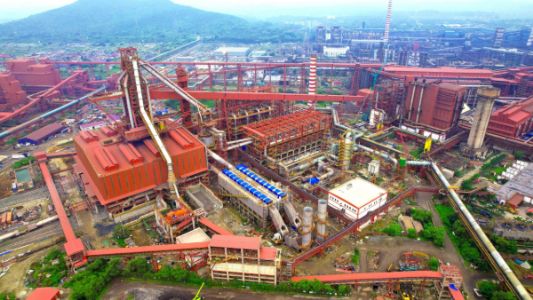
At the same time, the state continues to attract major industrial investments. JSW Utkal Steel has commenced construction on its integrated steel project near Paradip, one of the largest ongoing industrial developments in eastern India. Other major expansions include Rashmi Group's proposed steel facility in Jajpur, Shyam Metalics' expansion plans in Sambalpur and investments by SMC Power Generation in Jharsuguda. Together, these projects reinforce Odisha's position as a cornerstone of India's metal economy.
What makes the current phase different, however, is the effort to align industrial growth with cleaner energy sources. Through Green Energy Open Access policies, utility-scale renewable projects and future hydrogen integration, Odisha is building the infrastructure required for low-carbon manufacturing. The objective is not merely to produce more steel, but to produce steel that can remain competitive in a world increasingly focused on sustainability standards.
A major driver behind this transition is the European Union's Carbon Border Adjustment Mechanism (CBAM), which will gradually impose carbon-related costs on imports from countries with higher industrial emissions. Indian steel exporters face growing pressure to demonstrate lower carbon footprints if they are to remain competitive in key international markets. Industry experts believe cleaner production methods, renewable power integration and hydrogen-based technologies could help Indian manufacturers adapt to this changing trade environment.
Green hydrogen is expected to play a crucial role. Under India's National Green Hydrogen Mission, pilot projects are exploring ways to reduce coal dependence in iron and steel production. Researchers and industry players are testing technologies that use hydrogen to lower emissions during steelmaking, while evaluating the long-term viability of hydrogen-based industrial processes. Odisha's expanding renewable-energy ecosystem and industrial base place it in a favourable position to benefit from these developments.
The state's ambitions extend well beyond the current investment cycle. Odisha's renewable energy roadmap targets 10.96 GW of capacity by 2030, supported by nearly 18,000 MW of pumped hydro storage projects and significant battery energy storage systems. The state is also targeting large-scale production of green hydrogen and green ammonia, with its deep-water ports expected to support future exports to international markets.
For India, the significance of Odisha's transition extends beyond state boundaries. The country aims to achieve 500 GW of non-fossil fuel capacity by 2030 and net-zero emissions by 2070 while continuing to expand its manufacturing base. Success in Odisha could provide a blueprint for how heavy industry can grow while reducing carbon intensity.
The implications are economic as much as environmental. Cleaner steel production could help Indian manufacturers access premium export markets, attract investment and strengthen their position in global supply chains. It could also reduce dependence on imported clean-energy technologies by encouraging domestic manufacturing of solar, storage and hydrogen-related components.
If the twentieth century was defined by access to coal, iron ore and industrial capacity, the next phase of global competition may be shaped by access to clean energy and low-carbon manufacturing. Odisha's ongoing transformation suggests that the future of industrial competitiveness will depend not only on what a region produces, but on how sustainably it produces it.
In that sense, Odisha's green steel push is about more than cleaner production. It is a test of whether India can simultaneously accelerate industrial growth, protect export competitiveness and advance its climate ambitions. The outcome could influence the country's economic trajectory for decades to come.
---------------
Hindusthan Samachar / Jun Sarkar
24 Jun 2026
ED Raids Five Locations in Delhi in Mundra Drugs Case, Investigates Investments in Nightclubs
24 Jun 2026