Beijing, 20 May (H.S.):
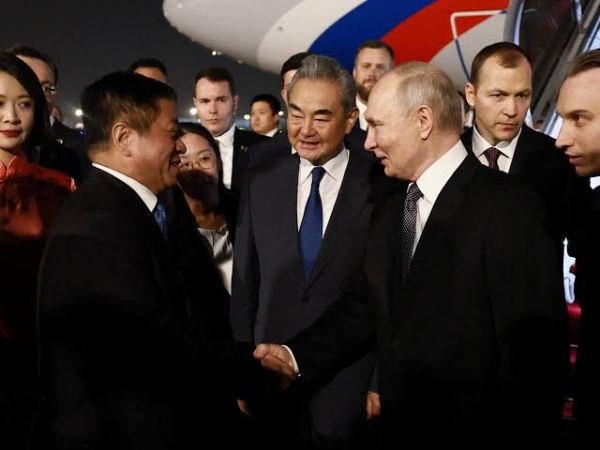
Russian President Vladimir Putin arrived in Beijing on Tuesday evening for a closely watched state visit that underscores the deepening strategic partnership between Russia and China amid mounting geopolitical tensions and a rapidly shifting global order.
The visit comes just days after US President Donald Trump concluded a high-profile trip to the Chinese capital, placing Beijing at the centre of competing global power dynamics.
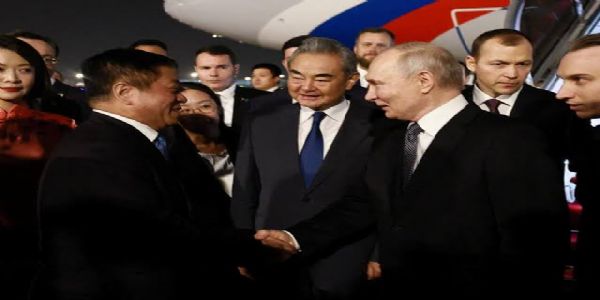
Putin was welcomed at Beijing Capital International Airport by Chinese Foreign Minister Wang Yi and an official honour guard, with Chinese and Russian flags lining the ceremonial reception. The Kremlin has described the visit as carrying “serious expectations,” highlighting its importance for both bilateral ties and broader geopolitical coordination.
Tea Diplomacy and Symbolic Optics
At the heart of the visit is an extensive summit between Putin and Chinese President Xi Jinping, expected to culminate in an informal tea meeting between the two leaders — a diplomatic gesture often reserved by Xi for leaders with whom he shares close personal rapport.
Chinese political observers note that Xi’s tea diplomacy carries symbolic weight. During Putin’s previous visit in 2024, the two leaders held relaxed outdoor discussions without formal attire inside Zhongnanhai, the political compound housing China’s top leadership. The imagery contrasted sharply with the carefully choreographed engagements during Trump’s recent Beijing trip.
The optics surrounding Putin’s visit are being interpreted as a deliberate signal of enduring Sino-Russian alignment despite sustained Western pressure on Moscow over the war in Ukraine.
Extensive Itinerary and Major Agreements
According to Kremlin officials, the visit will include formal bilateral negotiations, a signing ceremony, a state banquet, and closed-door strategic discussions covering regional security, trade, energy cooperation, and international governance structures.
Roughly 40 bilateral documents are expected to be signed during the visit, alongside a lengthy joint declaration outlining the expansion of the China-Russia strategic partnership. Officials from both sides are also anticipated to endorse a broader statement advocating a “multipolar world order” and a “new type of international relations” — language frequently used by both governments to challenge Western-led global institutions.
Putin is accompanied by a large delegation comprising deputy prime ministers, senior ministers, executives of major Russian state corporations, and banking officials, reflecting the economic significance of the trip.
Trade and Energy at the Core
Economic cooperation remains central to the summit agenda. After experiencing a decline in bilateral trade last year, economic exchanges between the two countries have shown renewed momentum in 2026. Official Chinese customs data indicates that trade between Moscow and Beijing increased significantly during the first four months of the year.
Russia continues to rely heavily on China as a crucial economic partner following extensive Western sanctions imposed after the Ukraine conflict. Beijing has emerged as one of Moscow’s largest energy buyers and a vital market for Russian exports.
One of the most closely watched issues during the visit is expected to be discussions surrounding the proposed “Power of Siberia 2” gas pipeline, a major infrastructure project intended to transport Russian natural gas to northern China. Industry experts suggest evolving instability in global energy markets, particularly tensions involving Iran and the Middle East, may strengthen Moscow’s case for accelerating the project.
However, Chinese policymakers are believed to remain cautious, prioritising diversified energy imports rather than excessive dependence on any single supplier.
Strategic Messaging to the West
The summit also carries significant geopolitical symbolism. Since declaring a “no limits” partnership shortly before the outbreak of the Ukraine war, China and Russia have increasingly coordinated positions on issues ranging from NATO expansion to global financial systems and regional security arrangements.
---------------
Hindusthan Samachar / Jun Sarkar

20 May 2026