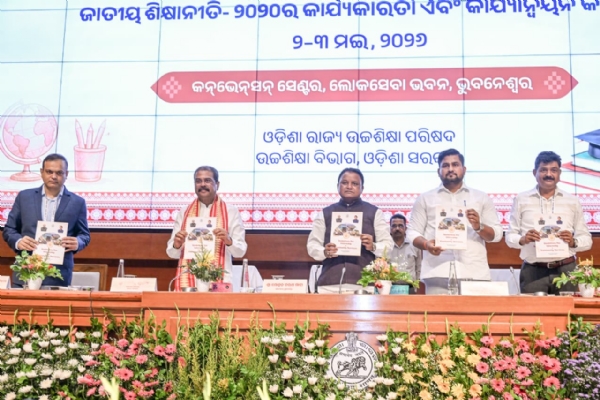
Bhubaneswar, 02 May (H.S.): A two-day national workshop on the implementation of the National Education Policy 2020 titled “Pragya Prerna” commenced in Bhubaneswar, with a strong emphasis on transforming Odisha’s education ecosystem through innovation, autonomy, and research.
Addressing the inaugural session, Union Education Minister Dharmendra Pradhan called upon educational institutions in Odisha to evolve into model centres for the country by embracing autonomy, innovation, and research-driven practices. He highlighted that universities should move beyond infrastructure development and focus on idea generation and knowledge creation.
The event, organized by the Higher Education Department of the Odisha government, was attended by Chief Minister Mohan Charan Majhi, Higher Education Minister Suryabanshi Suraj, vice-chancellors, academicians, and faculty members from across the state.
Describing Odisha as a “land of knowledge,” Pradhan emphasized the need to design curricula aligned with local needs, including the state’s coastline, mineral resources, and cultural heritage. He also stressed incorporating local history and contributions of eminent personalities into academic content.
Highlighting key provisions of NEP 2020, he noted that initiatives such as the Academic Bank of Credit and APAAR ID would promote skill-based education. He further underlined the importance of digital platforms to ensure access to quality education in remote areas and prepare students for global competitiveness. Referring to the leadership of Prime Minister Narendra Modi, Pradhan reiterated the importance of mother-tongue-based education and promotion of Indian languages.
On the occasion, an “Internship and Community Service Guidelines” booklet was released, and the “Shaktishree” mobile app aimed at women’s safety and empowerment was launched.
Meanwhile, Chief Minister Mohan Charan Majhi, in his address, called for a “revolutionary transformation” in Odisha’s education sector. He presented a forward-looking roadmap to position the state as India’s “knowledge hub,” asserting that eliminating long-standing inertia in the education system is a top priority for the government.
Majhi stated that NEP 2020 is not merely a policy document but a mission to establish India as a global knowledge capital. He emphasized that education must go beyond textbooks and serve as the foundation of societal progress, while ensuring students become industry-ready and globally competitive.
Reaffirming the government’s commitment, the Chief Minister highlighted a substantial allocation of ₹41,273 crore for the education sector in the 2025–26 financial year. He said this investment would strengthen infrastructure and create a robust foundation for the state’s youth.
To bridge the rural-urban education gap, he announced the ‘Godabarish Mishra Adarsha Vidyalaya’ initiative, under which modern schools will be established in all 6,794 GPs with an estimated investment of ₹12,000 crore. These schools will be equipped with advanced classrooms, laboratories, and sports facilities.
Focusing on social equity, Majhi also announced 11.25% reservation for SEBC students in higher education. Additionally, financial assistance is being provided to Scheduled Tribe (ST) students under the ‘Shaheed Madho Singh Haath Kharcha Yojana’ to reduce dropout rates.
The workshop is being seen as a significant step towards aligning Odisha’s education system with national goals, paving the way for a “Developed Odisha” and contributing to the vision of a “Developed India.”
Hindusthan Samachar / Monalisa Panda
02 May 2026
Prayagraj Division takes major action against encroachment, frees railway land worth Rs 100 cr

02 May 2026