New Delhi, 02 May (H.S.): The Government of India has conducted a nationwide trial of its “Cell Broadcast Alert System” today, aimed at swiftly delivering disaster and emergency information to citizens. The system is designed to flash a common emergency‑message box on all mobile‑phone screens simultaneously, accompanied by a distinct beep tone and vibration so as to instantaneously draw users’ attention.
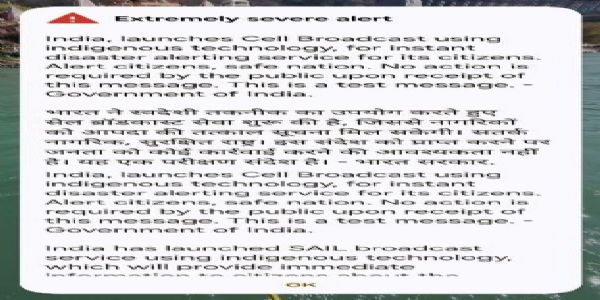
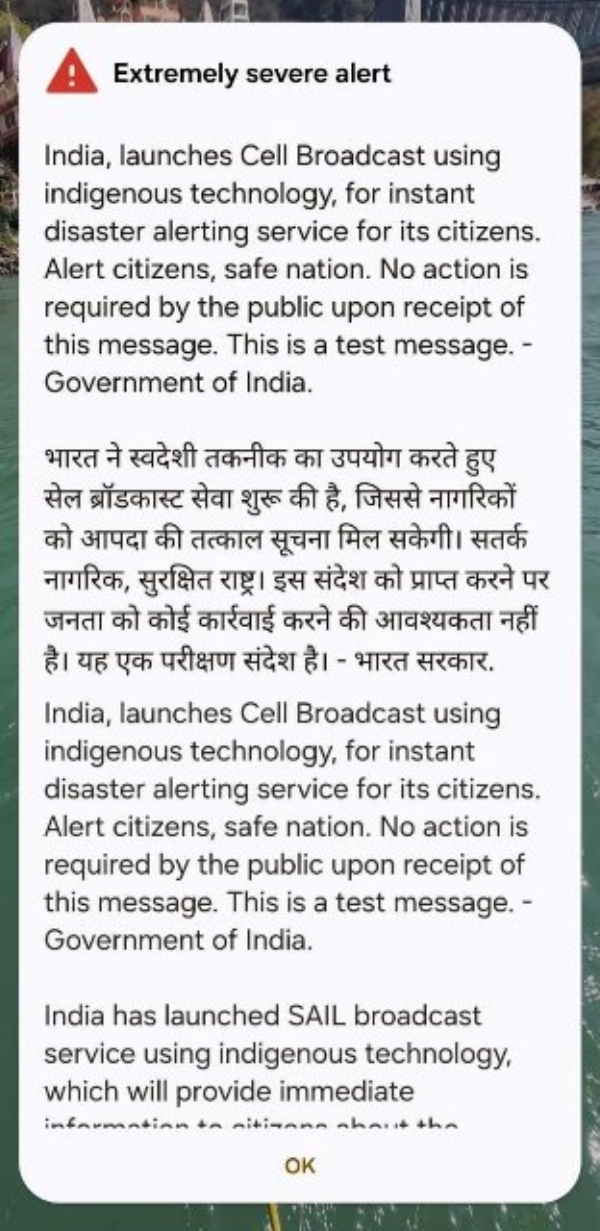
Union Communications Minister Jyotiraditya Scindia remotely and successfully inaugurated the all‑India test of the system during a programme in the capital. Around 11:45 a.m., mobile phones across the country received an emergency alert in unison, complete with the beep‑and‑vibration sequence. The test message clearly stated that the alert was part of a trial and that no action was required from the public.
This cutting‑edge system has been developed by the Department of Telecommunications under the Ministry of Communications, in collaboration with the National Disaster Management Authority (NDMA). It is built on the integrated alert platform “SACHET”, developed by the Department’s premier R&D centre, the Centre for Development of Telematics (C‑DOT), and is aligned with the Common Alerting Protocol (CAP) recommended by the International Telecommunication Union.
The SACHET‑based system is already operational in all 36 states and union territories of the country and currently delivers disaster‑ and emergency‑related alerts via SMS to mobile users in geographically targeted areas. Over 13.4 billion SMS alerts have been transmitted so far in more than 19 Indian languages, covering natural disasters, weather warnings, and cyclonic events.
To further strengthen early‑warning dissemination, the government has now integrated Cell Broadcast (CB) technology alongside SMS. Under this technology, alerts can be pushed to all mobile devices within a defined geographic area at once, enabling near real‑time information delivery to the public.
The system is expected to be particularly useful in time‑critical situations such as tsunamis, earthquakes, lightning strikes, gas leaks, chemical hazards, wars, or military attacks, where every second counts. The indigenous development and deployment of this Cell Broadcast‑based public emergency‑alert system has been entrusted to C‑DOT.
Under the first phase of the exercise, test messages were sent to mobile users in Delhi‑NCR and in all state capitals, in English, Hindi, and select regional languages. The sample alert read:
“India’s indigenous Cell Broadcast‑based rapid disaster‑warning service has been successfully rolled out for the country’s citizens. Alert citizens, secure nation. This is a test message; no action is required on receiving it.”
During the trial, mobile alerts sounded simultaneously in trains, buses, and other public places, causing brief confusion and anxiety among some people. However, once they read the message, most calmed down and the situation returned to normal. The government has described the launch as a key step towards “alert citizens, secure nation” and urged the public not to panic upon receiving such test alerts, as their sole purpose is to evaluate and strengthen the disaster‑notification mechanism.
---------------
Hindusthan Samachar / Jun Sarkar