New Delhi, 09 April (H.S.):
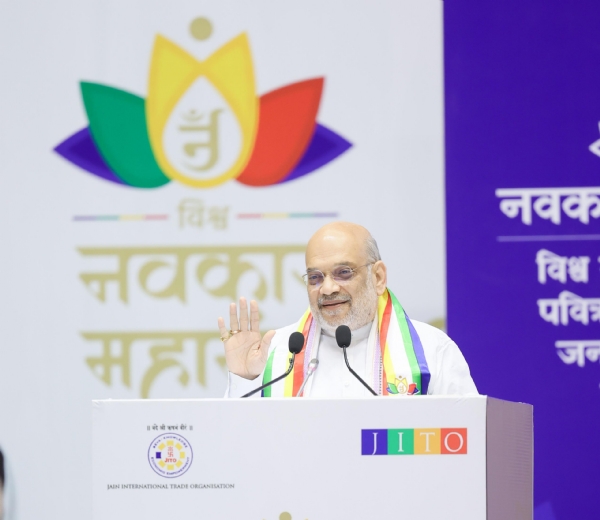
Union Home and Cooperation Minister Amit Shah has described the collective recitation of the Navkar Mantra as “highly meaningful and relevant” for global peace, at a time when the world is locked in struggles to impose ideological dominance.
Speaking at the Vishwa Navkar Mahamantra Diwas organised by the Jain International Trade Organisation (JITO) in the capital, he underlined that the present era urgently requires peace, camaraderie and mutual understanding, all of which, he said, can be strengthened through such spiritual initiatives.
Spiritual basis and universality of Navkar Mantra
Shah highlighted India’s rich spiritual heritage, noting that the country is home to diverse religions and traditions, each of which places special emphasis on the power of mantras and their inner potency. He observed that mantras, when chanted with faith and concentration, lend a positive direction to human life, awaken consciousness and fortify auspicious resolutions.
The Home Minister stressed that when people chant the same mantra in unison, its impact does not remain confined to the individual; it radiates outward, influencing society, the nation and ultimately the world. He described the Navkar Mantra as a completely formless, neutral and universal prayer, free of any discrimination and not limited to any particular caste, religion, region or time.
Symbolism of “Namo” and inner transformation
Shah explained that the Sanskrit word “Namō” in the mantra signifies complete surrender, fostering the shedding of ego and encouraging the practitioner toward inner purification. The very act of bowing, he said, begins the gradual erosion of arrogance and sets the aspirant on a path of spiritual uplift.
He elaborated on the internal enemies—anger, pride, illusion and greed—against which true victory must be won, and termed the person who overcomes these as an Arihant, the spiritually triumphant being extolled in Jain scriptures. Similarly, he described the Siddha as the soul that has transcended the cycle of birth and death and attained the highest state of liberation.
Panch Parmeshthi and their 108 virtues
Shah pointed out that the Navkar Mantra also pays homage to Āchāryas, Upādhyāyas and Sādhus—the Āchārya as the head of the community and guide of discipline, the Upādhyāya as the scholar‑teacher of scriptures, and the Sādhu as the ascetic who pursues self‑purity through austerity, restraint and renunciation. Together, these five categories are known as the Panch Parmeshthi—the five supreme beings.
The Home Minister emphasised that the core essence of the mantra lies in assimilating the qualities of these Panch Parmeshthi into one’s life. He noted that a total of 108 attributes are embedded in these five ideal beings, all of which are collectively remembered and venerated through the chanting of the Navkar Mantra.
Tradition, continuity and modern relevance
Shah recalled that the Navkar Mantra tradition has been passed down for thousands of years, with the 24 Tirthankaras and their followers making a profound contribution to its preservation. Initially transmitted orally, the mantra later found its place in inscriptions and canonical texts, underscoring its enduring spiritual stature.
Addressing youth, he urged them to continue the regular practice of the mantra even if its deeper meaning is not immediately grasped. Over time, he said, its layers can be unravelled under the guidance of Āchāryas and learned saints, leading to a deeper experiential understanding.
Peace, harmony and current global climate
In the context of today’s turbulent world, Shah asserted that when a climate of unrest and tension prevails, the collective chanting of the Navkar Mantra can help purify the environment and restore inner tranquillity. He held that such spiritual exercises also nurture goodwill, empathy and mutual cooperation in society, reinforcing the values of non‑violence and unity that are central to Jain thought and, more broadly, to India’s civilisational ethos.
---------------
Hindusthan Samachar / Jun Sarkar
09 Apr 2026
PM Modi Slams TMC's Broken Promises at Massive Birbhum Rally, Signals Bengal's Shift from Mamata Raj
09 Apr 2026