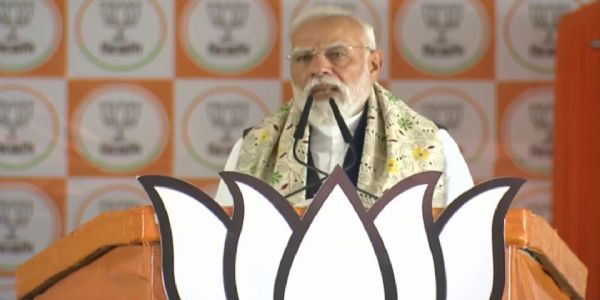
Asansol, 09 April (H.S.):
Prime Minister Narendra Modi on Thursday launched a blistering attack on the Trinamool Congress–led government in West Bengal during a high‑voltage election rally in Asansol, charging Mamata Banerjee’s administration with cruelty, corruption, and “mafia rule” over the past 15 years.
In a speech pitched to the industrial coal belt, the Prime Minister declared that the “pot of TMC’s sins is now full,” and insisted that a political change in Bengal had become “certain” as people across the state demanded relief from what he repeatedly termed the “Nirmam Sarkar” (insensitive or cruel government).
PM Modi framed the Assembly election as a decisive break from what he described as a decade‑and‑a‑half of “Nirmam Sarkar” rule, portraying the TMC as a regime that ignored the people’s welfare and prioritised political survival over governance.
Drawing on local sentiment, he invoked the phrase “Nirmam Sarkar” repeatedly to suggest that the ruling party had become indifferent to the sufferings of ordinary citizens, especially in industrial areas like Asansol and Durgapur.
He argued that the TMC had failed to modernise or protect the state’s industrial base, allowing the once‑thriving industrial belt to slide into decline. “The pot of TMC’s sins is now full,”PM Modi declared, adding that voters had reached a “moment of decision” on April 23 and that the true “rule of law” would only begin after May 4 once the BJP‑led NDA assumes power.
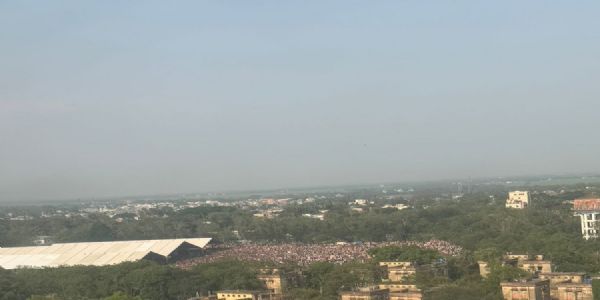
Addressing a packed crowd in Asansol, a key mining and coal‑processing hub, the Prime Minister directly targeted the TMC’s control over the coal and sand‑mining sectors. He alleged that instead of allowing transparent, regulated operations, the state government had allowed a “syndicate raj” to flourish, with powerful local networks—including the so‑called coal and sand mafia—dominating the sector.
PM Modi charged that under the TMC, the coal belt had become a haven for organised illegal activity and corruption, with permits, contracts and resources allegedly being distributed through political patronage. “Asansol is a major part of the coal belt, but under TMC rule, the entire sector is controlled by a syndicate raj,” he said, asserting that only a BJP‑led “double‑engine government” could restore good governance, industrial investment and workers’ rights.
In one of the most hard‑line segments of his speech, Modi turned to communal security and alleged that Hindus in Bengal were being systematically intimidated in the name of a specific community. He referenced the contentious “red posters” of the past—associated with militant groups and polarising rhetoric—and claimed that the TMC was now using similar tactics to stoke fear among Hindu communities.
“Hindus are being threatened with genocide through the issuance of red posters,” Modi said, later adding that the TMC was “weaponising fear” for 15 years, much like the earlier Left‑front regime. He insisted that people wanted security for their land, faith, livelihoods and children’s future, and positioned the BJP as the only force capable of providing that security along India’s eastern borders. “It is the BJP that has secured the western borders, and the BJP will secure the eastern borders,” he declared.
The Prime Minister devoted a significant portion of his remarks to women’s safety, accusing the TMC of turning a blind eye to abuses and even “openly standing in support of perpetrators of crimes.” He invoked the tumultuous episodes at RG Kar Medical College and the Sandeshkhali land and sexual‑assault controversy to paint a picture of a state where women felt increasingly insecure.
Bengal, he noted, was the land of “Shakti worship,” yet the current “Nirmam Sarkar,” he alleged, had allowed the situation to deteriorate dramatically. He claimed that cases of acid attacks and sexual violence were on the rise, and called for a stricter law‑and‑order regime to restore dignity and safety for women.
Alongside the political assault, PM Modi sought to position the BJP as Bengal’s development partner, listing several central projects he claimed had benefited the Asansol–Durgapur region despite resistance from the state government. He cited the expansion of the ESI Hospital and the launch of the Asansol–Bokaro train service as evidence of improved medical infrastructure and connectivity.
The Prime Minister said that the region had received over ₹45,000 crore in investments for steel‑plant expansion and the commissioning of the Durgapur–Haldia gas pipeline section, which he argued were vital for reviving the industrial belt. He also highlighted the introduction of Vande Bharat and Amrit Bharat trains, the ongoing upgrade of Andal Railway Station under the Amrit Bharat Station Scheme, and the establishment of a Gati Shakti Cargo Terminal in the Asansol Division as markers of a “double‑engine government” delivering progress.
PM Modi framed the election as a historic opportunity to break free from what he described as a cycle of failed governance—from Congress to the Left and then the TMC. He argued that each of these parties had had their chance but had let Bengal fall behind while the rest of India progressed on infrastructure, industry and security.
“This election is to get rid of mafia rule, and only a BJP government can accomplish this,” he said, promising that after May 4, the “Nirmam Sarkar” would be replaced with a regime that would address every problem in the region and restore Bengal’s industrial and social pride.
---------------
Hindusthan Samachar / Jun Sarkar
09 Apr 2026
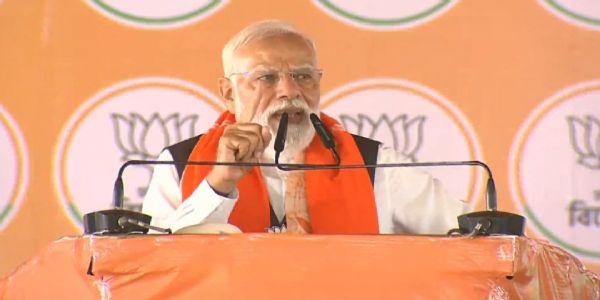
PM Modi Slams TMC's Broken Promises at Massive Birbhum Rally, Signals Bengal's Shift from Mamata Raj
09 Apr 2026