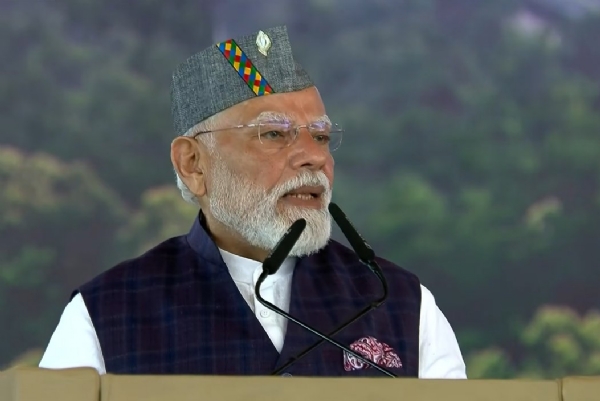
Dehradun, 14 April (H.S.): Prime Minister Narendra Modi inaugurated the Delhi–Dehradun Economic Corridor at a public function in Dehradun on Tuesday, formally launching one of the most ambitious highway‑development milestones in northern India.
Addressing a large gathering, the Prime Minister described the nation’s fate as being shaped by its roads, highways, expressways, airways, railways and waterways, framing these as the “fate‑lines” of progress.
He asserted that over the past decade, the country has been relentlessly building these development‑oriented fate‑lines, not merely to provide today’s convenience but to guarantee prosperity for the next generation—adding that this is also his own personal guarantee.
PM Modi noted that Uttarakhand, having completed 25 years of its formation, has now entered its 26th year, and that the inauguration of the Delhi–Dehradun Expressway marks another major achievement in the state’s journey. Recalling his earlier promise made at Kedarnath, he said the third decade of the 21st century must be Uttarakhand’s decade, and expressed satisfaction that, under the “double‑engine” model of governance and the hard work of the state’s people, this young state is adding new dimensions to its development trajectory.
He emphasized that this project, too, will give fresh momentum to the region’s progress.
The corridor, about 213 km long, is a six‑lane, access‑controlled expressway built at a cost of more than ₹12,000 crore, and is designed to impart new speed to connectivity between Delhi, Uttar Pradesh and Uttarakhand. Its most striking feature is that the travel time between Delhi and Dehradun, which currently exceeds six hours, will be reduced to approximately 2.5 hours, giving passengers a faster, safer and more comfortable journey.
Under the project, 10 interchanges, three railway over‑bridges (ROBs), four major bridges and 12 wayside amenities have been developed. In addition, an Advanced Traffic Management System (ATMS) has been installed to ensure better traffic control and enhanced safety along the corridor.
Keeping environmental conservation in view, the project incorporates several special provisions. A 12‑km‑long wildlife‑elevated corridor has been created to protect wild animals and to reduce human‑wildlife conflict, making it one of the longest elevated wildlife corridors in Asia.
Besides this, eight animal crossings, two 200‑metre‑long elephant underpasses, and a 370‑metre‑long tunnel near the Dat Kali Temple have been constructed to protect both ecology and heritage.
Before the inauguration, the Prime Minister inspected the wildlife‑elevated corridor section in Saharanpur, Uttar Pradesh, and then offered prayers at the historic Jai Maa Daat Kali Temple near Dehradun, symbolically linking the project with ecological stewardship and regional faith.
The corridor is expected to play a crucial role in boosting regional economic development, encouraging tourism and generating new business opportunities. It is widely regarded as an outstanding example of harmonising modern infrastructure with environmental balance, embodying a vision in which speed and sustainability coexist.
---------------
Hindusthan Samachar / Jun Sarkar