New Delhi, 14 April (H.S.):
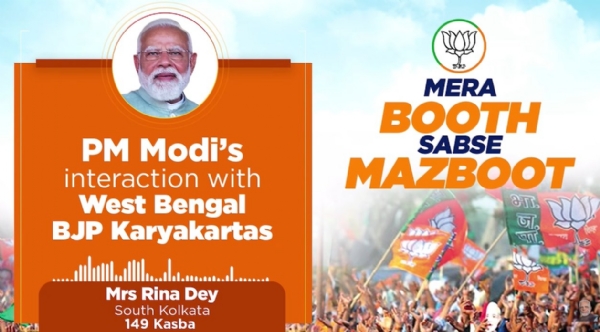
Senior BJP leader and Prime Minister Narendra Modi expressed profound concern over West Bengal's law and order, corruption, infiltration, and political violence during a conversation via the NaMo app with BJP booth workers in West Bengal on Tuesday.
He alleged that under the Trinamool Congress (TMC) government, an atmosphere of fear pervades Bengal, where ordinary citizens, women, and youth feel profoundly insecure.
The Prime Minister commenced his address by extending greetings to Bengal's people on ‘Poila Boishakh’ and ‘Shubho Nobo Borsho’.
He remarked that during recent visits, he witnessed widespread enthusiasm and support for BJP across every corner of the state—a direct outcome of booth-level workers' tireless dedication. Commending the workers, he noted that the mantra “My Booth is the Strongest” is being effectively implemented at the grassroots.
PM Modi stated that crime in West Bengal has reached its zenith. He accused the state of witnessing escalating murders, rapes, riots, and political violence. He emphasized that such an environment impacts women and youth most severely, jeopardizing their futures. He added that even government employees must resort to courts for their dues, while farmers and traders suffer under TMC's alleged syndicate raj.
Launching a vehement attack on the TMC government, the Prime Minister declared that people elected the party to liberate Bengal from Leftist rule, yet TMC has allegedly surpassed it in tyranny. He asserted that the culture of “cut-money” has institutionalized corruption, fostering an environment of plunder at every level.
On infiltration, the Prime Minister warned that the issue has transcended mere security concerns to become a demographic threat. He claimed observable shifts in population structures in several areas, eroding local culture and language. He stated that Bengal's rich cultural heritage is being damaged by infiltration.
He remarked, “TMC leaders assure infiltrators, ‘Nothing will happen to you; we’ll protect you—just ensure our government stays in power.’ They intimidate Matua and Namasudra refugee communities, threatening, ‘Your homes will be taken, you’ll be evicted, forced to return.’ In essence, they reassure those who should leave while terrifying those granted refuge under the Constitution via CAA. We must convey everywhere that no Matua or Namasudra individual will be expelled from India. This is Modi’s guarantee.”
Referencing the R.G. Kar Medical College and Sandeshkhali incidents, the Prime Minister instructed booth workers to compile lists of crimes in their areas and enlighten the public on their root causes. He alleged that antisocial elements operate under TMC leaders' patronage, with the police apparatus compromised. He urged workers to go door-to-door, disseminating the truth.
Stressing targeted interactions with women, the Prime Minister advocated small meetings to raise awareness. He suggested screening videos of past incidents to remind people of the conduct witnessed post-
TMC's ascent to power.
Describing BJP's manifesto as “practical and people-centric,” the Prime Minister appealed to workers to study it thoroughly and disseminate it widely. He highlighted key provisions for youth, women, and holistic state development, advising them to explain these schemes in simple language.
He contrasted this with states governed by BJP or NDA, where development schemes roll out rapidly, benefiting all without discrimination. Conversely, he accused Bengal of obstructing central schemes, depriving the poor, farmers, and youth.
Addressing trade and employment, the Prime Minister recalled Bengal's era as India's premier commercial hub, now undermined by fear and instability deterring investment. He noted that riots and violence inflict the greatest harm on the poor and laborers.
The Prime Minister appealed to booth workers to organize separate meetings with first-time young and female voters, acquainting them with BJP's policies and vision. He affirmed that robust booth organization holds the key to electoral triumph.
He vowed to bring corruptors within the law's ambit, ensuring “Sabka Saath, Sabka Vikas” alongside “Sabka Loot ka Hisaab.” He exhorted workers to labor vigorously at the booth level, fostering an atmosphere of trust among the populace.
---------------
Hindusthan Samachar / Jun Sarkar
14 Apr 2026
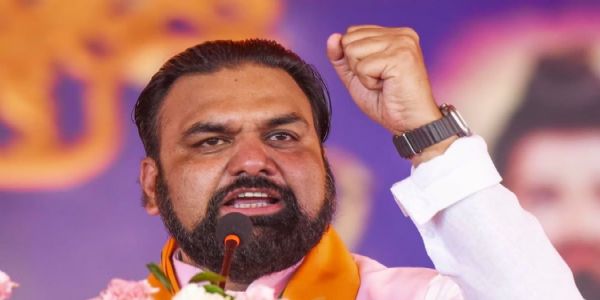
Bihar at Crossroads: Nitish Kumar Steps Down, Samrat Choudhary Set to Helm First BJP‑Led Government in State
14 Apr 2026