-Prime Minister inaugurates the Delhi–Dehradun Economic Corridor
Dehradun, April 14 (HS):
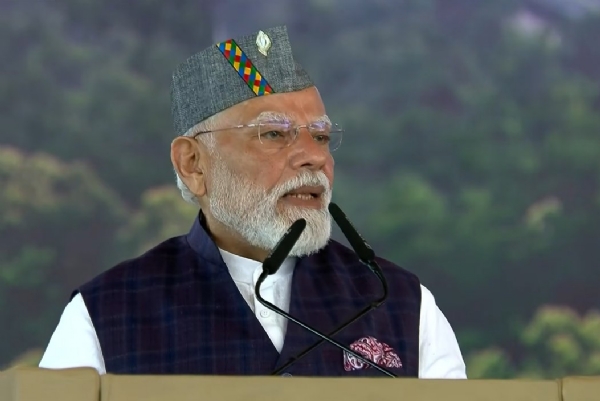
Prime Minister Narendra Modi inaugurated the long‑awaited Delhi–Dehradun Economic Corridor on Tuesday, declaring that roads, railways and other infrastructure are the “fate lines” of the nation and that India had been extensively building these over the past decade. He said the project would not only accelerate Uttarakhand’s development but also benefit several cities in Uttar Pradesh.
Addressing the inauguration ceremony in Dehradun, the Prime Minister remarked that Uttarakhand, having completed 25 years of its formation, has now entered its 26th year, and the inauguration of the Delhi–Dehradun Expressway on this occasion marks a significant achievement in the state’s progress. Reiterating an earlier statement, he said the present decade must be Uttarakhand’s decade, and that this is becoming visible through the “double‑engine” government’s policies and the state’s people’s hard work.
The Prime Minister noted that the economic corridor passes through cities such as Ghaziabad, Baghpat, Baraut, Shamli and Saharanpur in Uttar Pradesh, thereby extending wide benefits to these regions as well. Emphasising the importance from a tourism perspective, he said the corridor would give new momentum to Dehradun, Haridwar, Rishikesh, Mussoorie and the Char Dham pilgrimage, making these routes faster and more accessible.
Drawing an analogy with palm‑reading, the Prime Minister said that just as people read the lines of the hand to foresee the future, a nation’s fate is etched in its roads, highways, railways, airways and waterways. He added that these infrastructures are not merely present‑day conveniences but a guarantee of prosperity for future generations, which he also described as his own guarantee.
He explained that until 2014, annual infrastructure expenditure in the country was less than ₹2 lakh crore, which has now risen to over ₹12 lakh crore. In Uttarakhand alone, projects worth more than ₹2.25 lakh crore are under implementation.
The Prime Minister said that where villages once waited generations for roads, today road connectivity is reaching village after village, reviving depopulated hamlets and bringing them back to life.
Recalling the benefits of the Delhi–Dehradun Economic Corridor, he stated that travel time would drop from about six hours to roughly two and a half hours, resulting not only in time savings but also reduced fuel consumption and lower transport costs. The project worth around ₹12,000 crore has also provided employment for thousands of people, and would allow farmers’ produce to reach markets more swiftly.
The Prime Minister stressed the importance of environmental conservation, saying that preserving the sanctity of Devbhoomi (Uttarakhand) is everyone’s responsibility. He appealed to tourists and pilgrims to keep natural sites clean and refrain from polluting them with plastic and waste. He also highlighted the coming Kumbh at Haridwar next year, asking all to jointly work to make it divine, grand and clean.
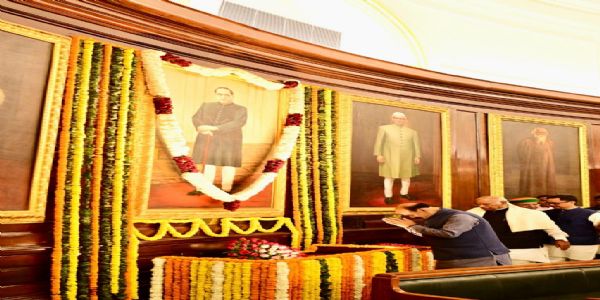
On the occasion of Dr Ambedkar’s Jayanti, the Prime Minister paid tributes to him, saying his government is continually working to strengthen the spirit of the Constitution. He noted that with the removal of Article 370, a single Constitution now applies across the entire country, and that peace and developmental paths have been opened even in several former Naxal‑affected regions.
The Prime Minister specially mentioned the Nari Shakti Vandana Act in his address and reiterated his appeal to all political parties to support amendments to the Act. He said that after four decades of waiting, Parliament had passed the Nari Shakti Vandana Act, ensuring 33 per cent reservation for women in the Lok Sabha and state assemblies.
All parties, he added, had come together to back this important law. The right conferred on women by this Act, he said, must not be delayed in implementation and must take effect now, before the 2029 Lok Sabha elections and subsequent state‑assembly elections. This, he said, reflects the sentiment of the country and the aspirations of women’s empowerment, and is not only a vital step toward women’s empowerment but also essential for the nation’s overall development.
The Prime Minister lauded Uttarakhand’s efforts in the direction of a uniform civil code, describing them as in line with the expectations of the Constitution. At the same time, he again called upon all political parties to cooperate in effectively implementing the Nari Shakti Vandana Act, so that women can fully enjoy their rights.
The Prime Minister extended felicitations to citizens on the occasions of Baisakhi, Bohag Bihu and Puthandu, and expressed his hope for the successful conduct of the upcoming Char Dham yatra.
It may be noted that the six‑lane, access‑controlled Delhi–Dehradun Economic Corridor, spanning approximately 213 km, includes 10 interchanges, three railway over‑bridges, four major bridges and 12 wayside facilities, along with an advanced traffic management system.
For wildlife conservation, the project features a 12‑km‑long elevated corridor, eight animal crossings and special underpasses for elephants, while a 370‑metre‑long tunnel near Dat Kali Temple has also been built. In this way, the Delhi–Dehradun Economic Corridor will not only strengthen regional connectivity but also pave the way for comprehensive development, balancing tourism, commerce, employment and environmental protection.
---------------
Hindusthan Samachar / Jun Sarkar