Dehradun, 14 April (H.S.):
Prime Minister Narendra Modi today formally inaugurated the Delhi–Dehradun Expressway—also branded as the Delhi–Dehradun Economic Corridor—describing it as a world‑class infrastructure project that will deepen connectivity, accelerate economic growth and unlock the tourism potential of Uttarakhand.
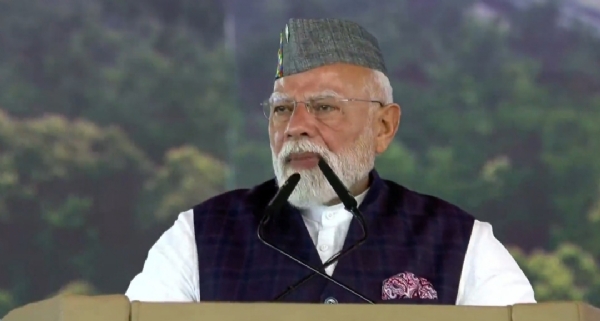
Pressing a remote button at a public function in Dehradun, PM Modi declared the 213‑km, access‑controlled, six‑lane corridor operational, marking the moment with a flourish of Garhwali‑inflected Hindi and acknowledgments of divine blessings drawn from the region’s sacred geography.
A corridor that shortens time and distances
The expressway, constructed at an estimated cost of around ₹12,000 crore, slashes the travel time between the national capital and Devbhoomi Uttarakhand from roughly 5–6.5 hours to just about 2.5 hours, compressing what was once a tiring mountain drive into a streamlined highway journey. With a designated speed limit of 100 km/h for cars and a meticulously engineered alignment that bypasses the most congested stretches, the project effectively shrinks the physical and psychological distance between Delhi’s urban core and Uttarakhand’s hill circuits.
PM Modi’s Garhwali address and apology for delay
In his remarks, the Prime Minister briefly addressed the crowd in Garhwali, seeking to resonate with local sentiment and affirm an emotional bond with the people of the hills. He apologized for arriving slightly late, explaining that his convoy had been delayed by a 12‑km roadshow through Dehradun, where thousands of citizens lined the streets, showering flower petals and offering spontaneous blessings.
Thanks to three states and key ministers
PM Modi explicitly expressed gratitude to the three states—Delhi, Uttar Pradesh and Uttarakhand—through whose territories the expressway threads, underscoring the collaborative nature of the project. He singled out Union Minister for Road Transport and Highways Nitin Gadkari for his role in expediting the economic corridor, while also felicitating Uttarakhand Chief Minister Pushkar Singh Dhami on the stage, thereby reinforcing the image of a “double‑engine” developmental partnership at the centre.
Kedarnath, Panch Kedar and Badrinath in his narrative
Woven into his address was a conscious invocation of the region’s spiritual cartography: PM Modi referenced Kedarnath, Badrinath and the broader circuits of Panch Kedar and Panch Badri, linking the new expressway with the quest of millions of pilgrims. He argued that smoother, safer connectivity would not only ease the pilgrimage experience but also catalyse ancillary services—homestays, transport, local crafts—turning the corridor into a developmental artery for both faith‑based and leisure tourism.
Framing the corridor as a national milestone
Positioning the Delhi–Dehradun link as part of a larger “gati‑shakti” (growth‑power) agenda,PM Modi stressed that such expressways symbolise India’s resolve to modernise infrastructure at a pace previously unseen. He projected the corridor as a template for future mountain‑state connectivity, signalling that the government views Uttarakhand not only as a spiritual epicentre but also as a strategic economic and security theatre worthy of sustained, high‑spec investment.
---------------
Hindusthan Samachar / Jun Sarkar