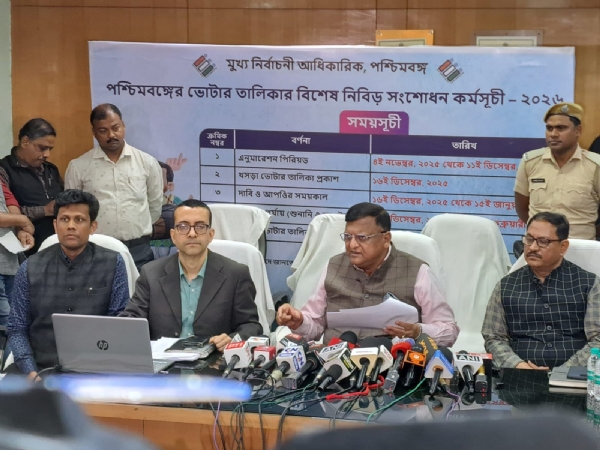
Kolkata, 15 March (H.S.): The Election Commission of India (ECI) on Sunday announced the schedule for the 2026 West Bengal Assembly elections. Polling for all 294 assembly constituencies will be conducted in two phases — on April 23 and April 29 — while counting of votes will take place on May 4. The entire election process will be completed by May 6.
With the announcement of the poll schedule, the Model Code of Conduct has come into immediate effect across the state and will remain in force until the completion of the electoral process. The code lays down guidelines for political parties and candidates to ensure free and fair elections and restricts new policy announcements, administrative transfers and certain forms of political campaigning.
Polling to be held in two phases
According to the Election Commission, voting will be held in 152 constituencies in the first phase, while the remaining 142 seats will go to the polls in the second phase.
Phase One (152 seats)
Notification: March 30, 2026
Last date for filing nominations: April 6, 2026
Scrutiny of nominations: April 7, 2026
Last date for withdrawal: April 9, 2026
Polling: April 23, 2026
Counting: May 4, 2026
Completion of process: May 6, 2026
Phase Two (142 seats)
Notification: April 2, 2026
Last date for filing nominations: April 9, 2026
Scrutiny: April 10, 2026
Withdrawal: April 13, 2026
Polling: April 29, 2026
Counting: May 4, 2026
Completion: May 6, 2026
Fewer phases compared to previous elections
The 2021 West Bengal Assembly elections were conducted in a record eight phases and were marred by incidents of violence in several areas. Earlier, the 2016 and 2011 elections were held in six phases, while the 2006 elections took place in five phases. The state has not voted in a single phase since 2001.
Central paramilitary forces were deployed in all these elections, and extensive security arrangements are again being planned for the 2026 polls.
Political temperature rises ahead of polls
The election announcement comes amid heightened political tensions in the state. Prime Minister Narendra Modi recently accused the ruling Trinamool Congress (TMC) of opposing the voter list revision exercise to allegedly benefit infiltrators.
The TMC, however, has countered by accusing the Bharatiya Janata Party (BJP) of attempting religious polarisation, indicating that the campaign is likely to be intensely contested.
Clashes were also reported between BJP and TMC supporters about five kilometres from the venue of the Prime Minister’s rally in Kolkata shortly before the event, with reports of stone pelting and slogan shouting.
-------
TMC in power since 2011
The Trinamool Congress has been in power in West Bengal since 2011, when it ended the 34-year rule of the Left Front under the leadership of Chief Minister Mamata Banerjee.
2011 election results:
TMC: 184 seats
Congress: 42 seats
Left Front: 40 seats
Since then, the BJP has gradually expanded its political presence in the state.
2016 election:
BJP: 3 seats
2021 election:
BJP: 77 seats
The TMC had won 213 seats in 2021, which later increased to 215 after by-poll victories.
BJP’s performance in Lok Sabha elections
In the 2019 Lok Sabha elections, the BJP won 18 of West Bengal’s 42 parliamentary seats. However, its tally declined to 12 in the 2024 general elections.
-------
Voter list controversy ahead of polls
Controversy has also surrounded the electoral rolls ahead of the elections. The TMC has alleged that around 6.3 million names were deleted and nearly 6 million voters were placed under the “under adjudication” category.
Chief Minister Mamata Banerjee staged a protest sit-in at Esplanade in Kolkata on March 6 over the issue.
-------
Supreme Court intervention
On February 24, the Supreme Court invoked its extraordinary powers under Article 142 of the Constitution and directed the Election Commission to continue publishing supplementary voter lists even after the final electoral roll notification to ensure that no eligible voter is disenfranchised.
The court also directed the deployment of additional judicial officers to dispose of pending claims and objections. More than 250 serving and retired district judges were engaged to adjudicate nearly 5 million claims and objections.
------
Poll preparations and protests
During a recent visit by the Election Commission team to Kolkata to review poll preparedness, TMC workers staged protests carrying black flags and placards.
The TMC has accused the BJP of misusing central agencies and the Election Commission for electoral advantage, allegations that the BJP has denied. Central forces have already begun deployment in the state, and the Election Commission has indicated that central security personnel will be stationed at all polling booths along with 100 percent webcasting arrangements.
------
High-stakes electoral battle expected
Political observers believe the TMC will be aiming to retain power for a third consecutive term, while the BJP is making a determined push to form a government in the state for the first time. The Left parties and the Congress are also attempting to regain lost political ground.
The 2026 West Bengal Assembly elections are thus being viewed as a crucial political contest that could significantly shape the future political landscape of the state.
Hindusthan Samachar / Satya Prakash Singh