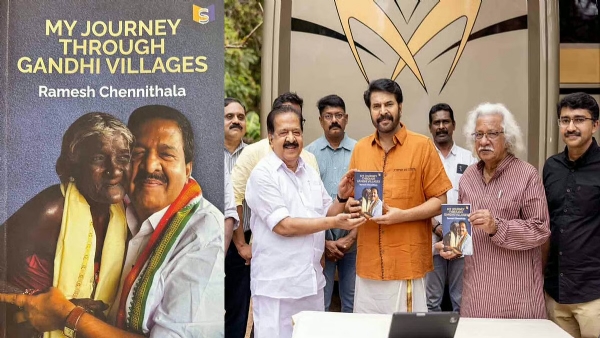
Thiruvananthapuram, 01 March (H.S.):Congress Working Committee member and former Kerala Home Minister Ramesh Chennithala has released a book chronicling his grassroots development initiative aimed at transforming Scheduled Caste and Scheduled Tribe colonies across Kerala. Titled “My Journey Through Gandhi Villages” (Gandhigramangaliloode), the book was formally launched at a function attended by acclaimed actor Mammootty and legendary filmmaker Adoor Gopalakrishnan, who jointly unveiled the publication.
The book documents the conception, execution and impact of the “Gandhigram” project, a comprehensive rural development initiative launched in 2012 when Chennithala was serving as President of the Kerala Pradesh Congress Committee (KPCC). The programme was designed with the objective of ensuring holistic development in SC/ST colonies across all 14 districts of Kerala.
According to Chennithala, the Gandhigram project was inspired by Mahatma Gandhi’s vision of inclusive village development and social justice. The initiative sought not merely infrastructure improvements but a broader transformation encompassing education, healthcare, sanitation, housing and social security measures in marginalised communities.
Under the scheme, ₹1 crore was sanctioned by the State Scheduled Caste and Scheduled Tribe Welfare Department to implement various development activities in selected villages. In addition, funds from the Gandhigram corpus were allocated for infrastructure upgrades, welfare schemes and community empowerment programmes. These included housing repairs, drinking water facilities, sanitation projects, skill development initiatives and improved access to public services.
My Journey Through Gandhi Villages offers a detailed account of these interventions and the visible changes brought about in the targeted colonies. The book presents case studies, on-ground experiences and narratives that highlight how focused administrative attention and coordinated welfare measures altered the socio-economic landscape of several underprivileged settlements.
Speaking at the launch, Chennithala reflected on the challenges faced during the implementation phase and emphasised that sustainable development must begin at the grassroots level. The presence of cultural icons like Mammootty and Adoor Gopalakrishnan underscored the broader social and intellectual interest in initiatives that bridge governance and social reform.
The publication serves both as a political memoir and a developmental case study, capturing a significant chapter in Kerala’s welfare-driven governance model and reaffirming the importance of inclusive growth in public policy.
---------------
Hindusthan Samachar / Arun Lakshman