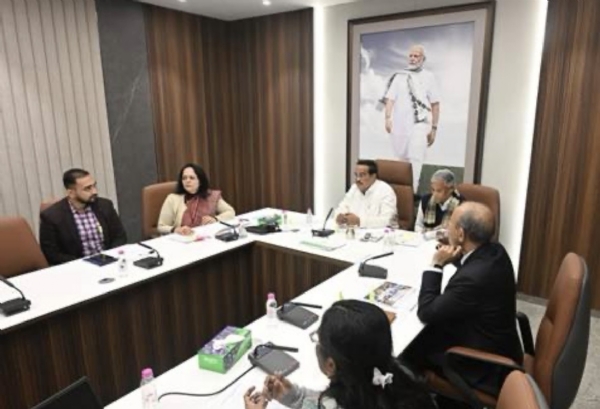
New Delhi, 07 January (H.S.): Union Jal Shakti Minister C.R. Patil commended innovative community-driven fecal sludge management (FSM) models under the Swachh Bharat Mission-Grameen during discussions with representatives from all states.
In a virtual dialogue organized on Tuesday by the Department of Drinking Water and Sanitation under the Jal Shakti Ministry, Patil emphasized that constructing toilets is insufficient; safely emptying, transporting, treating, and reusing them is equally vital.
He highlighted the inspiring initiative in Odisha's Khordha district, where a transgender group operates a Fecal Sludge Treatment Plant (FSTP), promoting both sanitation and employment opportunities.The dialogue also featured Jal Shakti Minister of State V. Somanna, Secretary Ashok K.K. Meena, and Swachh Bharat Mission-Grameen Mission Director Aishwarya Singh.
Participants included district collectors, district panchayat CEOs, panchayat members, and women and members from Self-Help Groups (SHGs) from various states, who joined online.
Innovative Models Across States
The ministry highlighted Gujarat's Dangs district, where twin-pit toilets are widely adopted in tribal areas. In Sikkim's Mangan district, single-pit toilets have been swiftly converted to twin-pit models to comply with FSM norms. Indore's Kalibillod Gram Panchayat in Madhya Pradesh hosts India's first rural FSTP, where treated water supports fish farming alongside an MRF center, creating new revenue streams for panchayats.
In Karnataka's Dakshina Kannada district, SHGs manage a cluster FSTP model, including maintenance responsibilities. Ladakh's Leh district features ecosan toilets tailored to extreme cold and high altitudes. Tripura's Gomati district deploys mobile bio-toilets for fairs and public events, operated by SHGs that have successfully made the model self-sustaining.
Participants were encouraged to share experiences in local languages, fostering open community dialogue.
Call for Collaborative Action
Patil stressed that FSM in villages succeeds only through joint efforts by panchayats, SHGs, and communities, with technology adapted to local conditions. These experiments in challenging environments prove that rural areas rival urban ones in devising innovative solutions.
---------------
Hindusthan Samachar / Jun Sarkar
08 Jan 2026
Pankhudi Portal Takes Flight: Women & Child Development Ministry Launches CSR Convergence Platform
08 Jan 2026
Startup Wizards & AI Trailblazers: India's Future Architects, Declares PM Modi at AI Startup Huddle
08 Jan 2026