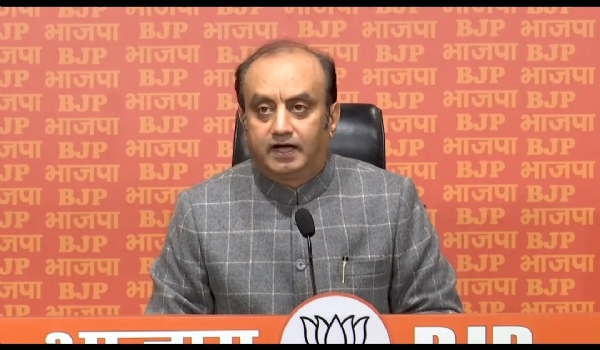
New Delhi, 07 January (H.S.): The Bharatiya Janata Party (BJP) on Wednesday shared letters from former Prime Minister Jawaharlal Nehru on social media, claiming they reveal profound hatred in his heart for the iconic Somnath Jyotirlinga Temple in Gujarat.
BJP spokesperson Dr. Sudhanshu Trivedi quoted Nehru's letters on X, alleging that while Muhammad Ghazni and Khilji looted Somnath in the past, independent India's greatest animosity toward Lord Somnath came from Pandit Nehru. He cited as prime evidence Nehru's letter to Pakistan's Prime Minister Liaquat Ali Khan on April 21, 1951, where Nehru addressed him as Dear Nawabzada and dismissed the story of Somnath's doors as completely false.
In a gesture of apparent capitulation, Nehru assured Khan that no reconstruction like Somnath was underway.Trivedi questioned, Why was Pandit Nehru so fearful of Liaquat Ali Khan that he wrote to him about Somnath? Instead of countering Pakistan's propaganda or defending India's civilizational memory, Nehru chose to belittle Hindu historical symbols to appease Pakistan, prioritizing external placation over internal confidence. If this wasn't blind appeasement politics and glorification of Mughal invaders, what was it?
Nehru's Repeated Opposition to Reconstruction
Trivedi asserted that Nehru never wanted the Somnath Temple's restoration. Nehru not only questioned the need for reconstruction in letters to cabinet ministers but also wrote to President Dr. Rajendra Prasad and Vice President Dr. Sarvepalli Radhakrishnan, discouraging their participation in the inauguration ceremony.
He further noted that Nehru wrote twice to all Indian chief ministers, complaining that the temple's construction damaged India's international image. Nehru even instructed Information and Broadcasting Minister R.R. Diwakar to minimize coverage of the consecration ceremony, labeling it ostentatious and harmful to India's global reputation. He expressed displeasure at the President's involvement in the event.
Directives to Embassies and Officials
Trivedi highlighted Nehru's letter to Indian embassies, explicitly prohibiting any assistance to the Somnath Trust, including requests for river water for the consecration. In a letter to India's Ambassador to China, K.M. Panikkar, Nehru openly admitted attempting to minimize the effect of the President's Somnath visit, revealing deliberate efforts to downplay the event's significance rather than remaining neutral.
Referring to a letter to India's Ambassador in Pakistan, Trivedi said Nehru formally rejected the use of Indus River water for the temple's consecration, directing the Foreign Secretary to convey lack of approval and mandating pre-approval for future requests to distance the government and diminish the ceremony's symbolic importance.
Nehru also instructed the Secretary-General and Foreign Secretary to direct embassies to ignore all Somnath Trust requests for holy river water, underscoring his unease with symbolic Hindu religious expressions. He admitted having already conveyed his displeasure to both the President and K.M. Munshi.
Finally, Nehru wrote twice to then-Home Minister C. Rajagopalachari, openly opposing the President's participation in the inauguration and stating he would prefer if the President stayed away—demonstrating active efforts to keep the head of state from a major Hindu civilizational event he deemed politically inconvenient.
---------------
Hindusthan Samachar / Jun Sarkar
08 Jan 2026
Pankhudi Portal Takes Flight: Women & Child Development Ministry Launches CSR Convergence Platform
08 Jan 2026
Startup Wizards & AI Trailblazers: India's Future Architects, Declares PM Modi at AI Startup Huddle
08 Jan 2026