New Delhi, 16 January (H.S.): Chief Minister Rekha Gupta affirmed that the Delhi government is working relentlessly, 12 months and seven days a year, to effectively control pollution through comprehensive short-term and long-term plans that are being rigorously implemented. She emphasized that the battle against pollution is a prolonged one, compelling all agencies to devise and execute meticulous strategies.
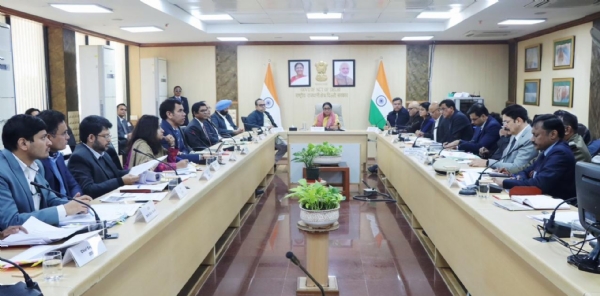
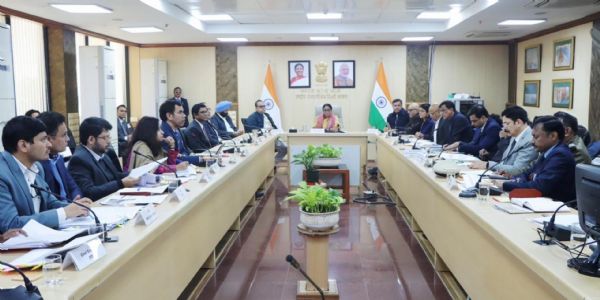
On Friday, the Chief Minister chaired a high-level review meeting on air pollution control at the Delhi Secretariat, attended by Cabinet Ministers Parvesh Sahib Singh, Manjinder Singh Sirsa, Dr. Pankaj Kumar Singh, Chief Secretary Rajiv Verma, and senior officials from various departments.In the meeting, she directed all department heads to execute the pollution control blueprint with unwavering effectiveness and timeliness.
Over the next four years, her government is pursuing a clear, measurable, and results-oriented action plan to substantially reduce PM2.5 levels.
The Chief Minister outlined ambitious fleet expansion targets: 6,000 buses by December 31, 2026; 7,500 by December 31, 2027; 10,400 by March 31, 2028; and 14,000 by March 31, 2029. This includes 500 seven-meter buses for bolstering last-mile connectivity, complementing the current deployment of 100 electric metro feeder buses.
A pilot integration of e-autos, bike taxis, and feeder cabs at 10 major metro stations is slated for execution by January 31, 2026.Under the new electric vehicle policy, the government is targeting Delhi's 5.8 million two-wheelers with subsidies and scrapping incentives, while commercial trucks and three-wheelers benefit from interest subventions and the central PM E-Drive scheme to transition to clean fuels.
To curb emissions from traffic congestion, 62 congestion points have been identified, with immediate improvements underway at 30 sites; Delhi government has also deputed 1,200 additional DTC staff to traffic police for enhanced management.Public transport remains the cornerstone of pollution reduction efforts.
Delhi Metro's 395 km network currently serves 6.5-7 million passengers daily, set for expansion with Phase-4's 110 km and Phases 5A/5B's 96 km, potentially doubling ridership upon Phase-4 completion. NCRTC's network will reach 323 km over the next four years.
The government has committed ₹6,000 crore for extensive road improvements across approximately 3,300 km, encompassing 800 km under PWD, 1,200 km under municipal corporations, and 1,000 km in unauthorized colonies—featuring full paving of edges, central verges, and greening, with tenders issuing within two months and completion targeted within one year.
Mechanized road sweeping and dust suppression are scaling up, with 76 mechanical road sweeping machines (MRSM) currently deployed by MCD, NDMC, DSIIDC, and NHAI; 14 more will join under the National Clean Air Programme by January 31, 2026. Strict deadlines are set for legacy waste clearance: Okhla landfill by July 2026, Bhalswa by October 2026, and Ghazipur by December 2027. MCD receives ₹500 crore this fiscal year and ₹300 crore annually henceforth for waste management.
Adopting a zero-tolerance stance on industrial pollution, over 1,000 polluting units have been sealed to date. Greening initiatives include planting 3.5 million trees in the Delhi Ridge over four years, alongside a new processing plant in Tehkhand to curb construction dust. To prevent winter waste burning, 15,500 electric heaters are being distributed.
Smart parking management, featuring zero-parking zones, designated roadside parking enforcement, and infrastructure expansion with smart pricing, addresses rising vehicle and traffic pressures.
The Chief Minister announced stringent enforcement against polluting vehicles, including special drives and registration campaigns, coupled with automatic number plate recognition systems at Delhi's entry points.
---------------
Hindusthan Samachar / Jun Sarkar
16 Jan 2026