Kolkata, 04 August (H.S.) : Emphasising that sustainable economic reforms require a holistic and systems-based approach, Sanjeev Sanyal, Member of the Economic Advisory Council to the Prime Minister (EAC-PM) and Chancellor of the Gokhale Institute of Politics and Economics, on Tuesday said that long-term development can be achieved only through carefully designed institutional reforms rather than isolated policy interventions.
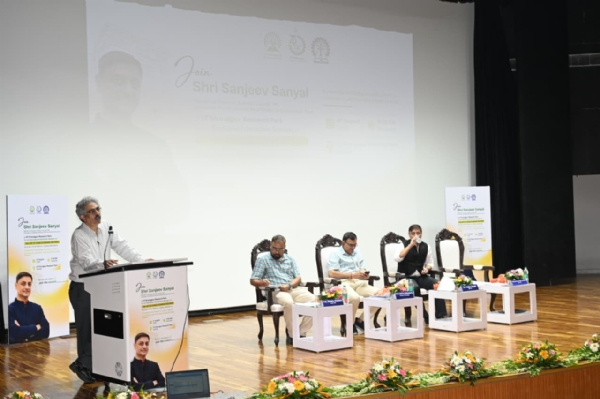
Sanyal was speaking at an interactive session titled The Art of Doing Economic Reforms, organised by the IIT Kharagpur Research Park as part of the institute's Platinum Jubilee celebrations. The programme drew more than 450 participants, including students, researchers, faculty members, entrepreneurs, industry leaders, innovators and alumni, for a discussion on India's reform journey and the roadmap towards Viksit Bharat @2047.
Addressing the gathering, Sanyal said successful reforms are built through systematic process mapping, the removal of bottlenecks and continuous improvements that strengthen institutions without disrupting stability. He stressed that macroeconomic stability remains the foundation of India's long-term growth strategy.
High growth is important, but it must be accompanied by macroeconomic stability. Development is a marathon, not a sprint. Sustainable reforms create lasting outcomes, he said.
Speaking on the impact of artificial intelligence (AI), Sanyal described the ongoing AI revolution as an opportunity to enhance human capabilities rather than replace them. He said the education system must move beyond traditional lecture-based teaching and embrace lifelong learning, apprenticeships and practical skill development.
The future of education lies in continuous learning. Knowledge is increasingly available to everyone; the real advantage will come from the ability to apply it, acquire new skills throughout life and solve real-world problems, he said.
Highlighting India's manufacturing potential, Sanyal said the country possesses all the essential ingredients to emerge as a global manufacturing hub. He noted that improvements in infrastructure, policy reforms and greater confidence in building at scale are creating new opportunities across sectors ranging from electronics to shipbuilding.
Welcoming the participants, Prof. Suman Chakraborty, Director of IIT Kharagpur, said the session provided valuable insights into the philosophy of designing meaningful reforms. He observed that transformative change does not always require dramatic interventions and that well-designed, incremental reforms supported by systems thinking can deliver lasting impact while preserving institutional stability.
Prof. Chakraborty added that the discussions aligned closely with IIT Kharagpur's vision of fostering innovation, interdisciplinary collaboration and meaningful engagement with national priorities.
The programme concluded with a fireside conversation between Prof. Chakraborty and Sanyal on governance reforms, manufacturing, artificial intelligence, higher education, innovation and India's evolving development trajectory. The event also featured an interactive question-and-answer session with students, researchers and industry professionals.
The session reaffirmed the IIT Kharagpur Research Park's commitment to promoting dialogue among academia, government, industry and society while contributing to India's vision of becoming a Viksit Bharat by 2047.
Hindusthan Samachar / Satya Prakash Singh
04 Aug 2026