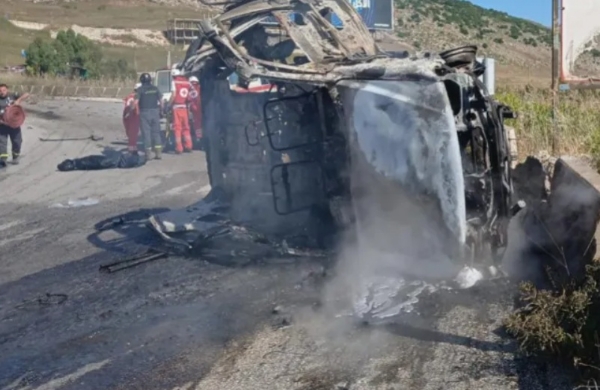
BEIRUT (Lebanon), 07 June (H.S.): The conditional military truce (ceasefire) announced in Washington between Israel and Lebanon through US mediation has proven ineffective, according to Lebanese officials, following a fresh Israeli attack that killed 12 people. Among the dead was Lebanon’s military chief. Authorities confirmed that the military commander, a captain, and a soldier were killed while travelling on the Khardali–Nabatieh Road. The military chief was reportedly scheduled to travel to Pakistan but was killed before reaching his destination.
Lebanese President Joseph Aoun and Prime Minister Nawaf Salam described the targeting of the country’s military chief and Commander-in-Chief of the Armed Forces, Brigadier General Rudolph Haikal, as an attack on Lebanon’s sovereignty. Several countries have also strongly condemned the strike.
According to a report by Al Jazeera, Israel carried out extensive attacks across Lebanon on June 6. The Lebanese Army confirmed that an Israeli airstrike destroyed what was considered a heavily protected military vehicle on the Khardali–Nabatieh Road. Brigadier General Haikal, a captain, and a soldier travelling in the vehicle were killed.
The Israel Defense Forces (IDF) stated that the strike occurred in an active combat zone. According to the IDF, movement within the area requires coordination with Israeli military authorities. The Israeli military said the incident is under investigation.
The Lebanese Army said, “Israel’s deliberate and repeated acts of aggression are aimed at undermining every effort to reach a solution.” President Aoun condemned the attack, describing it as “a blatant violation of Lebanon’s sovereignty and of international laws and norms.”
Prime Minister Salam called the strike “a heinous crime and an attack against Lebanon and all Lebanese people.” He also extended condolences to the families of Brigadier General Wassam Sabra, Captain Elie Khoury, and soldier Hussein Ghozal, as well as to the Lebanese Armed Forces.
The Lebanese Army stated that its top commander, Rudolph Haikal, was travelling to Pakistan for discussions with his Pakistani counterpart, Field Marshal Asim Munir.
The Iran-backed armed group Hezbollah described the attack as a “heinous crime.” The organisation also accused the Lebanese government of dragging the country into further bloodshed by “completely surrendering to the enemy’s demands in Washington.”
Iranian Foreign Ministry spokesman Ismail Baghaei said the killings once again demonstrated that Israel was attempting to assert control over all parts of Lebanon. He described the attack as a “heinous crime against Lebanon, its army, and its sovereignty,” adding that Israel appeared unwilling to see security, stability, or prosperity in Lebanon.
Saudi Arabia condemned the strike and what it described as Israel’s continued aggression against the Republic of Lebanon.
Jordan said the attack represented “a blatant violation of the sovereignty, security, and stability of the friendly state of Lebanon, as well as a clear breach of international law.”
Qatar characterised the incident as a “dangerous escalation and an open violation of Lebanon’s sovereignty.” The Qatari Foreign Ministry urged the international community to intervene, stating that the time had come to compel Israel to fully implement United Nations Security Council Resolution 1701.
The United Nations peacekeeping force in southern Lebanon stated that such attacks constitute serious violations of Lebanon’s sovereignty, territorial integrity, and Resolution 1701, which brought an end to the 2006 war between Israel and Hezbollah.
Lebanon’s state-run National News Agency (NNA) reported that six people were killed and four others injured in an Israeli airstrike on the village of Saksakiya in the Sidon district. Another person was killed in an Israeli drone strike targeting a vehicle in Deir al-Zahrani in the Nabatieh district.
The Israeli military said it had struck approximately 150 Hezbollah positions across southern Lebanon over the previous two days. The targets reportedly included weapons storage facilities, command centres, rocket launchers, and infrastructure sites.
Late on Saturday, the Israeli military announced that two of its soldiers had been killed in southern Lebanon. Meanwhile, Hezbollah claimed responsibility for a drone attack on an Israeli military position in the Bint Jbeil area.
The ceasefire process has been in place since April 17, but it has never been fully observed. Both Israel and Hezbollah have repeatedly accused each other of violating its terms.
Only a few days ago, Lebanese and Israeli representatives in Washington announced a conditional military truce. Hezbollah leader Naim Qassem stated that the group would not recognise the arrangement, arguing that any agreement would only be acceptable if Israel withdrew from southern Lebanon.
Notably, while Israel and Hezbollah have continued to engage in hostilities, the Lebanese Army has historically avoided direct involvement in the conflict and has not participated in the current fighting. The force is reportedly in shock following the death of its commander.
Hezbollah began launching aerial attacks against Israel on March 2 in support of Iran. According to the latest figures released by Lebanon’s Health Ministry, Israeli strikes across Lebanon since March 2 have killed at least 3,593 people and injured 10,990 others.
---------------
Hindusthan Samachar / Jun Sarkar

07 Jun 2026