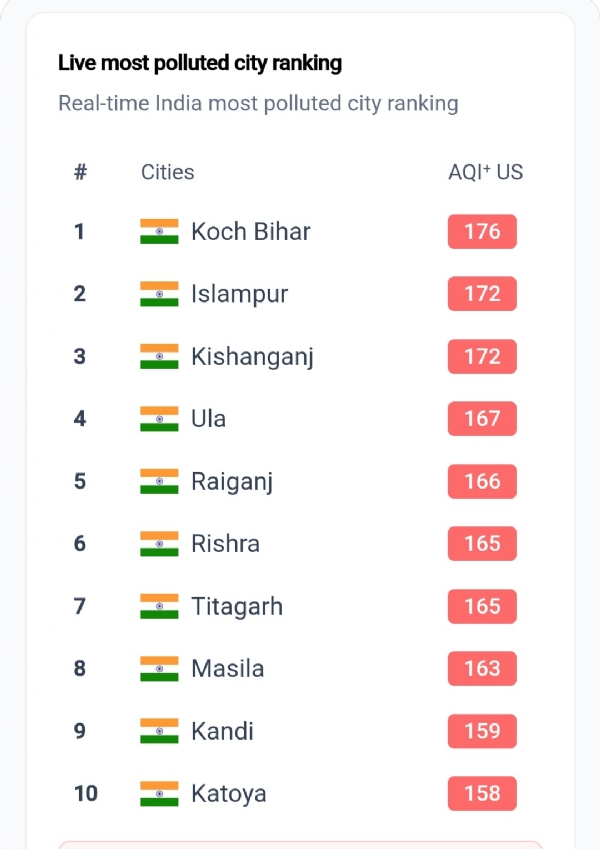
Kolkata, 04 June (H.S.): On the eve of World Environment Day, West Bengal is confronting a significant environmental concern, with eight of the country's ten most polluted cities located in the state, according to real-time air quality data released on Thursday.
Data published by IQAir's Live Most Polluted City Ranking indicated that Cooch Behar recorded the highest pollution level among Indian cities, with an air quality index (AQI) of 176. Other West Bengal cities prominently featured in the ranking include Islampur (172), Ula (167), Raiganj (166), Rishra (165), Titagarh (165), Masila (163), Kandi (159), and Katoya (158). Bihar's Kishanganj ranked third with an AQI of 172.
Under standard air quality classifications, an AQI between 151 and 200 is categorised as Unhealthy, signifying potential health risks for the general population and increased vulnerability for children, senior citizens, and individuals with respiratory conditions.
Environmental specialists noted that the presence of eight West Bengal cities among the country's ten most polluted urban centres underscores the mounting environmental pressures facing the state. Key factors contributing to declining air quality include rapid urbanisation, rising vehicular emissions, construction-related dust, industrial activities, and gaps in environmental compliance.
The report comes at a crucial juncture as governments, institutions, and environmental organisations prepare to observe World Environment Day on June 5, reinforcing calls for sustainable development and stronger environmental stewardship.
Experts have emphasised that awareness initiatives, while important, must be complemented by concrete policy measures and effective implementation. They have called for coordinated efforts involving government agencies, municipal authorities, industries, and citizens to reduce air pollution and safeguard public health.
As air pollution continues to emerge as a critical public health and environmental challenge across India, the latest rankings highlight the urgency of sustained intervention. The inclusion of a large number of West Bengal cities in the national pollution rankings is expected to strengthen calls for more robust pollution-control strategies and stricter enforcement of environmental regulations.
---------------
Hindusthan Samachar / Priyanka Pandey