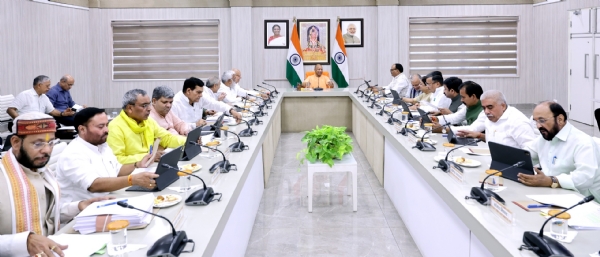
Lucknow, 04 June (HS): Chief Minister Yogi Adityanath has
stated that Uttar Pradesh is not only a center of faith, but also a
representative state of India's cultural consciousness, spiritual tradition,
and knowledge heritage. Tourism development should not be limited to infrastructure
construction alone, but should be further enhanced by linking it with cultural
renaissance, local economy, employment generation, and global recognition. While
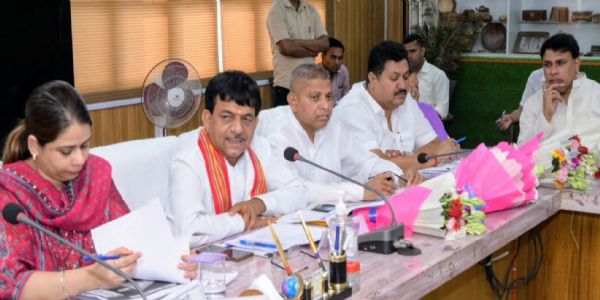
reviewing the Tourism Department on Thursday, the Chief Minister said that
tourism plays a vital role in stimulating Uttar Pradesh's cultural economy.
Through tourism development, local products, handicrafts, traditional arts,
food, culture, and the service sector will also receive significant
opportunities.
Reviewing the Gyan Bharatam Mission, which preserves the
Indian knowledge tradition, the Chief Minister said that India's ancient
manuscripts are a priceless treasure of our civilization, philosophy, science,
and cultural consciousness. Their preservation and digitization are not merely a
matter of documentation, but a means of connecting future generations to their
roots. The meeting was briefed on the progress made in the survey,
digitization, and preservation of more than 1.37 million manuscripts so far.
While reviewing proposed amendments to the Tourism
Policy-2022, the Chief Minister stated that Uttar Pradesh should be positioned
as a leading hub for investment, innovation, and experiential tourism. The
meeting discussed the development of new areas, such as the Neem Karoli Baba Circuit
and the Bundelkhand Fort Circuit. Discussions also focused on promoting new
concepts, such as the Parampara heritage experience center, agri-tourism,
and vineyard tourism. The Chief Minister emphasized that the tourism policy
should attract investment, generate employment, and provide unique experiences
to tourists.
Reviewing the newly inaugurated Naval Shaurya
Vatika and the under-construction INS Gomti Shaurya Museum in Lucknow,
the Chief Minister stated that these projects will serve as an important medium
for conveying patriotism, military pride, and India's maritime heritage to the
new generation. He stated that it should be managed by the Lucknow Development
Authority. The meeting was informed that the INS Gomti Shaurya Museum, under
construction, will showcase the glorious history of the Indian Navy, maritime
power, naval operations, the voyage of INS Gomti, maritime traditions, and
India's maritime heritage through modern technology, interactive galleries,
simulators, a youth cadet arena, and various experiential exhibits. The Chief
Minister stated that this project will further strengthen the spirit of
national service, discipline, and patriotism among the youth.
While reviewing the Chhatrapati Shivaji Maharaj Museum under
construction in Agra, the Chief Minister said that it is a national
responsibility to convey the inspiring stories of national heroes to the new
generation. The museum will showcase the life of Chhatrapati Shivaji Maharaj,
the establishment of Swarajya, his arrival in Agra, his indomitable courage in
the court of Aurangzeb, his historic departure from Agra, his coronation, his
military leadership, Hindu Swarajya, the development of forts, and the concept
of good governance through modern technology. The Chief Minister directed that
the museum should also prominently display the historical ties between the
Maratha Empire and Uttar Pradesh, the role of Ahilyabai Holkar in the
restoration of the Kashi Vishwanath Temple, the preservation of pilgrimage
sites, the state's cultural heritage, the heroes of the freedom struggle, and
the culture of Braj.
Reviewing the overall development of Naimisharanya, the
Chief Minister stated that it is not merely a pilgrimage site, but a vibrant
center of India's Vedic knowledge tradition, spiritual practice, and cultural
heritage. Its development must ensure a balance between religious faith,
environmental protection, and modern amenities. The meeting was informed that
the comprehensive master plan includes the development of the Veda Science Center,
Vedaranyam Wellness and Vedic Theme Park, Rajghat Riverfront, Vyas Gaddi, Sut
Gaddi, Hanumangarhi, Devdeveshwar, and Rudravat Temple Complexes, Naimish Haat,
pilgrim accommodation, an interpretation center, and modern tourism facilities.
It was also stated that the interpretation center will showcase the concept of
Naimisharanya as the birthplace of the Vedas, along with projection mapping,
laser shows, Dashavatara visualizations, and experiences of traditional village
life. The Chief Minister directed that the action plan be carried forward in a
mission mode.
While reviewing the Integrated Master Plan being prepared
for the Mirzapur-Vindhyachal region, the Chief Minister said that Maa
Vindhyavasini Dham is one of the major Shaktipeeths of the country and its
development plan should be prepared keeping in mind future needs. The
development of the Trikon Parikrama area was also discussed in the meeting. It
was also informed that necessary facilities are being developed keeping in mind
the expected number of devotees by the year 2050. The Chief Minister directed
that an effective and attractive presentation of the mythological story of Mata
Sati should be made near the Shaktipeeths of the state and the possibilities of
private sector cooperation should also be utilized for this.
The meeting also reviewed the conservation and enhancement
work at the ancient Somnath Temple in Chitrakoot. The Chief Minister stated
that preserving the state's historical and cultural heritage is our shared
responsibility. Conservation efforts should preserve the original form,
historical authenticity, and architectural features while developing necessary
facilities so that future generations can draw inspiration from these heritage
sites.
Hindusthan Samachar / Abhishek Awasthi