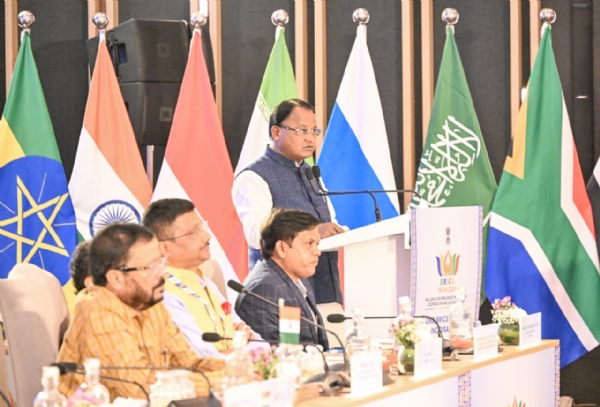
Bhubaneswar, 04 June (H.S.): Odisha Chief Minister Mohan Charan Majhi on Thursday inaugurated the BRICS Disaster Risk Reduction Working Group (DRRG) Technical Meeting in Puri, highlighting the state’s globally recognized disaster management model and calling for stronger international and inter-state cooperation to address the growing challenges posed by climate change and natural disasters.
Welcoming delegates, experts and representatives from BRICS nations, the Chief Minister described the meeting as an important platform for advancing global efforts in disaster risk reduction. He noted that the theme of the conference, “Building for Resilience, Innovation, Cooperation and Sustainability,” reflects the urgent need for collective action to safeguard lives, livelihoods and sustainable development.
Addressing the gathering, Majhi emphasized that disaster risk reduction has become a critical pillar of economic stability, sustainable growth and human security. He observed that climate change, rapid urbanization and environmental degradation are increasing the frequency and intensity of disasters worldwide, making preparedness and coordinated response more essential than ever.
Highlighting Odisha’s experience, the Chief Minister said the state has developed a globally acknowledged disaster management framework based on the principle of “Zero Casualty.” Through evidence-based planning, advanced early warning systems, resilient infrastructure, institutional strengthening and community participation, Odisha has significantly enhanced its disaster preparedness capabilities.
He pointed out that the state remains vulnerable to cyclones, heatwaves, lightning strikes, coastal erosion and emerging urban climate risks. “Odisha’s journey demonstrates that preparedness, strong institutions and active community engagement can substantially reduce disaster impacts. However, future challenges will require greater innovation, stronger partnerships and enhanced technological capabilities,” he said.
Majhi also acknowledged Prime Minister Narendra Modi’s leadership in placing disaster risk reduction at the center of India’s development agenda. He said the Prime Minister’s Ten-Point Agenda for Disaster Risk Reduction provides a comprehensive roadmap focusing on resilience, preparedness, technology adoption, risk-informed development and international collaboration.
Underscoring the importance of resilient infrastructure, the Chief Minister highlighted the recently approved 160-kilometre Greenfield Coastal Highway from Rameswar to Paradeep via Konark, with an estimated investment of Rs. 8,301 crore. He said the project would strengthen Odisha’s disaster preparedness by providing an alternative transportation corridor along the cyclone-prone coastline, facilitating faster evacuations, uninterrupted supply chains and efficient emergency response during disasters.
He also referred to other major infrastructure projects, including the 111-kilometre Capital Region Ring Road project and the Bhubaneswar-Cuttack-Puri-Paradeep Economic Region initiative, stating that these projects would contribute significantly to long-term resilience and climate adaptation while supporting economic growth.
Revenue and Disaster Management Minister Suresh Pujari highlighted Odisha’s transformation in disaster management since the devastating Super Cyclone of 1999. He said the lessons learned from the disaster helped shape a governance model that is now globally recognized.
Pujari emphasized the state’s strong focus on community-based disaster preparedness. Alongside robust infrastructure and advanced early warning systems, Odisha has invested heavily in strengthening local communities, which serve as first responders during emergencies. Initiatives such as last-mile information dissemination and community capacity-building programs have enhanced rapid response capabilities across vulnerable regions.
National Disaster Management Authority (NDMA) Member and Head of Department Krishna S. Vatsa and NDMA Member Rita Missal also addressed the gathering.
Expressing confidence in the outcomes of the meeting, the Chief Minister said the “Puri Deliberations” could emerge as a landmark contribution to global disaster risk reduction frameworks, further strengthening international cooperation and resilience-building efforts worldwide.
---------------
Hindusthan Samachar / Monalisa Panda