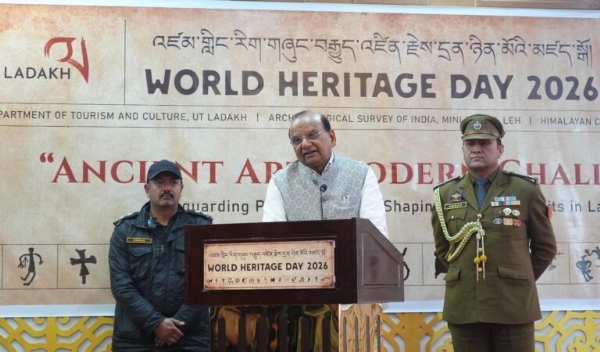
Leh, 19 April (H.S.): In a landmark initiative to preserve Ladakh’s ancient heritage, Lt Governor Vinai Kumar Saxena on Saturday laid the foundation stone for India’s first Petroglyph Conservation Park on the banks of the Indus River here on World Heritage Day.
Petroglyphs are prehistoric images, symbols, or carvings etched, pecked, or engraved directly onto rock surfaces.
The park aims to serve as a dedicated conservation space for centuries-old rock carvings (petroglyphs) that are increasingly under threat due to unregulated tourism, rapid infrastructure development, and a lack of awareness, officials said.
They said the park will house petroglyphs collected from vulnerable and isolated locations across Ladakh, ensuring their preservation for future generations while also making them accessible to visitors in a curated and educational setting.
A Memorandum of Understanding (MoU) was signed between the Department of Archives, Archaeology and Museums and the Archaeological Survey of India (ASI) for the preservation of heritage for future generations through joint intervention, they said.
Officials informed that nearly 400 sites across Ladakh contain petroglyphs, found either in clusters or in isolation.
While cluster sites are relatively easier to conserve, isolated petroglyphs — especially those along the banks of the Indus River and Zanskar River — face significant risk of damage due to construction activities and lack of awareness among people.
These endangered artefacts will be carefully relocated to the Petroglyph Conservation Park for protection and display, officials said, adding that some of the oldest petroglyphs have inscriptions in Chinese, Arabic, Sanskrit and other ancient languages.
The Lt Governor emphasised that the park would serve as a vital step towards preserving the region’s ancient art and history for generations to come. He termed Ladakh as a “repository of ancient heritage” and said the region hosts one of the most extensive collections of prehistoric rock art in South and Central Asia.
“Beyond natural weathering and climate stress, human activities, such as road construction, blasting of rocks, and unregulated tourism, pose serious risks to these petroglyphs.
---------------
Hindusthan Samachar / Krishan Kumar



19 Apr 2026
Vishu post row : Hindu Aikya Vedi files complaint over 'Derogatory’ deciption of Lord Krishna
Vishu post row : Hindu Aikya Vedi files complaint over 'Derogatory’ deciption of Lord Krishna..