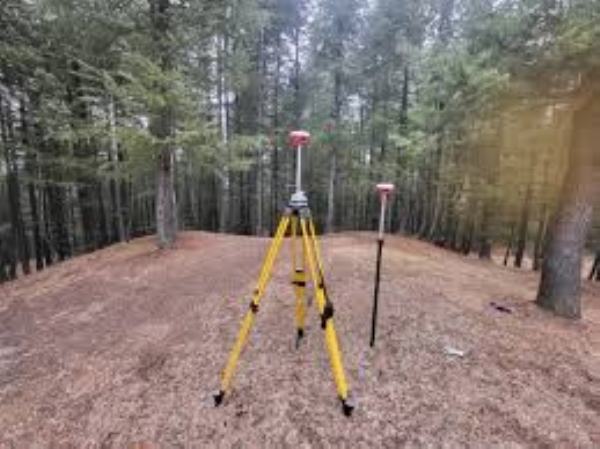
Jammu, 30 March (H.S.): The Jammu and Kashmir Forest Department has taken a major technological leap in protecting forest land by adopting advanced Differential Global Positioning System (DGPS) technology for survey and demarcation of forest boundaries.
Officials said safeguarding forest land is the department’s primary responsibility, with accurate boundary demarcation being a critical component of this mandate.
Forest demarcation in Jammu and Kashmir dates back to 1914, when the Jammu and Kashmir Forest Convention was implemented during the reign of Maharaja Pratap Singh.
Following the convention, extensive demarcation of forests was carried out and detailed records were prepared, including boundary pillar descriptions, forest registers, forest area registers, and other related documents.
“However, over time, boundary pillars often get damaged or displaced due to natural and human factors, requiring revision of demarcation, which is a time-consuming and labour-intensive process,” an official of the Forest department said.
He said that with the advancement of technology, the department started using GPS to record geo-coordinates of boundary pillars during demarcation revisions. The GPS system provided an accuracy of about three to five metres.
To achieve survey-grade and centimetre-level accuracy, the department has now adopted DGPS technology. DGPS consists of three main components – the space segment (satellites), the user segment (GNSS receiver and rover), and the control segment, which can be a base station or a CORS network.
Officials explained that when connectivity with the CORS network is not available, the department can establish its own base station. The base station, which is essentially another rover placed at a fixed static position, continuously monitors satellite signals and calculates errors and positional anomalies. These corrections are then transmitted to the rover, which applies real-time corrections to obtain highly accurate coordinates.
“Using this technology, the department can now record the precise coordinates of forest boundary pillars and prepare digitized forest maps, significantly improving forest land protection and boundary management,” the senior officer said.
---------------
Hindusthan Samachar / Krishan Kumar


30 Mar 2026