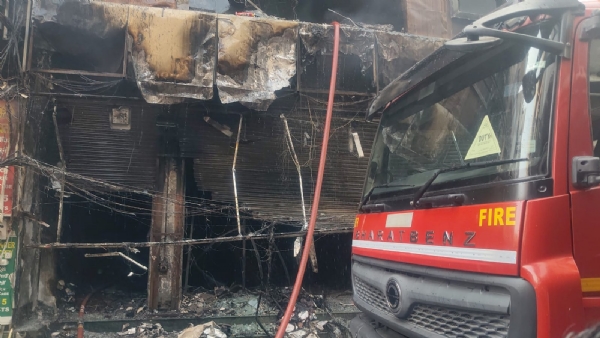
New Delhi, 18 March (H.S.): Delhi’s Palam area was engulfed in panic and grief on Wednesday morning when a four‑storey building in Sadh Nagar’s Gali No. 2 erupted into flames, turning the structure into a vertical inferno within minutes. The blaze trapped residents who had little time to react, and, with only one narrow, fire‑engulfed escape route, killed nine people, including three young girls. The tragedy has reignited anguish over unsafe high‑risk structures and lax fire‑safety enforcement in the capital.
Eyewitnesses described how most of the people inside the building were asleep when the fire started around 6:45–7:04 AM in the ground‑floor cosmetic and clothing showroom. The flames spread so fast that families barely had a chance to escape. The entire structure had only one constricted internal passage leading to the front of the building, and that very corridor quickly became saturated with dense, toxic smoke and scorching heat.
Many residents rushed to balconies, screaming for help, but onlookers were too scared to enter because of the ferocity of the flames. Firefighters later said the lack of alternate exits and emergency staircases turned the building into a “death trap,” effectively sealing the fate of several occupants.
One of the most harrowing moments came when Anil Kashyap, son of the building’s owner, Rajendra Kashyap, tried to save his one‑year‑old daughter, Mitali. Unable to carry the infant to safety along the burning passage, he hurled her from the second floor into a crowd below, who scrambled to catch her.
Miraculously, Mitali’s fall was cushioned and she survived. Anil then jumped himself, sustaining serious head injuries. Another person attempting to descend via a fire‑brigade ladder lost his balance, fell and crashed to the ground, further complicating rescue operations. Such scenes underscored how the building’s vertical layout and poor access multiplied the danger for both residents and rescuers.
Locals identified the building as owned by Rajendra Kashyap, the market head, and said it was a high‑risk mixed‑use structure: the basement and ground floor housed a large beauty salon, bangle and cosmetics showroom, where vast quantities of flammable cosmetics, chemicals and fabrics were stored.
The first floor also hosted textile displays. This gave the fire ample fuel, and within minutes it raced upwards to the residential floors above, where about 15 family members lived.
Rescue workers noted that if there had been even a secondary staircase or rear exit, far more lives might have been saved. The confined escape route and the hallway packed with combustible materials essentially turned the upper floors into airtight chambers of fire and smoke.
Residents claimed they first noticed flames around 6:45 AM, yet the first fire‑tender arrived only about 30 minutes later, and hydraulic ladder machines took additional time to become operational. Frustrated bystanders reportedly tried to break into another nearby building and force‑feed a connector line through its wall, but thick smoke and heat made this effort unworkable.
Finally, around 30 fire‑tenders and 11 ambulances converged on the site, and the blaze was brought under control after hours of gruelling work, though the factory section continued to smoulder for some time.
Police have now confirmed nine deaths: Praveen (33), Kamal (39), Aashu/Anil (35), Lado (70), Himanshi (22), and three minor girls (15, 6 and 3 years). Deepika (around 28) later succumbed after being rushed to hospital. Among the injured, Anil (about 32) and a two‑year‑old child are under treatment, while Sachin (29) has been admitted with around 25% burn injury at Safdarjung Hospital.
Other victims, including those who jumped or were pulled out unconscious, were rushed first to Manipal Hospital and IGI Hospital and then to other facilities; several were declared dead on arrival.
The Palam fire has once again spotlighted the dangers of unregulated multi‑storey buildings, illegal mixed‑use structures, and the absence of functioning fire‑safety norms in densely populated urban pockets. One escape route, unrestricted storage of combustibles, and inadequate emergency preparedness combined to turn a routine early‑morning fire into a catastrophic loss of life.
Locals argue that had there been proper fire‑safety infrastructure, building‑code compliance, and timely arrival of fire services, several lives could have been spared.
In this sense, the tragedy is not just an accident but a symptom of systemic negligence and institutional inertia—a stark reminder that in crowded Indian cities, a single unaddressed safety flaw can, on a Wednesday morning, rewrite the fate of an entire family.
---------------
Hindusthan Samachar / Jun Sarkar


18 Mar 2026