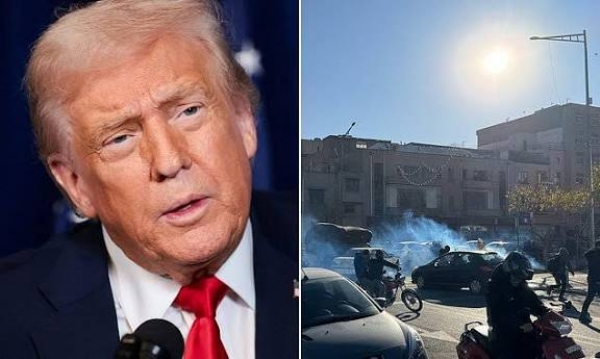
Tehran, 03 January (H.S.): Iranian leaders have issued stark threats against United States forces across West Asia after President Donald Trump declared that America was “locked and loaded” and would intervene if Iranian security forces used lethal force against anti-government demonstrators.
The escalation comes amid the most serious unrest in the Islamic Republic since the 2022 protests over Mahsa Amini’s death, with at least seven people reported killed in clashes linked to the latest wave of demonstrations.
Trump, posting on his Truth Social platform, warned that if Iran “violently kills peaceful protesters,” the United States “will come to their rescue,” adding that US forces were “locked and loaded and ready to go,” without clarifying what form any intervention might take.
His comments mark one of the clearest public signals of support by a sitting US president for Iranian protesters, a stance previous administrations had often softened over fears that activists inside Iran would be branded foreign agents.
Within hours, senior figures in Tehran accused Washington and Israel of inciting the unrest and warned of consequences for American troops stationed in the region.
Ali Larijani, former parliament speaker and now secretary of Iran’s Supreme National Security Council, alleged on X that the United States and Israel were “stoking the demonstrations,” offering no evidence but echoing a familiar narrative that blames external enemies for domestic unrest.
He cautioned that US interference in what he called Iran’s “domestic problem” would mean “chaos in the entire region and the destruction of US interests,” urging Americans to “take care of their own soldiers.”
Ali Shamkhani, a long-time security heavyweight and adviser to Supreme Leader Ayatollah Ali Khamenei, went further, warning that any “interventionist hand” nearing Iran’s security “will be cut.”
Hard-line parliament speaker Mohammad Bagher Qalibaf declared that all American military bases and forces in the region would be treated as “legitimate targets” if Washington moved beyond threats.
Iran’s foreign ministry spokesman Esmail Baghaei listed decades-old grievances—from the CIA-backed 1953 coup to the 1988 downing of an Iranian civilian airliner and recent US strikes on Iranian nuclear sites—to argue that Washington had forfeited any moral authority to speak on human rights in Iran.
Those nuclear strikes in June were themselves a turning point in the confrontation. In response to US attacks that Trump said “obliterated” three Iranian nuclear facilities during Israel’s 12‑day war with the Islamic Republic, Tehran launched ballistic missiles at Al Udeid Air Base in Qatar, a key hub for US forces.
Satellite imagery and US officials later confirmed that at least one missile hit a geodesic dome housing a secure communications terminal, causing limited structural damage but no casualties, and leaving the base fully operational.
Iranian media and officials framed the strike, dubbed Operation Besharat Fatah, as proof that US assets across the Middle East could be hit at will if Washington crossed Tehran’s red lines.
The latest protests, now in their sixth day, were initially triggered by the dramatic collapse of Iran’s rial currency, which has plunged to around 1.4 million rials to the US dollar, fuelling soaring prices and deepening public anger over mismanagement and corruption.
Demonstrations that began with bazaar merchants and shopkeepers in Tehran have spread to cities including Shiraz, Isfahan, Kermanshah and parts of the restive Sistan and Baluchestan province, with crowds chanting increasingly political, anti‑government slogans.
Analysts note that while participation is not yet nationwide, the unrest is already the largest since the 2022–2023 “Woman, Life, Freedom” movement that followed Mahsa Amini’s death in morality‑police custody.
Online footage from recent funerals has intensified public outrage, showing mourners confronting security personnel and disputing official efforts to portray some of the dead as members of the Basij militia.
One widely circulated clip from Lorestan province captured the father of a 21‑year‑old man killed during protests denying that his son had ever served in the volunteer force, forcing semi‑official media to acknowledge “questions” about initial government claims.
Rights advocates and regional experts say such episodes risk further eroding trust in state institutions already weakened by years of crackdowns and economic decline.
Iran’s newly elected reformist president, Masoud Pezeshkian, has struck a conciliatory tone in public, acknowledging that “people’s livelihoods” are in crisis and warning that failure to address economic grievances would have severe moral and political consequences for the leadership.
His government has signalled openness to dialogue with demonstrators and has reshuffled economic managers, including changes at the central bank, but Pezeshkian has conceded that he has limited room to maneuver under sanctions and the tight control of unelected institutions.
Tehran has also attempted to reassure foreign powers by announcing a halt to uranium enrichment at all declared sites, framing the move as a gesture aimed at reviving nuclear diplomacy and easing sanctions, although substantive talks have yet to resume. Trump’s intervention has introduced a volatile new variable into this already combustible mix.
Policy analysts warn that while his vow to “come to the rescue” of peaceful protesters may galvanise some Iranians, the authorities are likely to seize on his remarks as proof that the unrest is orchestrated by foreign enemies, providing a pretext for harsher repression.
The memory of Barack Obama’s more cautious approach during the 2009 Green Movement—later described by Obama himself as a mistake—underscores the dilemma: overt US support can both embolden demonstrators and hand hard‑liners a propaganda gift.
Regional security experts caution that any US strike in response to a bloody crackdown could trigger a chain reaction across a theatre where American forces remain heavily deployed, from the Gulf to Iraq and Syria.
Iranian officials and state media have already broadened their rhetoric beyond US bases to suggest that “every American citizen or military personnel” in the region could be considered a target if Washington escalates militarily. For now, US defence officials say there have been no major changes to troop posture or alert levels, but warn privately that the combination of street unrest inside Iran and open threats against US installations leaves little margin for miscalculation.
---------------
Hindusthan Samachar / Jun Sarkar
03 Jan 2026