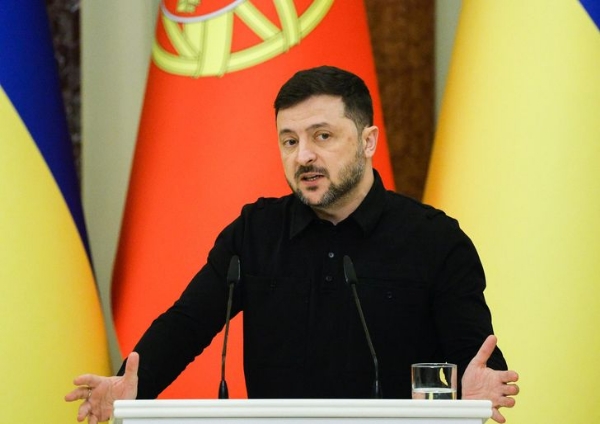
Kyiv, 03 January (H.S.): Ukrainian President Volodymyr Zelenskyy announced on Friday his intention to overhaul the defence ministry's structure by appointing First Deputy Prime Minister and Digital Transformation Minister Mykhailo Fedorov, aged 34, as the new defence minister, a move aimed at injecting technological innovation into the country's war effort against Russia.
In his daily evening address broadcast on social media, Zelenskyy praised Fedorov’s pivotal role in advancing Ukraine’s “drone line” initiative and digitalising state services, declaring that the nominee “works very effectively” on these fronts alongside military personnel, commanders, weapons manufacturers, and international partners.
Fedorov, who would succeed Rustem Umerov—the Crimean Tatar economist appointed in September 2023 to replace Oleksii Reznikov amid procurement scandals—brings a background as Ukraine’s youngest-ever minister, having spearheaded the “State in a Smartphone” (Diia) app since 2019.
This platform has amassed over 20 million users by delivering public services online, automating 20% of processes without bureaucratic intervention, and enabling digital IDs, business registrations, and wartime innovations like remote voting and e-governance under duress.
A former marketer from Zaporizhzhia who managed Zelenskyy’s 2019 presidential campaign digitally, Fedorov has prioritised AI, cybersecurity, and defence tech, including drone production scaling critical for frontline operations nearly four years into Russia’s full-scale invasion.
The proposal, part of a broader cabinet reshuffle, requires approval from Ukraine’s parliament, the Verkhovna Rada, where Zelenskyy’s Servant of the People faction holds sway despite wartime attrition.
Zelenskyy framed the changes as essential to “implement changes in the defence sector that will truly help,” amid persistent Russian advances, drone swarms over Moscow, and recent escalations like alleged Ukrainian strikes near President Vladimir Putin’s residence—claims Kyiv has dismissed as propaganda.
Critics and analysts view the shift from Umerov, a negotiation specialist who led Istanbul talks and focused on Western arms procurement, to the tech-oriented Fedorov as a bid to modernise procurement, combat corruption, and leverage digital tools for asymmetric warfare.
This is not Fedorov’s first brush with defence leadership; prior reshuffles saw him eyed for expanded roles, while Umerov transitioned to the National Security and Defense Council in mid-2025.
Zelenskyy’s address on Friday, delivered as the new year dawned under intensified Russian assaults on energy infrastructure, underscores Kyiv’s imperative to adapt amid donor fatigue and battlefield stalemates.
If ratified, Fedorov’s tenure—potentially retaining his digital portfolio—could accelerate Ukraine’s pivot to homegrown AI-driven munitions and cyber defences, vital as Western aid evolves under the second Trump administration.
---------------
Hindusthan Samachar / Jun Sarkar

03 Jan 2026
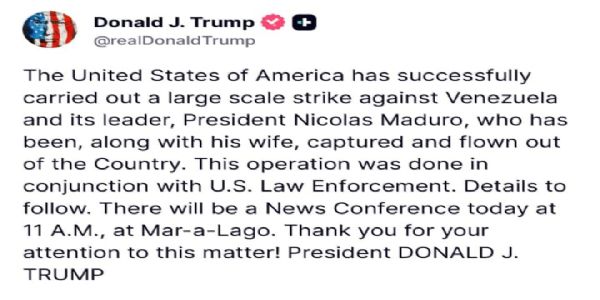
Global Outrage Erupts Over US Military Strikes on Venezuela, Sparking Sovereignty Crisis
03 Jan 2026