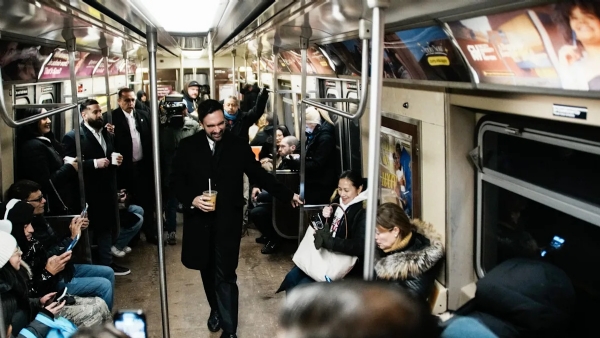
New York, 03 January (H.S.): Less than 24 hours after his historic midnight inauguration at the abandoned Old City Hall subway station on New Year's Eve, New York City's trailblazing democratic socialist mayor Zohran Mamdani launched his first full workday on Friday with an emblematic subway ride from his modest Queens apartment, bundled against biting cold and shadowed by security and media crews.
The 34-year-old son of Ugandan-Indian academic Mahmood Mamdani and trailblazing filmmaker Mira Nair—New York’s first South Asian and Muslim mayor—posed for selfies with starstruck riders on a Manhattan-bound train before settling into a corner to pore over briefings, his journey instantly viral as a nod to his pledge that government “looks and lives like the people it represents.”
When puzzled French tourists queried the commotion, Mamdani quipped he was “the new mayor of New York,” brandishing that morning’s New York Daily News emblazoned with his image to dispel scepticism, a light-hearted vignette underscoring his everyman ethos amid the unprecedented scrutiny shadowing his nascent tenure.
Hailing from a family of leftist intellectuals—Mamdani, a Queens assemblyman since 2020, rode a wave of renter frustration and progressive fervour to trounce establishment foes in November, vowing rent freezes, public safety reimagined sans “broken windows” policing, and divestment from Israel.
Fresh from Thursday’s inauguration—where Attorney General Letitia James administered the oath at stroke of midnight in the beaux-arts relic beneath City Hall, followed by public pomp at City Hall Plaza—Mamdani dashed to a Brooklyn tenants’ rally, amplifying cheers as he recommitted the city to battling negligent landlords emblematic of his “frozen rent” crusade.
He unveiled a “mass engagement” office to sustain campaign-style voter mobilisation and plans to relocate from his one-bedroom rental—shared with wife—to Gracie Mansion before month’s end.
Yet the day’s buoyancy soured with controversy over rescinding predecessor Eric Adams’ late-term executive orders: one enshrining the IHRA definition of antisemitism encompassing certain Israel critiques, and another prohibiting city boycotts or divestments from Israel—a nod to Mamdani’s vocal BDS advocacy, labelling Israel an “apartheid state” and decrying its Gaza operations as potential “genocide.”
Israel’s government blasted the reversal as “antisemitic gasoline on an open fire” via social media, while Jewish groups decried it; Mamdani countered from scripted notes, vowing relentless anti-hate efforts while retaining Adams’ dedicated antisemitism office.
Preemptively issued by Adams amid Mamdani’s anti-Zionist profile—critics spotlighting his October 7 equivocations, BDS endorsements, and calls to dismantle US-Israel economic ties—the orders aimed to shield synagogues and counter rising tensions in a city with the largest Jewish population outside Israel.
Mamdani, who condemned civilian killings on October 7 as “horrific war crimes” while prioritising “ending the occupation,” affirmed focus on “public safety for all,” including Jews, amid NYPD Commissioner Jessica Tisch’s brother’s prior “enemy” slur—now apologised for.
Surrounded by throngs phones aloft at City Hall, he evoked renewed faith in governance: “New Yorkers are allowing themselves to believe in the possibility of city government once again... That belief will not sustain itself without action.”
---------------
Hindusthan Samachar / Jun Sarkar
03 Jan 2026
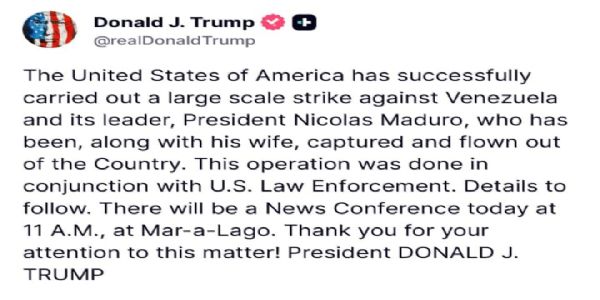
Global Outrage Erupts Over US Military Strikes on Venezuela, Sparking Sovereignty Crisis
03 Jan 2026