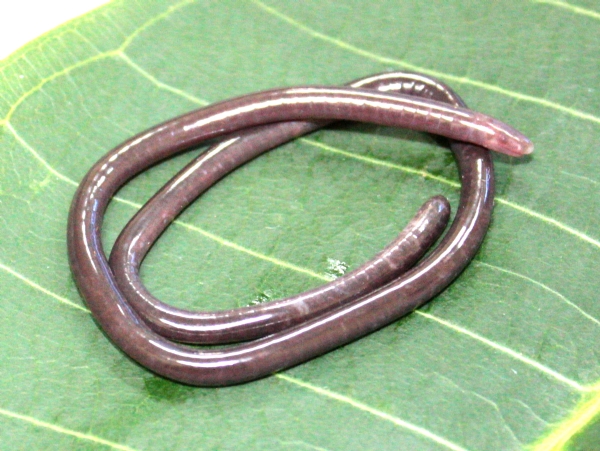
Kolkata, 16 January (H.S.) : A team of Indian scientists has discovered a new and extremely rare species of subterranean amphibian in the northern Western Ghats of Maharashtra. The newly identified species has been named Gegeneophis valmiki. The discovery is considered significant as it marks the first scientific identification of a new species within this genus in more than a decade. Animals belonging to this group are often referred to in the scientific community as “hidden amphibians” due to their secretive, underground lifestyle.
The species was first collected in 2017 from the Valmiki Plateau area of Satara district in Maharashtra. It was discovered by Dr. K. P. Dinesh, Senior Scientist at the Zoological Survey of India (ZSI), Kolkata. The species has been named in honor of the historic Maharshi Valmiki temple located near the discovery site. The findings of the study have been published in the international scientific journal Phyllomedusa. The research was carried out through a collaborative effort involving the Zoological Survey of India, Savitribai Phule Pune University, Balasaheb Desai College, and the Mhadei Research Centre.
Caecilians are limbless, worm-like amphibians that live deep within soil and organic layers. Unlike frogs, they do not produce vocal calls and are rarely seen, making their discovery particularly challenging. Scientists explain that identifying members of the Gegeneophis group in the field is extremely difficult, as they are commonly known as blind caecilians. Their eyes are hidden beneath a bony skull, and their appearance and movement closely resemble earthworms. As a result, confirming this animal as a new species required years of detailed morphological and genetic analysis.
Although the Western Ghats are recognized globally as a major biodiversity hotspot, caecilian amphibians remain among the least understood groups. Of the nearly 9,000 amphibian species known worldwide, only 231 are caecilians. India is home to 457 amphibian species, of which 42 are caecilians. The Western Ghats alone host 26 endemic caecilian species, including 11 belonging to the Gegeneophis group. Interestingly, while overall amphibian diversity is higher in the southern Western Ghats, the northern region shows a distinct concentration of Gegeneophis species.
Scientists note that caecilians play an important role in maintaining ecological balance. By burrowing through the soil, they help aerate it and improve its structure, while feeding on soil-dwelling invertebrates. They also serve as an important food source for birds, reptiles, and small mammals. From an evolutionary perspective, caecilians are considered a crucial link between aquatic and terrestrial vertebrate life.
Director of the Zoological Survey of India, Dr. Dhriti Banerjee, has warned that nearly 41 percent of the world’s amphibian species are currently threatened with extinction. In this context, documenting such rare species has become a race against time. Without timely identification and conservation, many species could disappear without ever being known to science, a phenomenon referred to as “silent extinction.”
According to conservation expert Nirmal U. Kulkarni, this discovery is only the beginning. Genetic studies suggest that several more unknown species may still be hidden in the northern Western Ghats. Formal scientific recognition, he said, is the first crucial step toward bringing these hidden amphibians into the conservation mainstream and protecting their fragile habitats.
Hindusthan Samachar / Satya Prakash Singh

16 Jan 2026