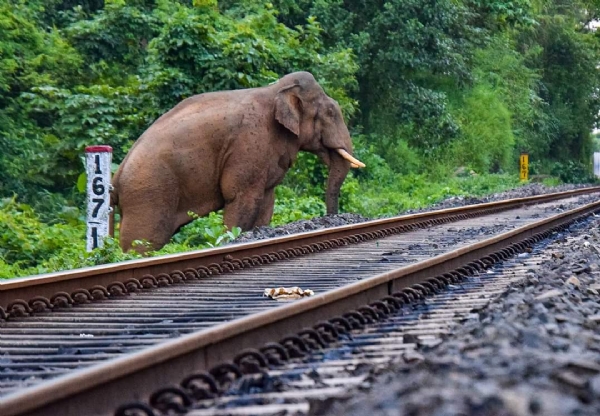
Guwahati, 25 December (HS): The Northeast Frontier Railway (NFR) has successfully safeguarded the lives of more than 160 elephants during 2025 through a series of proactive and technology-driven measures aimed at preventing elephant–train collisions. These sustained efforts underline NFR’s strong commitment to wildlife conservation while ensuring safe and uninterrupted train operations across its network.
A key initiative in this direction is the deployment of the Intrusion Detection System (IDS), an advanced Artificial Intelligence-based technology that works on Distributed Acoustic System (DAS) principles. The system detects elephant movement near railway tracks and immediately sends real-time alerts to loco pilots and control rooms, enabling timely preventive action and significantly enhancing operational safety.
The IDS has already been commissioned in several critical sections passing through elephant corridors. These include the 24-km Kamakhya–Azara–Mirza section under Rangiya Division, the 52-km Madarihat–Nagrakata section under Alipurduar Division, the 32-km Habaipur–Lamsakhang–Patharkhola–Lumding section under Lumding Division, and the 23-km Titabar–Mariani–Nakachari section under Tinsukia Division. Together, these cover 62.7 km of elephant corridors and 131 km of block sections, substantially improving safety in sensitive wildlife zones.
Building on the success of these installations, IDS work is currently underway across multiple divisions, including 92 km in Alipurduar, 25 km in Katihar, 174 km in Rangiya, 110 km in Lumding and 12 km in Tinsukia Division. Once completed, the system will cover all elephant corridors under NFR, spanning 146.4 km, with a total block section length of 413.42 km, creating a comprehensive and robust safety network.
In addition to IDS, NFR has implemented several innovative preventive measures. The ‘Plan Bee’ system, installed at vulnerable level crossing gates, uses amplified honeybee sounds audible up to 400 metres to deter elephants from approaching railway tracks. In close coordination with the Forest Department, NFR has also strengthened safety through real-time information sharing, night-time speed restrictions in elephant corridors, temporary speed curbs based on sightings, sensitization of train crews, installation of cautionary signage and vegetation clearance to improve visibility.
At the national level, Indian Railways has expanded the use of the AI-enabled IDS based on DAS technology, which was successfully piloted on the Northeast Frontier Railway. The system is now being extended to other parts of the country, covering an additional 981 route kilometres and taking the total coverage to 1,122 route kilometres across Indian Railways. Since 2017, more than 2,000 elephants have been safely protected while crossing railway tracks under the NFR network, reflecting a sustained and impactful commitment to wildlife conservation. --------
Hindusthan Samachar / Sriprakash