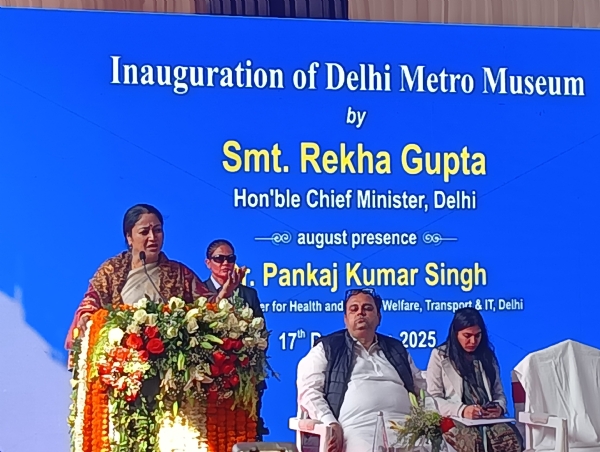
New Delhi, 21 December (H.S.): Delhi Chief Minister Rekha Gupta on Sunday emphasized that strengthening public transport, particularly expanding the Delhi Metro network with last-mile connectivity, remains essential for effectively controlling pollution in the national capital and NCR.
Addressing the issue, Gupta stated her government has allocated 60% more funds to the transport department in the current budget compared to the previous year, including adequate provisions for ongoing Delhi Metro projects to ensure no disruptions. She revealed that the government is also clearing the metro's legacy dues from previous administrations, adding that had earlier governments taken transport infrastructure seriously, Delhi would not face such severe pollution today.
Gupta cited reports from the Centre for Science and Environment (CSE) and other sources indicating vehicle emissions as a major contributor to Delhi-NCR's environmental degradation.
To counter this, the government is taking decisive steps to reduce vehicular pressure and pollution through robust public transport, aligning with Prime Minister Narendra Modi's vision of net-zero emissions and modern infrastructure.
Budget Boost for Metro Revival
In the 2025-26 budget, the transport department receives ₹9,110 crore—nearly 60% higher than the ₹5,702 crore allocated by the previous government in 2024-25—demonstrating commitment to the lifeline Delhi Metro. While the prior regime provided around ₹500 crore for metro projects, the current budget allocates a substantial ₹2,929 crore.
The cabinet has approved three key MRTS Phase-IV corridors: Lajpat Nagar-Saket, Indralok-Indraprastha, and Rithala-Kundli (Haryana), enhancing intra-city and NCR connectivity.
Delhi government bears ₹3,386.18 crore of the cost, having already disbursed ₹940 crore this fiscal year with ₹336 crore in process, alongside settling nearly ₹2,700 crore in Phase I-III dues.
Gupta asserted that sustainable pollution reduction demands shifting from private vehicles to public transport, aiming to make the metro network so extensive that last-mile private vehicle use becomes unnecessary.
Active government representation on the DMRC board ensures better coordination, prompt funding, and timely execution. She reiterated that previous governments' neglect exacerbated pollution and public health issues in Delhi-NCR.
Aligning with PM Modi's zero-emission transport dream, the government efficiently utilizes central assistance under the special package to complete Phase-IV on schedule.
---------------
Hindusthan Samachar / Jun Sarkar