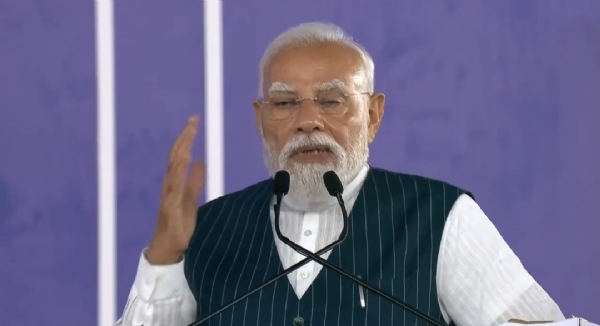
SANAND (Gujarat), 04 July (H.S.): Prime Minister Narendra Modi on Saturday inaugurated CG Semi's Outsourced Semiconductor Assembly and Test (OSAT) facility in Sanand, Gujarat, and said that the expansion of India's semiconductor industry represents the next phase of the electronics revolution that has transformed the country over the past decade. He said India's goal is to build a complete semiconductor ecosystem, from chip design and fabrication to packaging, thereby establishing the entire electronics value chain within the country.
Developed with an investment of more than Rs 7,500 crore, the facility is among the first four semiconductor projects approved under the India Semiconductor Mission. Addressing the gathering, the Prime Minister said the inauguration demonstrates India's ability to accomplish the goals it sets for itself.
PM Modi recalled that five years ago India had resolved to emerge as a global semiconductor hub. Advancing with the vision of Design in India and Make in India, the country has now commenced commercial chip packaging production at its third semiconductor plant.
He said he had laid the foundation stone for the project in 2024, testing of semiconductor chips began at the facility in August 2025, and the plant has now been formally inaugurated. He described the journey from foundation stone to commercial production as the outcome of the dedicated efforts of numerous individuals.
The Prime Minister said the CG Semi facility reflects the joint efforts of industrial partners from India, Japan and Thailand. He described it as not merely a commercial enterprise but a model of technology, trust and international partnership that will accelerate India's semiconductor journey.
He said he had been informed that the facility would manufacture nearly 200 million semiconductor chips annually, with a target of producing more than 15 million chips every day. Expressing confidence that the target would soon be achieved, Modi remarked that the Semicon India Programme is progressing step by step, brick by brick, and now chip by chip.
Recalling his earlier efforts, the Prime Minister said that nearly two decades ago, and even earlier, he had prepared a comprehensive plan to establish a semiconductor manufacturing plant in Gujarat. Around 350 to 400 acres of land had been identified and discussions had been held with several companies. However, he said, policy constraints at the Centre at that time prevented the project from moving forward.
He added that when he used to speak about semiconductors during those years, many in the media mocked the idea. Today, seeing that vision become a reality gives him immense satisfaction.
PM Modi said the occasion also reflects India's unwavering commitment to building a developed nation. He recalled that at the beginning of the year he had stated that four semiconductor facilities would become operational by 2026, but he had now been informed by his ministers that the number would increase to five.
The Prime Minister said today's India sets ambitious goals and completes them within the stipulated timeframe. This, he added, has strengthened the confidence of global investors in the country. India's policy stability, clarity in decision-making and speed of implementation have created a favourable investment climate, and the reform process will continue to gather momentum.
Referring to the C-295 aircraft manufactured in Vadodara, PM Modi said the aircraft had successfully taken flight after being built in India, although it did not receive the level of media attention it deserved. He observed that no country can become a global industrial power on the strength of a single factory alone. Citing Silicon Valley in the United States and Silicon Island in Japan as examples of successful industrial clusters, he said Sanand is now moving in the same direction as India develops a major semiconductor manufacturing cluster.
The Prime Minister remarked, I never set small targets, nor do I think small. Even when I build a statue, I build the world's tallest. In a lighter moment, he added, You hear it, don't you, Vinod... the work speaks for itself.
He reiterated that India's objective is to establish a complete semiconductor ecosystem encompassing chip design, fabrication and packaging. Chips manufactured in India, he said, will empower the country's youth to lead the next wave of innovation in artificial intelligence, robotics and other advanced technologies.
PM Modi emphasised that the growth of India's semiconductor industry has not occurred overnight but is the natural progression of the electronics revolution witnessed over the past decade. He said India has advanced from manufacturing finished products to producing electronic components and has now entered semiconductor manufacturing, ensuring that the entire electronics value chain is developed domestically. According to him, this is the roadmap for Viksit Bharat and the next stage of the Make in India initiative.
Highlighting the country's achievements, the Prime Minister said India is now the world's second-largest mobile phone manufacturer and the second-largest exporter of mobile phones. Compared with 2014, India's total electronics production has increased nearly sevenfold, while electronics exports have risen approximately elevenfold.
He said the government's vision extends beyond achieving self-reliance in finished products to attaining self-sufficiency in electronic components as well. India, he asserted, will not only manufacture mobile phones and other electronic products but also produce the semiconductor chips that power the global electronics industry. This, he said, is India's long-term strategic vision.
Expressing confidence in the country's youth, PM Modi said every major industrial revolution creates the greatest opportunities for young people. He said he is confident that India's talented youth will lead the nation to new heights in the global semiconductor and advanced technology sectors.
---------------
Hindusthan Samachar / Jun Sarkar

04 Jul 2026