Yogi govt's efforts give new impetus to quality, digital
governance, research, employment-oriented education, and student welfare in
higher education
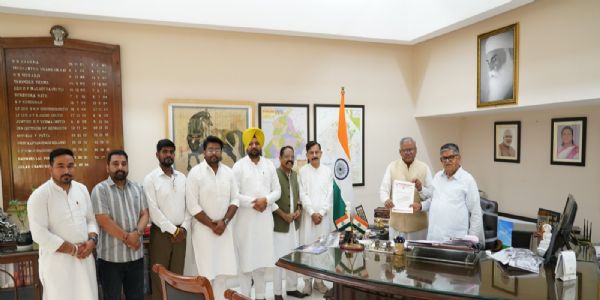
Lucknow, 27 July (HS): A high-level education committee of
the Haryana Assembly arrived in Lucknow on Monday to study Uttar Pradesh's
higher education system, academic quality, infrastructure facilities, and
innovations in the education sector. The committee met with officials from the
Higher Education Department, including Special Secretary Higher Education Nidhi
Srivastava, in the Assembly hall to learn about the extensive reforms and
innovations being undertaken in the state's higher education sector. The
Chairperson of the Haryana Assembly's Education Committee, Laxman Singh Yadav,
along with other committee members and officials, were present at the meeting.
During the meeting, information was presented to the
committee regarding the reforms being undertaken by the Yogi government in the
field of higher education in Uttar Pradesh, the expansion of quality education,
digital systems, promotion of research and innovation, and various schemes
being run for students. The Haryana Assembly committee praised these efforts in
the field of higher education in Uttar Pradesh, describing the state's systems and
innovations as significant and useful.
The meeting was informed that currently, Uttar Pradesh has
24 state universities, 56 private universities, one deemed university, and one
open university, along with 216 government colleges, 330 aided non-government
colleges, and 7,526 self-financed colleges. A total of 1,349 posts for
principals, assistant professors, librarians, and third-class employees have
been created in the 71 new government colleges established in the state.
Admissions and teaching have already commenced in 46 of these colleges from the
academic session 2025-26.
To enhance the quality of higher education and improve
administrative control in colleges, regional higher education officer offices
have been established in all divisions of the state. Additionally, to ensure
the quality of higher education, a State Level Quality Assurance Cell (SLQAC)
has been formed and made fully active. In line with the goals of the National
Education Policy-2020, Choice Based Credit System, Multiple Entry-Exit System,
and employment-oriented vocational value-added courses are being offered in the
state's universities and colleges.
Significant steps have also been taken in the state towards
digital governance. File management in the Directorate of Higher Education,
Prayagraj, is being done through e-office. Furthermore, the 'Samarth' portal
has been implemented in all state and private universities in the state from
the academic session 2024-25, and the student admission process is also being
conducted through the Samarth portal from the session 2025-26. The complete
service details of teachers and non-teaching staff have been uploaded on the
Manav Sampada portal.
The Yogi government has also launched the Chief Minister's
Cashless Medical Scheme for teachers associated with higher education and their
dependents. Under this scheme, approximately 7.5 lakh people, including 1.28
lakh teachers from state and private universities, aided and self-financed
colleges, and their dependents, are being provided free medical treatment. In
addition, efforts are underway to benefit non-teaching staff and their
dependents from the scheme.
To technically empower students in the state, free
smartphones and tablets are being distributed to students studying in higher
education institutions under the Swami Vivekananda Youth Empowerment Scheme. To
promote research and innovation, a provision of Rs 500 lakh has been made under
the Research and Development scheme in 2026-27. A provision of Rs 13.60 crore
has also been made for the development of basic facilities in government
colleges.
Special emphasis was also placed on employment-oriented
education and skill development for students during the meeting. Under the
Chief Minister's Apprenticeship Promotion Scheme, a monthly incentive of Rs
1,000 has been provided to eligible students studying in higher education
institutions to make them proficient in technical work. Additionally, important
initiatives such as the Chief Minister Vidya Lakshmi Scheme to help meritorious
students continue their higher education, the Rani Lakshmi Bai Scooty Scheme to
provide free electric scooters to eligible female students, and the Chief
Minister's Indian Knowledge System Global Excellence Fund to give global
recognition to the Indian knowledge tradition are also being undertaken.
Officials from the Higher Education Department stated that
processes for appointment and selection are also being expedited to increase
the availability of teachers in the state. Online postings have been made for
840 selected lecturer positions in government colleges, while requisitions for
1,253 positions have been sent to the Uttar Pradesh Public Service Commission.
Appointments of principals and lecturers have also been made in aided colleges,
and the selection process for various positions is ongoing.
The high-level committee of the Haryana Assembly praised
these reforms, the use of digital technology, quality education, research and
innovation, infrastructure development, and student welfare schemes in the
field of higher education in Uttar Pradesh. The committee members stated that
Uttar Pradesh's efforts in the field of higher education are useful and
exemplary for other states as well.
Hindusthan Samachar / Abhishek Awasthi