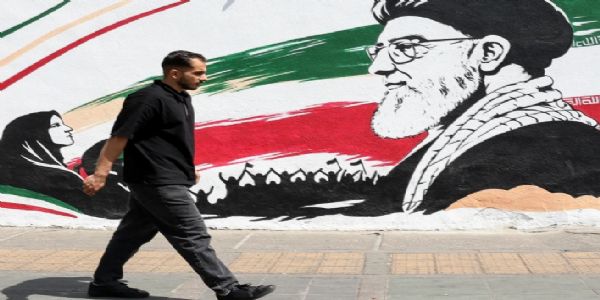
Tehran/Washington/Kyiv, 26 July (H.S.): Positive signs have emerged indicating a possible easing of the conflict between Iran and the United States, which began on February 28 this year. Diplomatic talks over the Strait of Hormuz have reportedly made progress, and Iran experienced its first night without a US military strike after nearly two weeks of sustained bombardment. However, tensions across West Asia (the Middle East) remain high as Yemen's Houthi rebels continue their attacks. Meanwhile, Iran has strongly protested against Ukraine following an alleged attack in the Caspian Sea and summoned Ukrainian diplomats.
According to reports by Al Jazeera, CNN and CBS News, diplomatic negotiations between Oman and Iran have moved forward, with both countries holding discussions on reopening the Strait of Hormuz and their respective territorial waters in the region for maritime traffic. Sources indicated that the negotiations are progressing in a positive direction, although a final agreement may still take some time. Omani officials travelled to Tehran on Friday for the latest round of talks.
The diplomatic initiative reportedly followed US President Donald Trump's decision to halt the bombing campaign. The United States had conducted airstrikes for 13 consecutive nights. Following Trump's decision, Iran witnessed a 14th consecutive night without any US military strike. Neither the White House nor the United States Central Command (CENTCOM) has officially commented on the development. However, US officials confirmed that President Trump is closely monitoring the ongoing negotiations between Oman and Iran.
Reports also suggest that both Iran and the United States are currently exploring possible avenues for a ceasefire, with several intermediary countries attempting to facilitate dialogue. However, both sides continue to maintain firm positions regarding control over the Strait of Hormuz. According to the report, Iran seeks to levy mandatory transit charges on commercial vessels, while the US naval blockade around Iranian ports continues to prevent such measures from being implemented.
The maritime dispute has also drawn in US ally Ukraine. Iran has reacted sharply after alleging that a Ukrainian attack on an Iranian vessel in the Caspian Sea killed at least one sailor and injured another. Tehran summoned Ukrainian diplomats and condemned the incident, describing it as a violation of the United Nations Charter. Iran's Foreign Ministry expressed deep concern over the alleged attack, while Foreign Minister Abbas Araghchi discussed the matter with the European Union's High Representative for Foreign Affairs and urged the United Nations Security Council to respond.
In a post on X, CENTCOM said it had boarded and inspected a tanker as part of its blockade operations targeting Iranian ports. According to the post, Earlier today, US forces boarded and inspected the Comoros-flagged tanker MT Charminar in the Arabian Sea before allowing it to proceed. Yesterday, the Mozambique-flagged tanker MT Lavin was stopped and inspected in the Gulf of Oman. CENTCOM stated that the tanker was bound for Iran and reiterated that the maritime blockade of Iranian ports remains fully in force.
Ukraine has acknowledged targeting Russian vessels, claiming that some of them were transporting supplies destined for Iran. Ukrainian President Volodymyr Zelensky alleged that Russia is assisting Iran's military operations in the Middle East.
Meanwhile, Yemen's Houthi rebels launched missile and drone attacks on Saudi Aramco oil facilities in Jizan and Yanbu along the Red Sea coast, claiming the strikes were retaliation for attacks carried out by the Saudi-led coalition on Hodeidah Port and Kamaran Island.
In a post on X on Saturday, President Zelensky said Ukraine would share evidence with the United States that, he alleged, demonstrates Russia has been assisting Iran in targeting US military installations in the Middle East through satellite surveillance.
Since the beginning of July, we have observed active Russian satellite surveillance of Gulf countries and US military bases stationed there, Zelensky said. He alleged that the satellite imagery was subsequently shared with Iran.
Zelensky further claimed that on July 19 and 20, Russian satellites captured images of military preparations at two air bases in Bahrain, one in Jordan and another in Kuwait, alleging that the information was later made available to Iran.
---------------
Hindusthan Samachar / Jun Sarkar