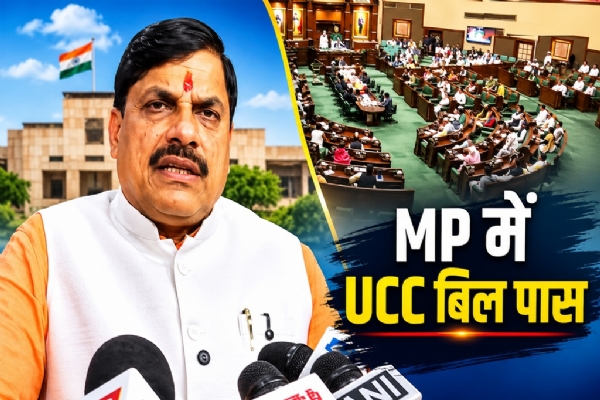
One Law, Equal Rights: Madhya Pradesh Becomes the Fourth State to Pass the Uniform Civil Code Bill
Bhopal, 21 July (H.S.). With the passing of the Uniform Civil Code (UCC) Bill in the Madhya Pradesh Legislative Assembly on Tuesday, amidst massive uproar and opposition protest, the state has taken a significant step towards implementing a uniform civil law. Following Uttarakhand, Gujarat, and Assam, Madhya Pradesh is set to become the fourth state in the country to implement the UCC.
The proposed legislation seeks to bring personal civil matters, such as marriage, divorce, inheritance, and live-in relationships, under a unified legal framework. Under this law, the registration of live-in relationships will be mandatory; meanwhile, promoting, insisting upon, or compelling anyone to undergo practices like 'Halala', which are degrading and violate individual dignity, for the purpose of remarrying a former spouse will be considered a punishable offense.
Government Committed to Ensuring Equal Opportunities, Equal Rights and Equal Justice
Speaking on the matter, Chief Minister Dr. Mohan Yadav said, Extensive dialogue was held with citizens across the state regarding the Uniform Civil Code through various channels. As part of this process, 3.49 crore SMS messages were sent, and over 10 lakh people shared their suggestions and feedback. The process was advanced based on public sentiment and the suggestions received. The Madhya Pradesh government is firmly committed to ensuring equal opportunities, equal rights, and equal justice. This decision is the outcome of that public participation and resolve.
He stated that while the social and religious customs of the state's citizens would continue as before, official registration of all marriages within the state would be mandatory. A provision for a penalty has been included for failure to register. Once the UCC is implemented, entering into a second marriage while a spouse is still alive, whether by a husband or a wife, will not be permitted. This law will ensure a uniform system for all citizens. Congress engaged in appeasement and Muslim vote-bank politics for years
The Chief Minister stated that for years, the Congress engaged in appeasement and Muslim vote-bank politics, effectively stabbing the people of the country in the back; however, the implementation of the UCC will bring freedom from discrimination in Madhya Pradesh. Following Uttarakhand, Gujarat and Assam, Madhya Pradesh is now also set to implement the Uniform Civil Code.
During the Assembly discussion on the UCC Bill, Parliamentary Affairs Minister Kailash Vargiya responded to Congress's allegations by raising a point of order. He stated that the Bill was not introduced solely by the government but was drafted based on suggestions from the public. Laws similar to the UCC have been implemented in other states as well, not just in Madhya Pradesh. This initiative is being undertaken in the spirit of One Nation, One Flag, One Constitution, One Leader. It is not merely a government decision but a reflection of public opinion; approximately 10 lakh people have submitted their suggestions and views regarding the UCC.
Mandatory registration of live-in relationships
The most discussed provision of Madhya Pradesh's UCC Bill is the mandatory registration of live-in relationships. Under the proposed system, couples in a live-in relationship must declare and register their relationship before a designated authority within one month of its commencement. The government argues that this will provide legal protection for the rights of women and children in such relationships and clarify rights and responsibilities should the relationship end.
Proposed strict ban on practices like 'Halala'
The Bill proposes making it a punishable offense to promote, enforce, or coerce any individual into practices like 'Nikah Halala', a practice involving remarriage to a former spouse after divorce. Provisions have also been included to ban practices such as 'Triple Talaq' and polygamy. The government maintains that no woman should be forced into a system of marriage and divorce that strips her of her dignity and the right to make independent decisions.
The bill excludes Scheduled Tribes and certain protected tribal communities from its ambit. The government maintains that India's tribal communities possess distinct social traditions and customs and bringing them abruptly under a Uniform Civil Code would not be appropriate.
Over 93 Percent Support the UCC
The government states that the UCC draft was not prepared in haste. A committee headed by former Supreme Court Justice Ranjana Prakash Desai solicited suggestions from various sections of society and regions. According to the Chief Minister, the government received approximately 9.58 lakh suggestions, with over 93 percent of respondents expressing support for the Uniform Civil Code. The government also claims that the consultation process revealed significant support for the UCC among both Muslim men and women.
It is noteworthy that the passing of the UCC bill in the Madhya Pradesh Assembly is significant because the national debate on the Uniform Civil Code has now entered a new phase. One thing is certain: Madhya Pradesh has moved the issue of the Uniform Civil Code beyond mere political discourse and onto the concrete ground of law and governance. Naturally, other states are likely to draw inspiration from this decision.
---------------
Hindusthan Samachar / Mayank Chaturvedi
21 Jul 2026