Dr.Mayank Chaturvedi
Bhopal, 11 July (H.S.): India's great religious institutions are not merely administrative bodies; they are the custodians of the faith of millions of devotees and the representatives of the eternal Sanatan tradition. Therefore, from time to time, these institutions should receive guidance in accordance with Dharma, the scriptures and established traditions through a guiding Dharma Council comprising the Shankaracharyas of the country's four Amnaya Peethas, the principal Vaishnava Acharyas, other revered and distinguished Acharyas, and eminent saints. Alongside this, a Sanatan Dharma Protection Committee, or Sanatan Board, should be constituted to oversee the administration of temples across the country.
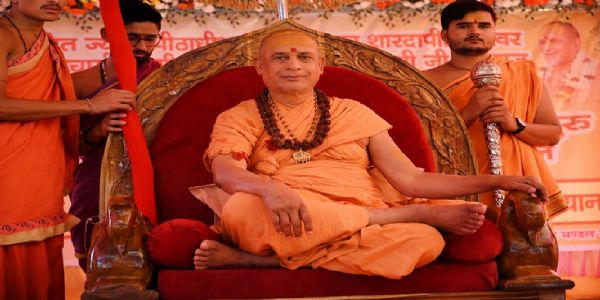
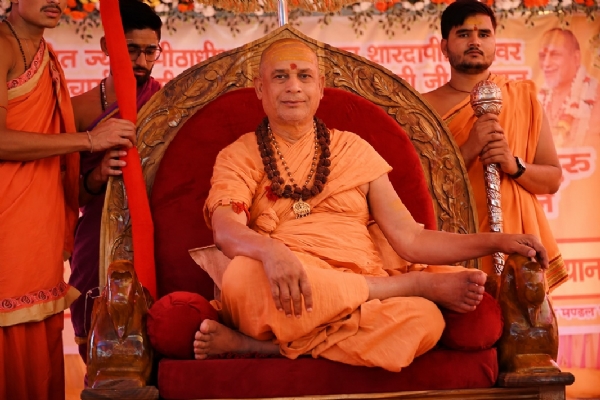
These views were expressed by Jagadguru Shankaracharya Swami Sadanand Saraswati Maharaj, the Shankaracharya and Pontiff of Shri Dwarka Sharada Peeth, during an exclusive interview with Hindusthan Samachar.
Speaking amid the ongoing discussions surrounding the donations to the Shri Ram Janmabhoomi Temple in Ayodhya, and the concerns, doubts and growing apprehensions among devotees across the country, Jagadguru Shankaracharya Swami Sadanand Saraswati Maharaj said that the role of religious leaders is not to administer institutions but to provide guidance rooted in Dharma, propriety and scriptural principles.
He observed that if such a guiding council were to offer its recommendations periodically, it would not only preserve the dignity and traditions of temples but also strengthen the faith of millions of devotees. The temple of Bhagwan Shri Ram is the spiritual centre of the entire Hindu community. Therefore, the light of Dharma must continuously illuminate its administration, he said.
Temple Administration Should Be Entrusted to a 'Sanatan Board'
He stated, Temples should be administered under the guidance of religious leaders, Vedic scholars and devoted, competent and individuals of impeccable integrity from society. Government cooperation is welcome wherever necessary, but religious control is not the function of the State.
We propose the formation of a 'Sanatan Dharma Protection Committee,' or 'Sanatan Board,' to oversee the administration of temples throughout the country. This Board should include the Shankaracharyas of the four Amnaya Peethas, the five principal Vaishnava Acharyas and other respected and distinguished religious leaders. The religious administration of all temples should function under their guidance and protection.
Jagadguru Shankaracharya Swami Sadanand Saraswati Maharaj further stated, This is necessary because the government neither possesses scriptural knowledge nor spiritual experience. Moreover, under a secular system of governance, it has no moral authority to conduct the religious administration of temples.
He added that such a Board should guide matters relating to temple sanctity, preservation of traditions, transparency in the management of temple offerings (Devadravya), promotion of Dharma, protection of the Vedas, cow conservation, promotion of Sanskrit and public welfare. This will ensure that temples remain centres of Dharma rather than politics, while further strengthening public faith, he said.
Temple Offerings Should Be Utilised in Accordance with Scriptural Principles
He further stated, We also believe that the offerings made to temples should primarily be utilised for the religious, educational and social upliftment of the district and region in which the temple is situated.
He suggested that such resources should be used for establishing and supporting schools, Gurukuls, Vedic institutions, Gaushalas, hospitals, community kitchens (Annakshetras), Dharamshalas and welfare activities for the poor, the helpless and the distressed. This has always been the tradition of Sanatan Dharma and represents the scripturally prescribed use of Devadravya, he said.
Religious Administration of Temples Should Not Remain Under Government Control
Emphasising his position, Jagadguru Shankaracharya said, It is my firm view that the religious administration of temples should not remain under the control of the government. The responsibility of the State is administration, security, justice and public welfare, whereas temples are centres of spiritual, religious and cultural consciousness.
The government neither possesses scriptural wisdom nor practical experience of religious traditions, nor does it carry spiritual responsibility. Under a secular system of governance, the State should not become the administrator of the religious affairs of any faith.
Explaining further, he said that governments lack both scriptural understanding and officials with genuine religious experience. The role of a secular government is to provide public services, not to conduct spiritual rituals. Therefore, it cannot administer religious institutions in a truly just manner.
He observed that officials who fail to appreciate the sanctity of temples often treat them as tourist destinations rather than sacred places of penance, thereby affecting the sanctity of the sanctum sanctorum and the continuity of traditional modes of worship.
Temple Offerings Belong to the Deity
Responding to a question, Jagadguru Shankaracharya cited scriptural authority, saying, Devadravyam na hartavyam nopabhogyam kadachana — property dedicated to the Deity must neither be misappropriated nor used for personal benefit.
He said that once wealth is offered to Bhagwan, it becomes Devadravya. If theft has indeed occurred, it is not merely an economic offence but a betrayal of Bhagwan Shri Ram and the faith of millions of devotees. Such allegations must be investigated impartially, promptly and fearlessly, and those found guilty should face strict punishment.
My only expectation is that the investigation should not be influenced by position, power, prestige or political pressure. The inquiry should proceed wherever the truth leads. The innocent must be protected, while the guilty, irrespective of how influential they may be, must be held accountable before justice. That alone is Dharma, that alone is justice, and that alone is consistent with the ideals of Bhagwan Shri Ram.
He further stated that Sanatan Dharma regards Devadravya as the property of Bhagwan, over which no individual has any personal claim. Therefore, misappropriation or misuse of Devadravya is not merely theft but a grave religious offence.
Referring to Ayodhya, he said, Ayodhya is the sacred city of Dharma, the city of noble values and the holy birthplace of Bhagwan Shri Ram. How could such an act occur at such a sacred place? It is akin to a poisonous tree growing within a forest of sandalwood.
Quoting the Puranas, he said:
Devadravyam brahmanasvam cha lobhenopahinasti yah,
Sa papatma niraye ghore brahmahatyasamam vrajet.
He explained that the verse means that anyone who misappropriates property dedicated to Bhagwan out of greed incurs a sin comparable to the gravest of offences. Therefore, if there has indeed been deception involving offerings made at the feet of Bhagwan Shri Ram, it constitutes an assault on the faith of millions of devotees.
Temple Administration Should Serve as a National Model
Responding to a question regarding restructuring the Shri Ram Temple Trust, Jagadguru Shankaracharya clarified, My appeal is not for changing individuals but for reforming the rules and making the administrative system exemplary. Management should be entrusted to capable and worthy individuals.
No institution becomes great merely because of the individuals associated with it; it is the strength of its principles and transparent governance that determines its greatness. If administrative or structural shortcomings exist, they should be addressed with courage.
He further stated that a system must be established ensuring continuous guidance from religious leaders, financial transparency, regular audits and public accountability. The Shri Ram Temple belongs to the entire Hindu community; therefore, its administration should become a model worthy of emulation.
Five Essential Principles for Transparency in Donations
When asked how transparency in temple donations could be ensured, Jagadguru Shankaracharya outlined five essential principles:
-Every donation should have both digital and written records.
-Independent and impartial audits should be conducted annually.
-Regular public disclosure of income and expenditure through a White Paper.
-Joint oversight by religious authorities and financial experts.
-Every expenditure should be clearly explained before the devotees.
He remarked, Dharma is founded not upon secrecy but upon sanctity and transparency. Where accounts remain transparent, public faith becomes even stronger.
When asked about his demands, he replied, I have no demands against any individual or political party. My only demand is for the protection of Dharma, truth and public trust.
He urged that authenticated and publicly accessible White Papers detailing all income and expenditure relating to donations offered at the feet of Bhagwan Shri Ram should be published periodically to reinforce the confidence of devotees.
Temple Donations Should Support Vedic Learning, Gurukuls and Public Welfare
He further said, Temple donations should, to the greatest possible extent, be utilised for Vedic education, Gurukuls, cow protection, promotion of Sanskrit, propagation of Dharma, food distribution and public welfare, so that the blessings of Bhagwan may reach society as a whole.
Bhagwan Shri Ram is not merely a historical figure; He is the eternal embodiment of Dharma, truth, righteousness and public welfare. If we truly regard ourselves as His devotees, we must not only build temples but also cultivate His ideals within our own lives.
Dharma cannot be protected merely through slogans. It is preserved through truth, honesty, transparency, service, sacrifice and righteous conduct.
Appeal to the Nation
In his concluding message, Jagadguru Shankaracharya Swami Sadanand Saraswati Maharaj said, Bhagwan Shri Ram is not merely a consecrated deity within temples; He is the very soul of Bharat. Every episode of His life exemplifies truth, righteousness, compassion, sacrifice, justice and the welfare of all.
I appeal to all citizens of the country not to confine their devotion to Bhagwan Shri Ram merely to celebrations and festivals, but to embody His ideals in their daily lives.
Let us regard the preservation of the sanctity, transparency and dignity of temples as our collective responsibility. Let us consider Devadravya to be the sacred property of Bhagwan and remain vigilant regarding its proper utilisation.
Never accept corruption, deception or selfishness in the name of Dharma. Contribute actively towards truth, selfless service, righteous conduct, cow protection, Vedic learning, the promotion of Sanskrit and the preservation of India's spiritual and cultural heritage.
He concluded by quoting the ancient maxim:
Dharmo Rakshati Rakshitah — Dharma protects those who protect it.May Lord Shri Ram bless the entire nation with truth, righteousness, noble wisdom and unwavering devotion to Dharma. May Bharat once again illuminate the world through its spiritual, cultural and moral leadership. This is my humble prayer.Shri Ramachandrarpanamastu.
---------------
Hindusthan Samachar / Jun Sarkar