New Delhi, 26 June (H.S.):
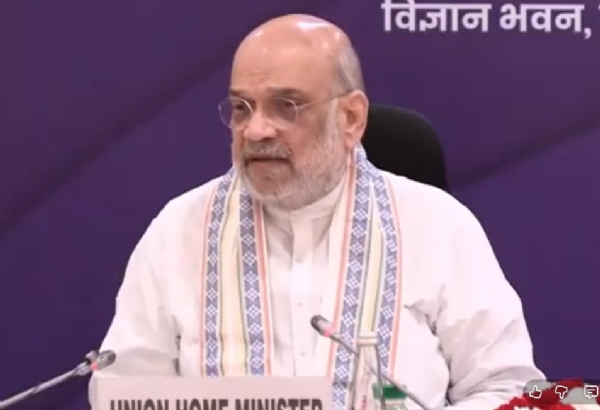
Union Home Minister Amit Shah on Friday said the next three years would be crucial in India's fight against narcotics, asserting that the government has prepared a comprehensive roadmap to make the country drug-free. He stressed that India must move forward with a ruthless approach against drug traffickers while maintaining a compassionate attitude towards those who have fallen victim to addiction.
Addressing the 10th Apex Level Meeting of the Narco-Coordination Centre (NCORD) in New Delhi, Shah emphasized the need for a collective and coordinated response involving state police chiefs, senior government officials and law enforcement agencies. He called for intelligence-led operations, technology-driven strategies and targeted action against entire drug trafficking networks.
The meeting was attended in hybrid mode by 108 representatives from state governments, drug law enforcement agencies and 44 key stakeholders from various Central ministries and departments.
During the event, the Home Minister released the Vision Document on Drug Control (2026–2029), unveiled the Narcotics Control Bureau (NCB) Annual Report 2025 and inaugurated newly constructed NCB zonal offices in Jammu and Guwahati.
In his address, Shah said that achieving complete victory over the illegal drug trade is essential for India's internal security, economic security and the future of its youth.
He pointed out that India is geographically located between the Death Triangle—comprising Myanmar, Thailand and Laos—and the Death Crescent—consisting of Afghanistan, Iran and Pakistan. He added that drug traffickers are increasingly using sophisticated methods such as drone-based drops, containerised cargo transported through sea routes, the dark web, cryptocurrency payments and parcel-based order-to-delivery models, making enforcement efforts significantly more challenging.
The Home Minister said the fight against narcotics cannot be treated as an ordinary law enforcement exercise. He noted that drug syndicates are now technology-enabled, network-driven and have evolved into multi-domain criminal enterprises, making the challenge even more complex. It was in this context, he said, that a ruthless approach is necessary.
Clarifying his remarks, Shah said the government's ruthless approach is meant exclusively for those engaged in drug trafficking, while victims of drug addiction should be treated with empathy and guided back to a healthy and productive life.
He further stated that the government's Action Plan against Narcotic Drugs for the period 2026–2029 is built on four key pillars. The first focuses on enforcement, intelligence gathering and coordinated operations. The second aims to strengthen control over precursor chemicals and synthetic drugs. The third pillar is dedicated to reducing drug demand and preventing harm, while the fourth emphasizes capacity building, inter-agency coordination and effective monitoring.
Shah said the roadmap is based on the principles of a Whole-of-Government and Whole-of-Society approach, with emphasis on ensuring active participation from every citizen. He underlined that secretaries of both Central and state government departments have a vital role to play in mobilising public participation and ensuring the successful implementation of the anti-drug campaign.
---------------
Hindusthan Samachar / Jun Sarkar

26 Jun 2026