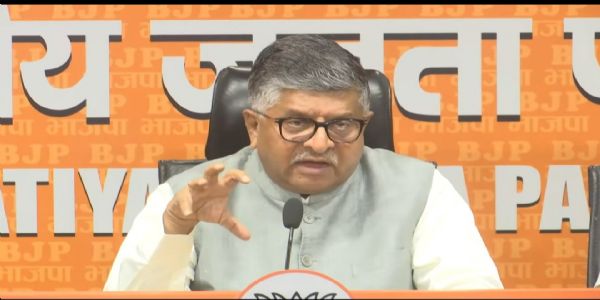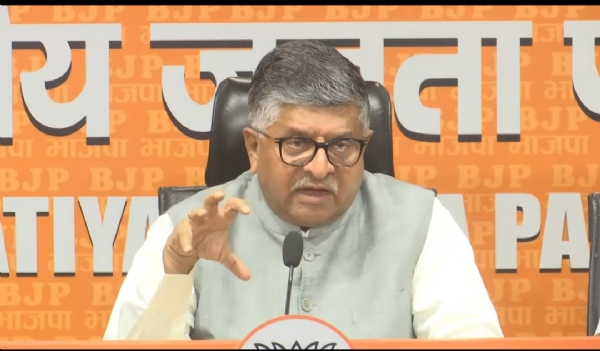
New Delhi, 25 June (H.S.): Senior Bharatiya Janata Party (BJP) leader and Member of Parliament Ravi Shankar Prasad on Thursday said that the Emergency imposed in 1975 was intended solely to protect then Prime Minister Indira Gandhi from losing power. Addressing a press conference at the party headquarters, he described the Emergency declared on June 25, 1975, as the saddest and darkest chapter in the history of Indian democracy.
Prasad said that the Allahabad High Court had invalidated Indira Gandhi’s election. Although she subsequently approached the Supreme Court, she did not receive complete relief. According to him, efforts to protect her political position intensified following these developments, ultimately leading to the imposition of the Emergency.
He noted that 50 years have now passed since the Emergency and said that at a time when discussions about safeguarding democracy and protecting the Constitution are prominent, it is important to expose what actually transpired five decades ago.
Prasad said he had been an activist in the movement led by Jayaprakash Narayan and was detained under the Maintenance of Internal Security Act (MISA) during the Emergency. Having personally participated in the struggle against the Emergency, he said he could vividly recall the events of that period. He added that several journalists had documented the alleged excesses and hardships faced by detainees in books and memoirs.
Referring to a book by journalist Coomi Kapoor, Prasad claimed that administrative officials had been instructed to house detainees in rooms with tin roofs so that they would suffer from extreme heat and discomfort. He alleged that political prisoners across the country were subjected to harassment and, in many instances, inhumane treatment.
Discussing the controversial sterilisation campaign carried out during the Emergency, Prasad said government employees were pressured to meet sterilisation targets. According to him, promotions and other benefits were linked to the campaign, resulting in people being forced to undergo sterilisation in several places. He alleged that even individuals who were unmarried were subjected to sterilisation procedures, describing the campaign as an assault on humanity.
Highlighting restrictions imposed on the media during the Emergency, Prasad said electricity supply to the offices of several major newspapers in Delhi was allegedly cut off on the night of June 24 to prevent publication. He said strict censorship was enforced and that no news report could be published without approval from the Chief Censor Officer. According to him, instructions were issued that the nationwide tours of Sanjay Gandhi should receive priority coverage as the most important news.
Prasad also praised the role played by Prime Minister Narendra Modi during the Emergency, stating that he remained active underground while opposing the government of the day.
He further said that several journalists, including veteran journalist Kuldip Nayar, were arrested during the Emergency. Many newspapers, he noted, left their editorial columns blank as a mark of protest against censorship.
Prasad also recalled the famous observation made by veteran BJP leader Lal Krishna Advani, who had remarked that “when some journalists were asked to bend, they began to crawl.” He added that despite the prevailing atmosphere of fear and censorship, several newspapers and journalists displayed remarkable courage and continued to uphold the principles of a free press.
---------------
Hindusthan Samachar / Jun Sarkar
25 Jun 2026
PM Modi to Attend Seychelles’ Golden Jubilee Independence Celebrations as Guest of Honour
25 Jun 2026