- Emergency Was the Biggest Assault on Democracy; People's Struggle Defeated Authoritarianism in 19 Months, Says Ambekar
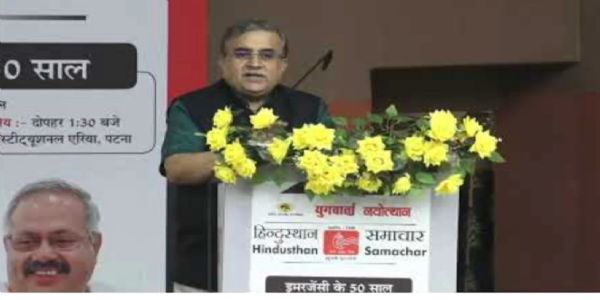
Patna, June 24 (HS): Rashtriya Swayamsevak Sangh (RSS) Akhil Bharatiya Prachar Pramukh Sunil Ambekar on Wednesday said that the Emergency imposed in 1975 was the darkest chapter in the history of Indian democracy. He said it was not merely an attempt to suppress political dissent, but a direct attack on democratic institutions, civil liberties and constitutional values. Owing to nationwide public resistance, mass awareness and the people's commitment to democracy, authoritarian tendencies were defeated within just 19 months, making the restoration of democracy possible.
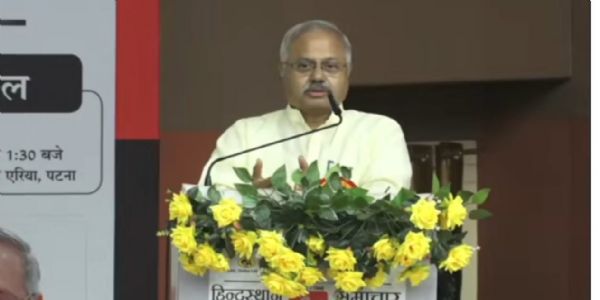
Addressing a programme on “50 Years of the Emergency: The Bihar Movement and the Emergency” organised by Hindusthan Samachar Group in Patna on Wednesday, Ambekar said it was necessary to identify the forces and circumstances that could threaten the nation's freedom and democratic system to ensure that a situation like the Emergency never arises again.
He said that only 25 years had passed since India attained Independence. After Independence in 1947, the adoption of the Constitution in 1950 and the first general elections in 1952, democratic institutions were still in the process of consolidation when authoritarian tendencies challenged the democratic framework, culminating in the imposition of the Emergency on June 25, 1975.
Ambekar said that in many countries, authoritarian regimes remained in power for two to three decades. He asserted that those who imposed the Emergency in India also had long-term plans, but the democratic consciousness of Indian society and widespread public resistance prevented those plans from succeeding.
Describing the anti-Emergency struggle as a golden chapter in India's democratic history, he said people from all sections of society, ideologies and organisations participated in the movement. It was not the movement of any single party or organisation, but a collective national struggle to protect democracy, freedom of expression and civil liberties.
Referring to the ban imposed on the RSS during the Emergency, Ambekar questioned why a non-political organisation was targeted. He said that since Independence, the attitude and actions of the then government indicated that it viewed the RSS as a political rival, although the organisation had consistently functioned as a social and cultural body.
He said the government believed that arbitrary actions would not be possible in the presence of the RSS. According to him, there was already a mindset to eliminate the organisation, which ultimately led to the ban. Despite restrictions, arrests and repression, RSS workers continued their struggle for the protection of democracy.
Ambekar said that the ideological foundation and organisational network developed by the RSS over the previous 25 years enabled extensive public awareness efforts during the Emergency. While senior leaders of various political parties were in jail, thousands of ordinary RSS workers took responsibility for sustaining the movement and maintaining public contact.
He said many of these workers were largely unknown in public life, yet they travelled from village to village and city to city carrying the message of democracy. Without seeking personal recognition, position or political gain, they opposed the Emergency and worked to awaken public consciousness. This grassroots effort eventually evolved into a nationwide mass movement.
He said it was this nationwide struggle to defend democracy that resulted in the end of the Emergency within 19 months and ensured the restoration of democratic values and constitutional governance in India.
Indira Gandhi National Centre for the Arts Chairman Ram Bahadur Rai addressed the gathering as the keynote speaker and spoke on various aspects of the Bihar Movement, Loknayak Jayaprakash Narayan's leadership and the anti-Emergency struggle.
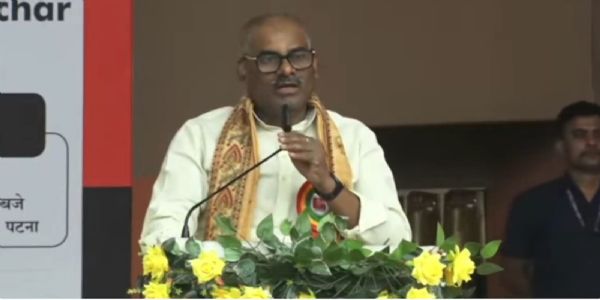
Former Union Minister Ashwini Kumar Choubey, Bihar Minister for Art, Culture and Youth Affairs and Mines and Geology Dr Pramod Kumar, and several other dignitaries also addressed the programme.
A large number of academicians, intellectuals, social workers, students and representatives of various organisations participated in the event. Speakers called for continued vigilance in safeguarding democratic values and learning from the experiences of the Emergency.
---------------
Hindusthan Samachar / Indrani Sarkar
24 Jun 2026