• Described the Bihar Movement as the foundation of a nationwide people's movement that played a crucial role in safeguarding democracy.
• Said the anti-Emergency movement gained momentum after Jayaprakash Narayan returned to active politics.
• Described the 1975–77 struggle against the Emergency as India's Second Freedom Movement aimed at restoring and protecting democratic values.
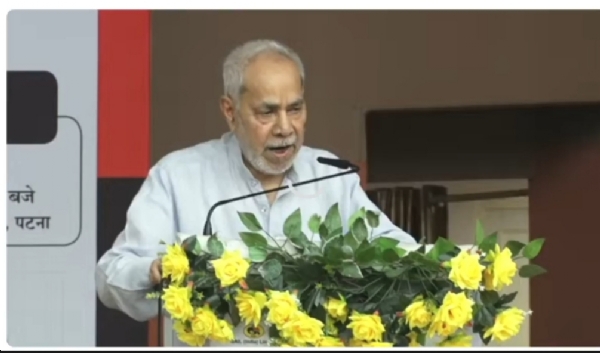
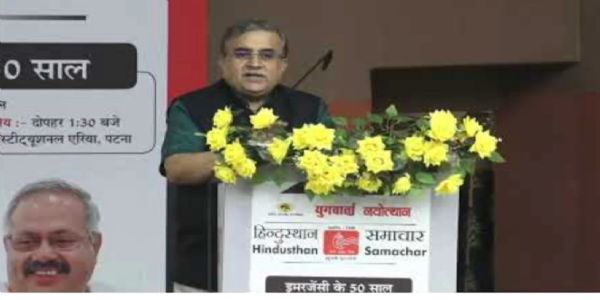
Patna, 24 June (H.S.): Senior journalist, public intellectual, and Chairman of the Indira Gandhi National Centre for the Arts, Ram Bahadur Rai on Wednesday said that just as the Quit India Movement of 1942 was a decisive battle for India's political independence, the struggle against the Emergency between 1975 and 1977 was a second fight for freedom aimed at restoring democracy.
Addressing a programme titled “50 Years of the Emergency: The Bihar Movement and the Emergency,” organised by Hindusthan Samachar Group at Mithapur Institutional Area in Patna, Ram Bahadur Rai said that while India gained freedom from British rule in 1947, the democratic verdict of 1977 liberated the country from authoritarian tendencies. He described both struggles as equally significant milestones in the history of modern India.
He said the Bihar Movement's greatest achievement was bringing Jayaprakash Narayan back into active public life. According to Ram Bahadur Rai, Jayaprakash Narayan had distanced himself from active politics after 1955 and devoted his efforts to the Bhoodan Movement and social reform initiatives. His decision to lead the Bihar Movement in 1974 transformed a student-led agitation into a nationwide people's movement that laid the foundation for the democratic struggle against the Emergency.
Ram Bahadur Rai said the Bihar Movement should not be viewed merely as an anti-corruption campaign. Its broader objective was Total Revolution—a comprehensive transformation of governance, political culture, and social structures. He noted that Jayaprakash Narayan sought systemic change rather than merely a change of government.
Speaking on the circumstances that led to the Emergency, Ram Bahadur Rai said it would be incorrect to attribute its imposition solely to Jayaprakash Narayan's speech at Delhi's Ramlila Maidan. He argued that the political crisis following the June 12, 1975 judgment of the Allahabad High Court, which invalidated the election of then Prime Minister Indira Gandhi, significantly contributed to the developments that culminated in the Emergency.
Ram Bahadur Rai, who was among the first detainees under the Maintenance of Internal Security Act (MISA), said the report of the Shah Commission remains the most authoritative document for understanding the causes and consequences of the Emergency. He said the report clearly details how democratic institutions, civil liberties, and constitutional processes were affected during that period.
He further stated that thousands of democracy activists were imprisoned during the Emergency while defending civil liberties and democratic rights. He credited Jayaprakash Narayan and former Rashtriya Swayamsevak Sangh chief Balasaheb Deoras with providing leadership and direction to the pro-democracy movement.
According to Ram Bahadur Rai, the anti-Emergency struggle extended far beyond political parties and drew support from students, youth, social organisations, intellectuals, and ordinary citizens committed to democratic values. This broad public participation, he said, enabled the movement to successfully challenge authoritarianism.
He said the announcement of elections in January 1977 allowed citizens to express their verdict through democratic means. The election results paved the way for the restoration of democracy and reaffirmed the Indian people's enduring faith in democratic principles.
Ram Bahadur Rai concluded that the restoration of democracy in 1977 remains one of the strongest examples of the Indian people's democratic consciousness, resilience, and commitment to the Constitution, which is why the anti-Emergency movement is remembered as India's second struggle for freedom.
---------------
Hindusthan Samachar / Jun Sarkar
24 Jun 2026