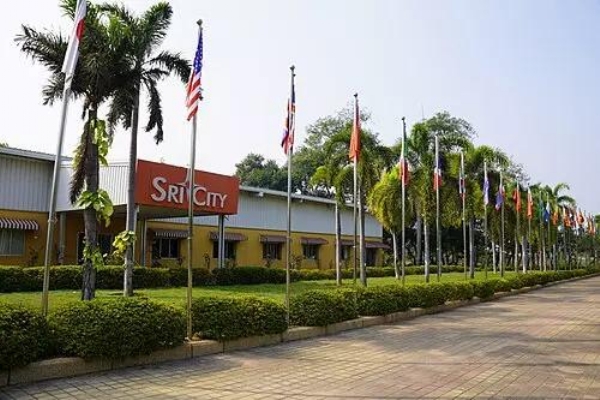

Sri City (Andhra Pradesh), 17 June (H.S.): A little over a decade ago, Sri City was largely known as an industrial township on the Andhra Pradesh-Tamil Nadu border. Today, the integrated business city is emerging as one of India's most closely watched manufacturing ecosystems, attracting global corporations, expanding into advanced sectors such as aerospace and electronics, and positioning itself as a key node in India's industrial growth story.
The transformation has gathered pace in 2026. A series of recent developments-from the launch of an aerospace manufacturing facility supplying global aviation programmes to the rapid progress of major electronics investments-have reinforced Sri City's reputation as a destination for large-scale manufacturing and global supply-chain integration.
Among the most significant developments this year is the operational launch of the aerospace facility established by UK-based Nasmyth Group in partnership with Sigma Advanced Systems. After securing the internationally recognised AS9100D aerospace quality certification, the facility has begun manufacturing precision-engineered components for Rolls-Royce aerospace programmes. The development marks Sri City's entry into a highly specialised segment of global manufacturing, moving beyond traditional industrial production into advanced engineering and aerospace supply chains.
The electronics sector is witnessing a similar expansion. LG Electronics' proposed ₹5,000-crore manufacturing facility is progressing rapidly and is expected to become operational by the end of 2026. Spread across a large industrial campus, the project is expected to strengthen domestic production of consumer appliances while supporting India's broader ambition of becoming a major manufacturing base for global companies. Industry observers view the LG facility as an anchor investment that could attract a wider network of suppliers and ancillary industries to the region.
Another major milestone came in May when Carrier Global broke ground on its ₹1,000-crore manufacturing facility in Sri City. The plant is expected to produce advanced cooling systems required for hyperscale data centres and next-generation AI infrastructure. As artificial intelligence, cloud computing and data-intensive technologies continue to expand globally, demand for specialised cooling solutions is expected to rise sharply. The project is projected to generate around 3,000 jobs and further strengthen Sri City's position within India's industrial ecosystem.
The momentum is not limited to new investments. Japanese-origin industrial companies continue to expand operations, while established manufacturers are increasing production capacities. Kobelco Construction Equipment recently marked the rollout of its 20,000th excavator from its Sri City facility, reflecting the scale and maturity that the industrial ecosystem has achieved over the years.
The scale of Sri City today provides context to its latest expansion. Spread across nearly 7,500 acres, the integrated business city hosts more than 220 companies from around 29 countries and has attracted investments exceeding USD 4.5 billion over the years. What began as an ambitious industrial project has evolved into one of India's most significant manufacturing and export-oriented ecosystems.
A key factor behind Sri City's growth is its strategic location. Situated about 55 km from Chennai and connected to major highways, ports and airports, the township offers manufacturers direct access to domestic and international markets. The presence of Special Economic Zones, Domestic Tariff Zones, warehousing facilities and dedicated industrial infrastructure has helped create an integrated ecosystem that appeals to both exporters and companies targeting India's growing consumer market.
Recognising growing demand from investors, the Andhra Pradesh government has approved plans for a major expansion of the industrial zone. An additional 2,500 acres is expected to be brought under development as part of the next phase of growth. Discussions are also underway regarding dedicated aviation infrastructure that could improve connectivity for global investors and corporate operations.
The expansion is aligned with an ambitious Vision 2029 roadmap. State authorities aim to increase the number of industries operating in Sri City from around 220 at present to 500, while expanding participation from companies representing 50 countries. Direct employment is projected to rise from more than 62,000 jobs currently to around 1.5 lakh over the next few years.
Equally important is Sri City's effort to position itself as a model for sustainable industrialisation. In partnership with industry bodies and environmental authorities, initiatives are being undertaken to expand renewable energy use, improve water recycling systems and promote green-building practices. The objective is to ensure that future industrial growth is accompanied by greater environmental efficiency and resource conservation.
Industry observers increasingly view the rise of manufacturing hubs such as Sri City within the broader context of global supply-chain diversification. As multinational companies pursue a China+1 strategy by expanding production beyond traditional manufacturing centres, India is emerging as an attractive destination for investment. Sri City's combination of industrial infrastructure, logistics connectivity and policy support places it in a favourable position to benefit from this global realignment.
For Andhra Pradesh, Sri City has become one of the state's most visible industrial success stories. For India, it offers a glimpse of how manufacturing, technology and global investment may shape the country's next phase of economic growth.
If the current pace of expansion continues, Sri City could become one of the clearest examples of India's attempt to move beyond low-cost manufacturing and into advanced electronics, aerospace engineering, AI-linked infrastructure and technology-driven industrial production. In that sense, the story of Sri City is not merely about the growth of an industrial township in Andhra Pradesh. It is also about the direction of India's industrial future and its growing role in global manufacturing networks.
---------------
Hindusthan Samachar / Indrani Sarkar

17 Jun 2026