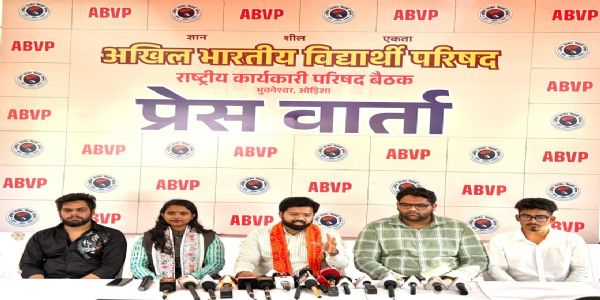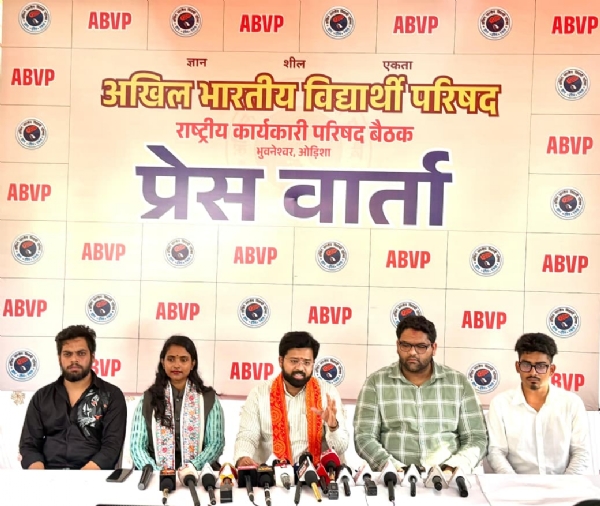
Bhubaneswar, 01 June (H.S.): The Akhil Bharatiya Vidyarthi Parishad (ABVP) has called for stringent measures to curb the exploitation of women and forced religious conversions allegedly carried out through organized criminal networks. The demand was made in a resolution adopted during the three-day National Executive Council meeting of ABVP held in Bhubaneswar.
Addressing a press conference, ABVP National General Secretary Dr. Virendra Singh Solanki said the council passed four major resolutions focusing on educational reforms, women's safety, urban Maoism, and the prevailing global situation.
In its resolution on women's safety, the student organization expressed concern over incidents of alleged organized exploitation, cyber blackmail, and religious conversions carried out through coercion, deception, or inducement. ABVP urged the Government of India to enact a comprehensive national law declaring forced or fraudulent religious conversions a serious criminal offence. The organization also demanded that such cases be tried in fast-track courts to ensure swift justice and stringent punishment.
The council further called for the establishment of a specialized central investigative agency to probe organized crimes targeting women and young girls, including cyber exploitation and illegal conversion networks. It also advocated stronger monitoring of social media platforms, enhanced safety mechanisms in educational institutions and workplaces, and the expansion of self-defence training and awareness programmes for female students.
On educational reforms, ABVP acknowledged the transformative intent behind initiatives such as the National Education Policy (NEP) 2020, NEET, and CUET. However, it noted that implementation challenges, examination irregularities, and administrative shortcomings have hindered the desired outcomes. The organization demanded greater transparency in the functioning of the National Testing Agency (NTA), improved institutional accountability, and measures to ensure affordable, accessible, and quality education for all students.
The council also described urban Maoism as an emerging challenge to national security and social harmony. While welcoming the success of security forces in weakening armed Maoist movements, ABVP cautioned that Maoist ideology continues to spread through certain academic, cultural, and digital platforms. It called for identifying and countering such networks through intellectual and democratic means.
In its resolution on global affairs, ABVP highlighted the impact of ongoing geopolitical conflicts, including the Russia–Ukraine war and tensions in West Asia, on the global economy. The organization praised India's balanced and independent foreign policy, stating that the country is emerging as a responsible global power through strategic autonomy, economic resilience, and multilateral engagement.
The council concluded by urging the youth of India to contribute actively towards nation-building through innovation, self-reliance, and a commitment to national development.
---------------
Hindusthan Samachar / Monalisa Panda


01 Jun 2026