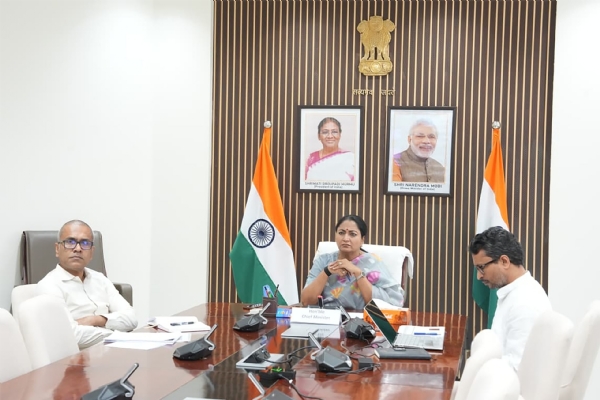
New Delhi, 30 May (H.S.): With severe heat and rising water demand gripping the capital, the Delhi government is working at full throttle to ensure uninterrupted drinking-water supply to all residents. The administration aims to provide adequate and regular water to every citizen while simultaneously increasing supply, speeding up grievance redressal, promoting water conservation and implementing long-term management plans, Chief Minister Rekha Gupta said on Saturday.
CM Rekha Gupta conducted a detailed review of the city’s water-supply situation and related challenges from the Chief Minister’s residence via video conference. Water Minister Parvesh Sahib Singh, Delhi Jal Board (DJB) vice-chair Satish Upadhyay, member Ajay Mahawar, Chief Secretary Rajeev Verma, DJB Chief Executive Officer Vijay Bidhudi and other senior officials attended the meeting.
The chief minister said water availability in the Yamuna near Wazirabad has been affected, putting pressure on the capital’s supply. In response, she spoke with Haryana Chief Minister Nayab Singh Saini, who has assured maintaining a minimum supply of 1,000 cusecs to Delhi through the Munak canal. Gupta said ensuring adequate water for Delhi residents and safeguarding the capital’s interests remain the government’s top priorities.
Officials informed the chief minister that, to cope with the situation, over 980 water tankers of the Delhi Jal Board are making more than 6,000 trips daily. Small tankers have been specially deployed to serve densely populated areas and narrow lanes. Additional borewells have been installed in the Yamuna Khadar area, raising production capacity by 10.5 MGD (million gallons per day), which has strengthened the supply system.
The chief minister directed officials to treat every instance of water leakage seriously and ensure immediate action. “Every drop of water is precious,” she said, adding that wastage will not be tolerated under any circumstances. She asked officials to personally monitor daily complaints and visit sites when necessary to assess situations on the ground.
During the review, officials said the DJB helpline received 11,055 complaints over the past week, of which more than 8,500 have been resolved. The chief minister ordered the prompt disposal of the remaining grievances and instructed that no citizen should face hardship due to water shortages. She also directed that adequate numbers of tankers be deployed in affected areas, with additional tankers and trips provided as needed.
Gupta emphasised that immediate measures alone will not suffice to address the current challenges. The government is therefore working on both short-term and long-term solutions in parallel. She said feasibility studies are underway for supplying water from Haryana via pipelines to reduce losses and leakages during transport; the Indian Institute of Technology (IIT) Roorkee is conducting the technical study for this project.
Looking ahead, the chief minister said plans are being fast-tracked for dredging and de-silting the Yamuna near Wazirabad, commissioning new water-treatment plants and developing additional borewells in the Yamuna Khadar area. Completion of these projects is expected to significantly boost the capital’s water-supply capacity.
She also urged maximum use of treated wastewater. Officials were directed to phase in a dual water-supply system to ensure treated water from sewage-treatment plants is used for gardening, vehicle washing and other non-potable purposes. This, she said, would reduce pressure on potable sources and improve overall water management.
Stressing the need to turn water conservation into a mass movement, the chief minister instructed the DJB to launch a comprehensive public-awareness campaign. She said lasting solutions will come not just from increasing supply but from prudent use and conservation of water.
To promote conservation, 75 chief minister’s schools are being equipped with rainwater-harvesting structures. Plans are also underway to build 500 new rainwater-harvesting structures across the capital and to restore 1,000 existing systems; the tendering process has already begun.
Gupta expressed confidence that the measures being taken now and the strategic projects being planned for the future will strengthen Delhi’s water security and help the capital effectively manage any water crises in the years ahead.
---------------
Hindusthan Samachar / Jun Sarkar
30 May 2026