Lucknow/Mumbai,
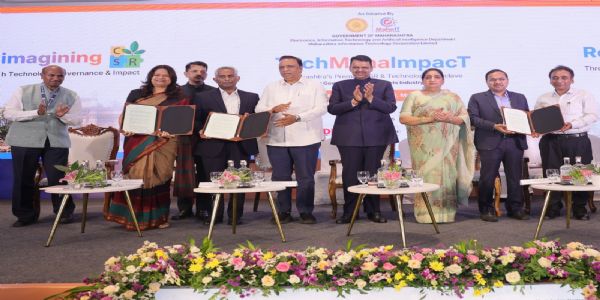
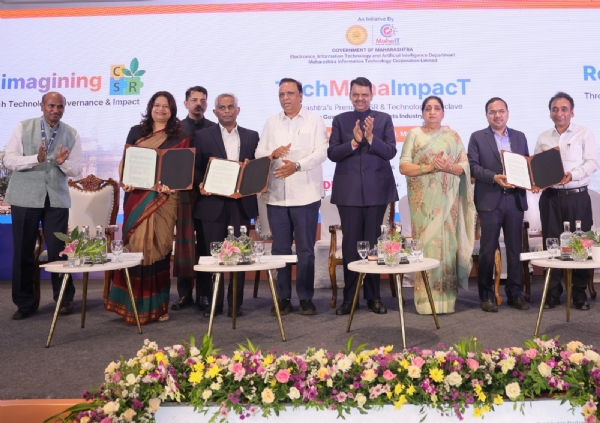
25 May (HS): Aga Khan Agency for Habitat India (AKAH) officially signed a
Memorandum of Understanding (MoU) with Maharashtra Information Technology
Corporation Limited (MahaIT). This partnership will potentially enable the
agency to further scale habitat improvement and build the resilience of
vulnerable communities against heat, drought and flood as well as other impacts
of climate change.
Devendra
Fadnavis, the Chief Minister of Maharashtra, in whose presence the MoU was
signed, said that total CSR contributes nearly Rs. 36,000 crore annually and
Maharashtra is the largest contributor of CSR funds. He emphasised the need to
ensure these resources are equitably channelled towards leveraging technology
across districts in Maharashtra.
Delivering
the Opening Remarks, Sanjay Shripatrao Katkar (IAS) stated that the Government
of Maharashtra aims to facilitate, rather than regulate, the CSR ecosystem in
the state. He highlighted that MahaIT is developing a dedicated CSR platform to
enable complete visibility into onboarding, execution, and compliance for
corporates, donors, and implementing agencies.
AKAH
works to create habitats that allow communities to be resilient to disasters,
adapt to climate change, and thrive. MahaIT on the other hand is the nodal
agency of the Government of Maharashtra for Information and Communication
Technology (ICT), e-Governance, and Digital Governance, responsible for
planning, implementation, operation, and capacity building across State
departments, local governments, and allied institutions. This MoU between the
two is expected to galvanise powerful data-driven risk-responsive strategies in
the service of climate-resilient habitats.
Prerana
Langa, Chief Executive Officer of the Aga Khan Agency for Habitat India, believes
that the expertise of MahaIT in designing and executing structured initiatives
will prove to be invaluable in the near future. She says, This MoU will
further streamline actionable, large-scale implementation within a
facilitative, collaborative framework. Through our heat mitigation
interventions in informal settlements, schools, and housing societies across
Mira Bhayandar and Chandrapur, AKAH India has demonstrated measurable
improvements in thermal comfort, with indoor temperatures reduced by up to 4–6°C
in vulnerable communities. This collaboration underscores our commitment to
urban habitat risk resilience, biodiversity preservation and water security.
Our focus as always will remain on Climatic vulnerable zones and communities on
the margins with a special focus on women and children.
On
the immediate agenda of both partners are future synergies in heat and flood
mitigation, ecosystem-based climate change adaptation, urban greening, energy
as well as water efficiency solutions in schools with inclusion of IoT and
Smart Technology. The path forward will also include knowledge sharing,
exploration of pilots, proof-of-concepts, training and awareness initiatives,
research, documentation, and policy insights, co-design of concepts, frameworks
along with effective public digital solutions.
Hindusthan Samachar / Abhishek Awasthi